QUESTION IMAGE
Question
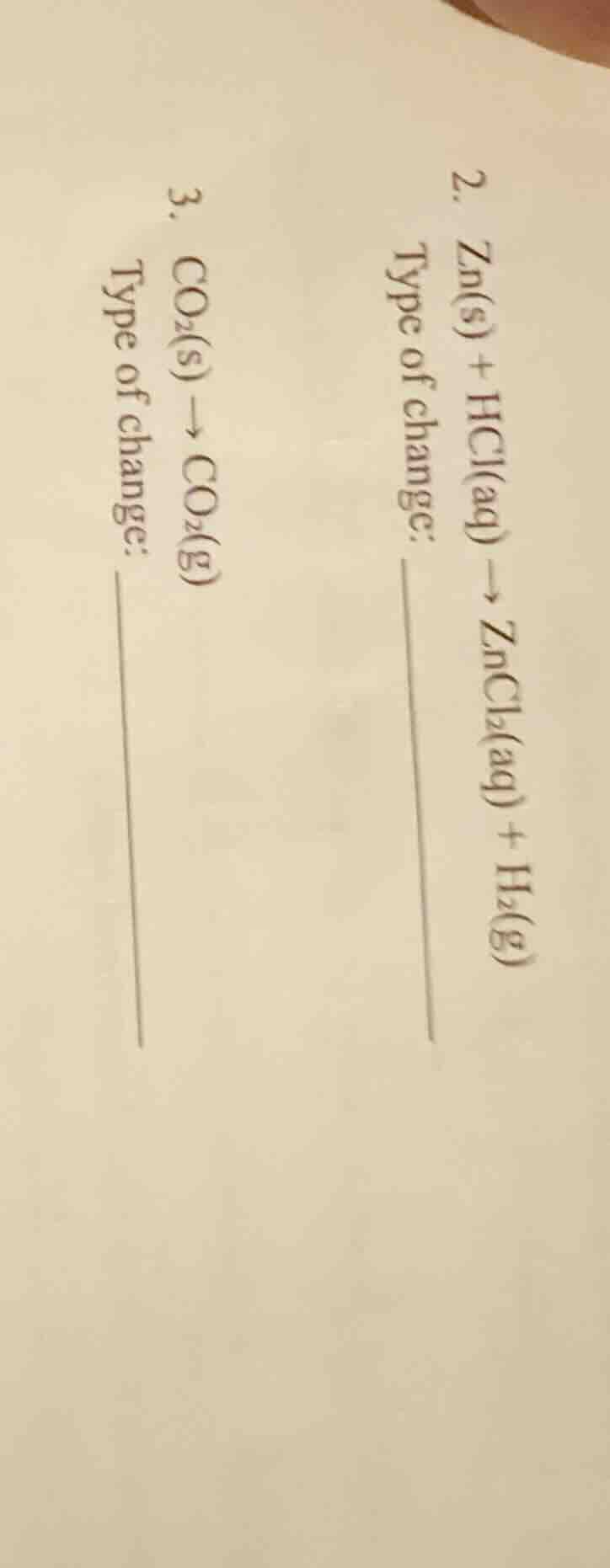
- zn(s) + hcl(aq) → zncl₂(aq) + h₂(g)
type of change: ______
- co₂(s) → co₂(g)
type of change: ______
Question 2:
Step1: Identify reaction type
This is a reaction where a metal (Zn) reacts with an acid (HCl) to produce a salt (ZnCl₂) and hydrogen gas (H₂). This fits the pattern of a single - displacement reaction, where one element replaces another in a compound. The general form of a single - displacement reaction is \(A + BC
ightarrow AC + B\), here \(A = Zn\), \(B=H\) and \(BC = HCl\), \(AC=ZnCl_2\). Also, since new substances ( \(ZnCl_2\) and \(H_2\)) are formed from the reactants (Zn and HCl), it is a chemical change.
Step1: Analyze the change
In the reaction \(CO_2(s)
ightarrow CO_2(g)\), the substance is still carbon dioxide, but its physical state is changing from solid (dry ice) to gas. There is no formation of a new substance. A change in which no new substance is formed is a physical change. The type of physical change here is a phase change (sublimation, as solid directly changes to gas).

Snap & solve any problem in the app
Get step-by-step solutions on Sovi AI
Photo-based solutions with guided steps
Explore more problems and detailed explanations
Chemical change (specifically single - displacement reaction)