QUESTION IMAGE
Question
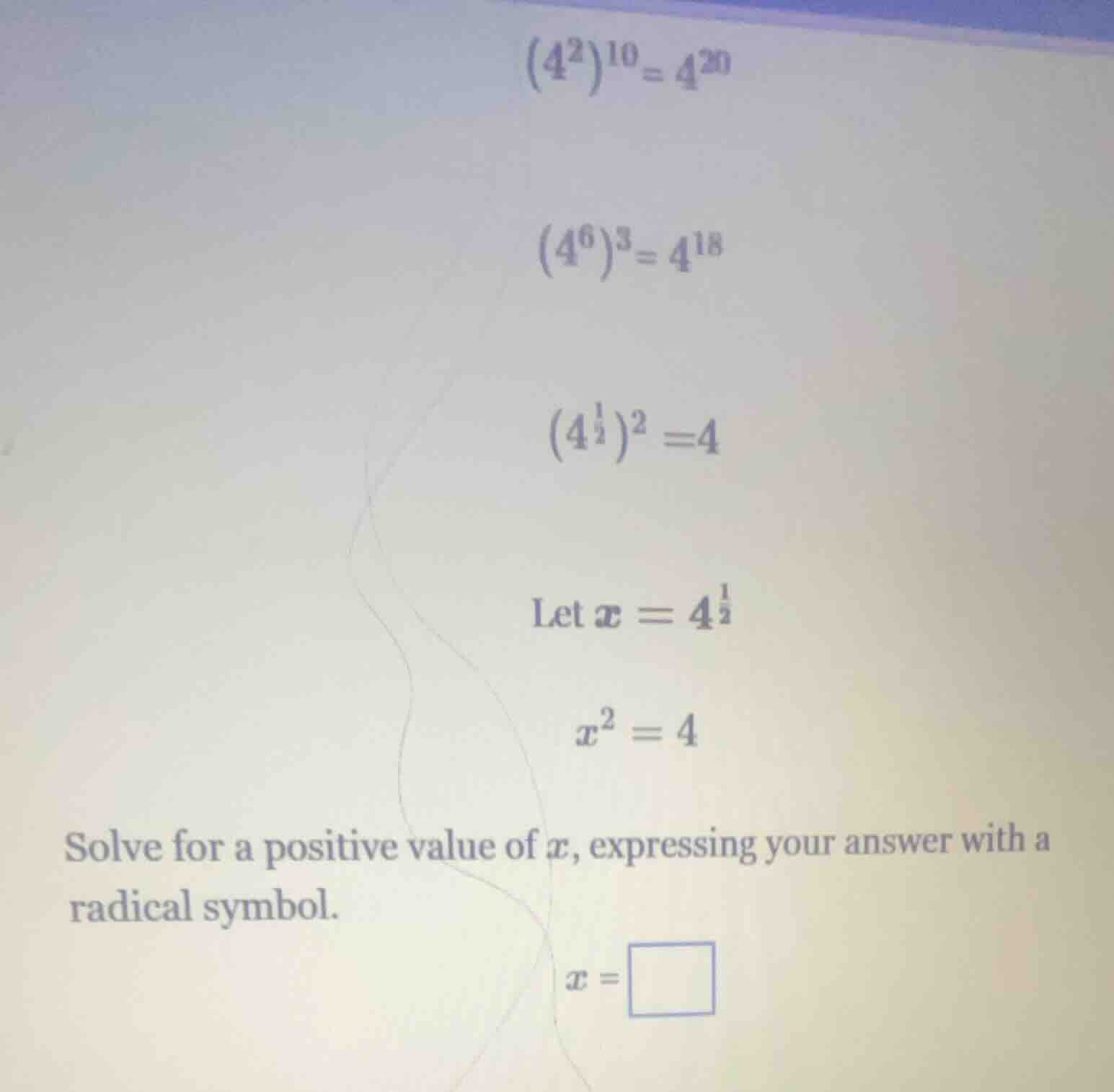
(4^2)^10 = 4^20
(4^6)^3 = 4^18
(4^{\frac{1}{2}})^2 = 4
let x = 4^{\frac{1}{2}}
x^2 = 4
solve for a positive value of x, expressing your answer with a radical symbol.
x = \square
Step1: Start with the equation
We have the equation \(x^{2}=4\).
Step2: Take square root of both sides
To solve for \(x\), we take the square root of both sides. Since we want the positive value, we consider the principal square root. So \(x = \sqrt{4}\).
Step3: Simplify the square root
We know that \(\sqrt{4}=2\), but also from the original definition \(x = 4^{\frac{1}{2}}\) which is equivalent to \(\sqrt{4}\). But we can also note that from \(x^{2}=4\), the positive solution is \(x=\sqrt{4}\) or we can relate it back to the exponent form. Wait, but let's check the original definition where \(x = 4^{\frac{1}{2}}\), and we also have \(x^{2}=4\). So solving \(x^{2}=4\) for positive \(x\), we take the square root: \(x=\sqrt{4}\) which simplifies to \(x = 2\), but also \(4^{\frac{1}{2}}=\sqrt{4}\). So the positive solution is \(x=\sqrt{4}\) (or \(2\), but expressed with a radical symbol, it's \(\sqrt{4}\) or we can see that \(4\) is a perfect square, so \(\sqrt{4} = 2\), but the problem says "expressing your answer with a radical symbol", so we can write \(x=\sqrt{4}\) or since \(4 = 2^{2}\), \(\sqrt{4}=\sqrt{2^{2}} = 2\), but to have a radical symbol, we can write \(x=\sqrt{4}\) or also, from the equation \(x^{2}=4\), the positive root is \(x = \sqrt{4}\). Alternatively, since \(x = 4^{\frac{1}{2}}\), and \(4^{\frac{1}{2}}=\sqrt{4}\), so the positive solution is \(x=\sqrt{4}\) (which is equal to \(2\), but in radical form).
Wait, maybe a better way: We have \(x^{2}=4\). To solve for \(x\) (positive), we use the square root property. If \(y^{2}=a\) (\(a\geq0\)), then \(y = \sqrt{a}\) (for positive \(y\)). So here, \(x^{2}=4\), so \(x=\sqrt{4}\). And \(\sqrt{4}\) can be simplified, but the problem says "expressing your answer with a radical symbol", so we can write \(x = \sqrt{4}\) or since \(4 = 2\times2\), but \(\sqrt{4}=2\), but to keep the radical, we write \(x=\sqrt{4}\) or also, note that \(4 = 4^{1}\), so \(x = 4^{\frac{1}{2}}=\sqrt{4}\). So the positive solution is \(x=\sqrt{4}\) (which is \(2\), but in radical form).

Snap & solve any problem in the app
Get step-by-step solutions on Sovi AI
Photo-based solutions with guided steps
Explore more problems and detailed explanations
\(\sqrt{4}\) (or also, since \(\sqrt{4}=2\), but the problem asks for radical symbol, so \(\sqrt{4}\) is correct. Alternatively, if we consider that \(x = 4^{\frac{1}{2}}\) and \(x^{2}=4\), then the positive \(x\) is \(\sqrt{4}\))