QUESTION IMAGE
Question
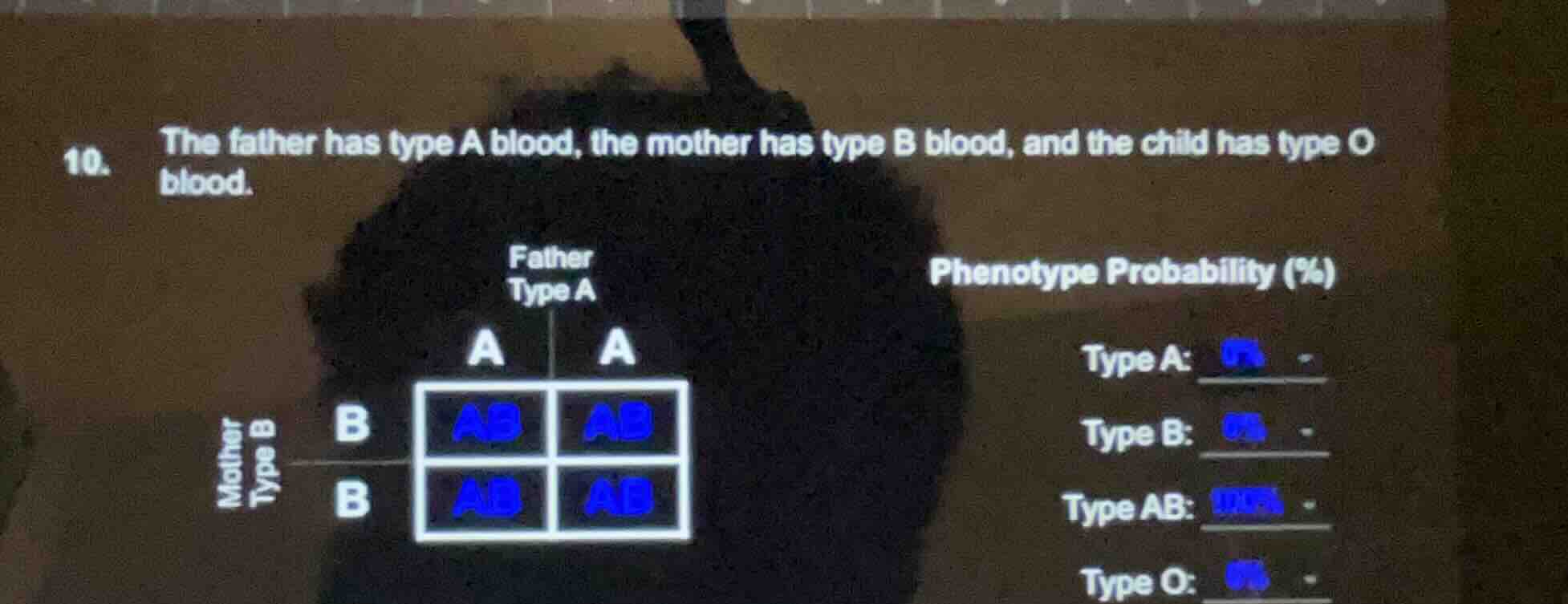
- the father has type a blood, the mother has type b blood, and the child has type o blood. father type a phenotype probability (%) a a type a: mother type b b ab ab type b: b ab ab type ab: type o:
Step1: Analyze Blood Type Genetics
Blood type is determined by alleles. Type A can be \(AA\) or \(AO\), type B can be \(BB\) or \(BO\), type AB is \(AB\), and type O is \(OO\). For a child to have type O (\(OO\)), both parents must pass on an \(O\) allele.
Step2: Evaluate Given Parent Genotypes
In the provided Punnett square, the father is \(AA\) (only passes \(A\)) and the mother is \(BB\) (only passes \(B\)). Their children would all be \(AB\) (since \(A\) from father and \(B\) from mother), so they can't have a type O child. This means the father's genotype must actually be \(AO\) (to pass \(O\)) and the mother's must be \(BO\) (to pass \(O\)) for a child to be \(OO\) (type O). The current Punnett square is incorrect for the scenario where the child is O because the parents' genotypes here are \(AA\) and \(BB\), which can't produce O.

Snap & solve any problem in the app
Get step-by-step solutions on Sovi AI
Photo-based solutions with guided steps
Explore more problems and detailed explanations
The given Punnett square is incorrect for the scenario (father type A, mother type B, child type O) because the father is shown as \(AA\) (can only pass \(A\)) and mother as \(BB\) (can only pass \(B\)), so all children would be \(AB\), not O. For a child to be O, father must be \(AO\) and mother \(BO\) (to both pass \(O\) alleles, resulting in \(OO\) for the child).