QUESTION IMAGE
Question
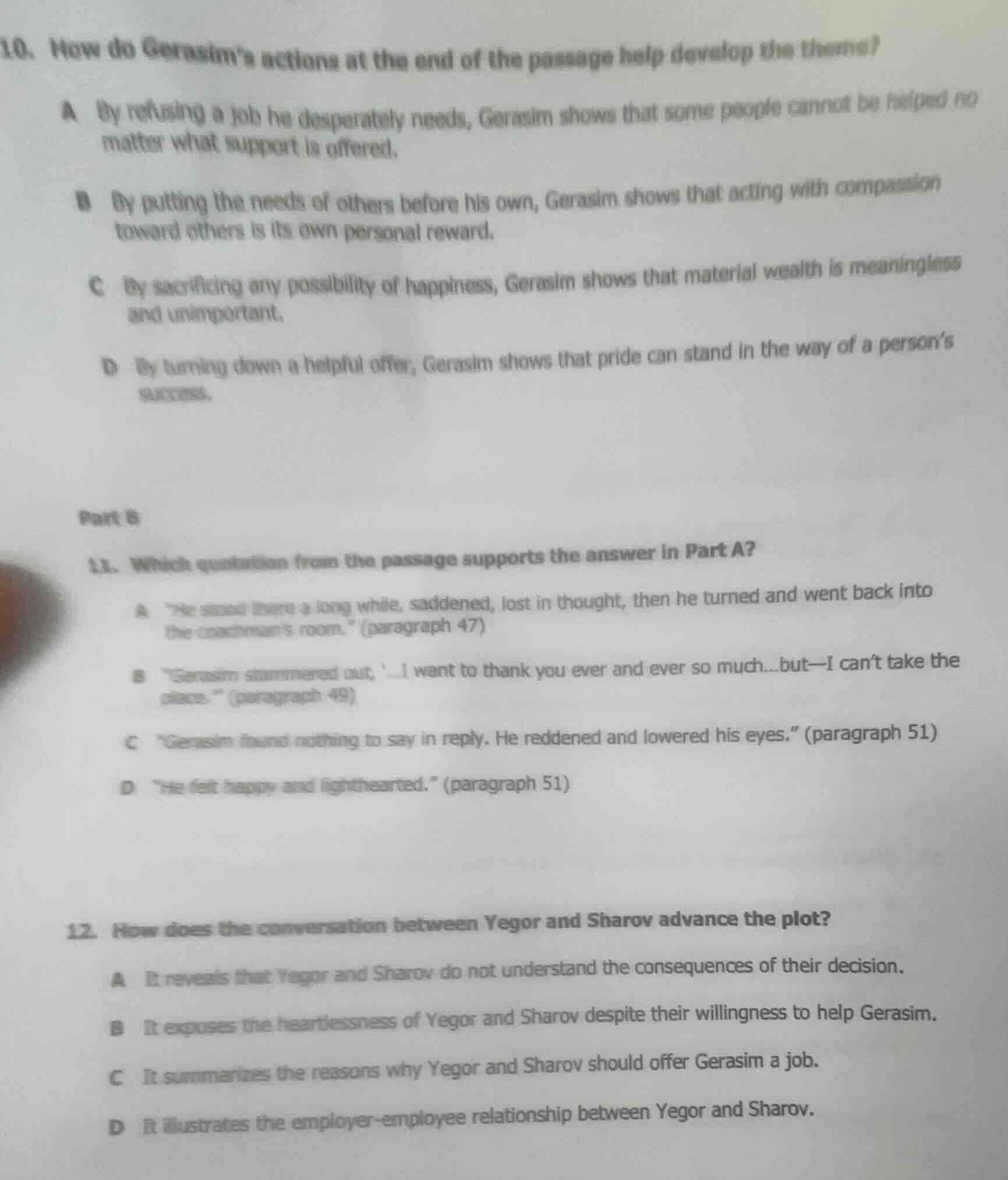
- how do gerasim’s actions at the end of the passage help develop the theme?
a by refusing a job he desperately needs, gerasim shows that some people cannot be helped no matter what support is offered.
b by putting the needs of others before his own, gerasim shows that acting with compassion toward others is its own personal reward.
c by sacrificing any possibility of happiness, gerasim shows that material wealth is meaningless and unimportant.
d by turning down a helpful offer, gerasim shows that pride can stand in the way of a person’s success.
part b
- which quotation from the passage supports the answer in part a?
a “he stood there a long while, saddened, lost in thought, then he turned and went back into the coachman’s room.” (paragraph 47)
b “gerasim stammered out, ‘...i want to thank you ever and ever so much...but—i can’t take the place.’” (paragraph 49)
c “gerasim found nothing to say in reply. he reddened and lowered his eyes.” (paragraph 51)
d “he felt happy and lighthearted.” (paragraph 51)
- how does the conversation between yegor and sharov advance the plot?
a it reveals that yegor and sharov do not understand the consequences of their decision.
b it exposes the heartlessness of yegor and sharov despite their willingness to help gerasim.
c it summarizes the reasons why yegor and sharov should offer gerasim a job.
d it illustrates the employer - employee relationship between yegor and sharov.
Question 10
To solve this, we analyze each option:
- Option A: If Gerasim refuses a needed job, it implies he can't be helped, but we need to check the theme. However, let's check other options.
- Option B: Putting others' needs first (like maybe helping the coachman) and acting with compassion as a reward. This aligns with themes of compassion.
- Option C: Sacrificing happiness for material wealth? No, the action is about helping, not material wealth.
- Option D: Pride blocking success? The action is more about compassion than pride. So B is correct as it focuses on compassion for others.
We need a quote supporting Question 10's answer (B, about compassion/putting others first).
- Option A: Just thinking, no support for compassion.
- Option B: Refusing a job (maybe to help the coachman), showing he puts others first. This supports B.
- Option C: Being embarrassed, not related to compassion.
- Option D: Feeling happy, but not showing the action of putting others first. So B is correct.
Analyze how Yegor and Sharov's conversation advances the plot:
- Option A: Revealing they don't understand consequences? Not clear.
- Option B: Exposing heartlessness despite helping? No, the conversation likely shows their decision's impact. Wait, no—if they offer a job but maybe don't understand Gerasim's situation (consequences of their decision to offer, like him refusing). Wait, no, let's recheck. The conversation's role: if they offer a job, and maybe don't realize he won't take it (consequences of their decision). But let's check options:
- Option A: Reveals they don't understand consequences of their decision (to offer the job, and how Gerasim will react). This makes sense.
- Option B: Exposing heartlessness? No, they are willing to help.
- Option C: Summarizing reasons to offer job? The conversation is about the plot advance, not summarizing reasons.
- Option D: Illustrating employer - employee relationship? No, it's about Gerasim. So A is correct.

Snap & solve any problem in the app
Get step-by-step solutions on Sovi AI
Photo-based solutions with guided steps
Explore more problems and detailed explanations
B. By putting the needs of others before his own, Gerasim shows that acting with compassion toward others is its own personal reward.