QUESTION IMAGE
Question
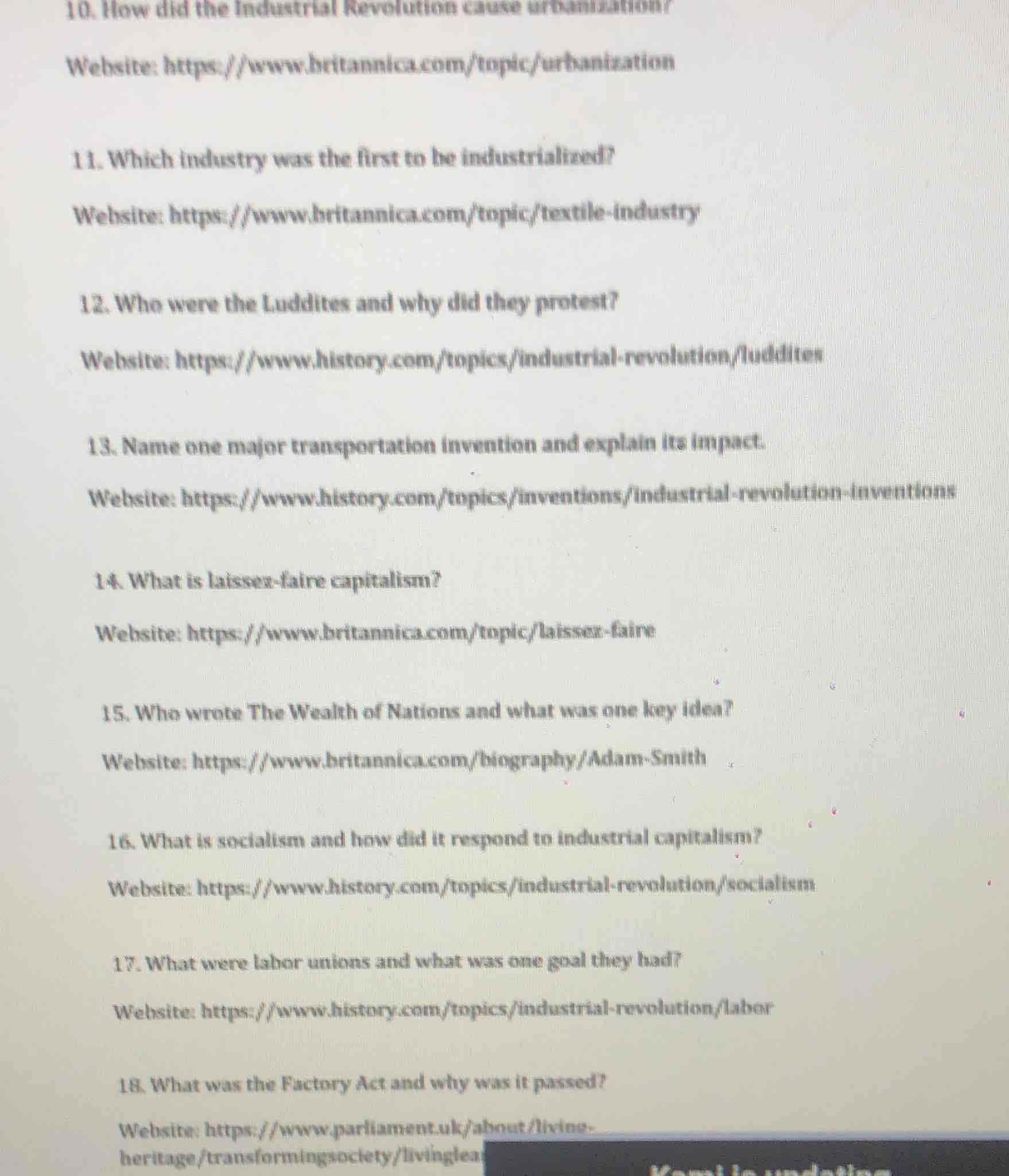
- how did the industrial revolution cause urbanization?website: https://www.britannica.com/topic/urbanization11. which industry was the first to be industrialized?website: https://www.britannica.com/topic/textile-industry12. who were the luddites and why did they protest?website: https://www.history.com/topics/industrial-revolution/luddites13. name one major transportation invention and explain its impact.website: https://www.history.com/topics/inventions/industrial-revolution-inventions14. what is laissez-faire capitalism?website: https://www.britannica.com/topic/laissez-faire15. who wrote the wealth of nations and what was one key idea?website: https://www.britannica.com/biography/adam-smith16. what is socialism and how did it respond to industrial capitalism?website: https://www.history.com/topics/industrial-revolution/socialism17. what were labor unions and what was one goal they had?website: https://www.history.com/topics/industrial-revolution/labor18. what was the factory act and why was it passed?website: https://www.parliament.uk/about/living-heritage/transformingsociety/livinglea
Brief Explanations
- Factories shifted work from rural homes to urban centers, drawing rural workers to cities for jobs, while new transportation links supported urban growth.
- The textile industry mechanized first with inventions like the spinning jenny, driving early industrialization.
- Luddites were English textile workers who protested mechanization, fearing job loss and reduced wages from new machinery.
- The steam locomotive enabled fast, mass overland transport of goods/people, unifying markets and spurring urbanization.
- It is an economic system with minimal government interference in markets, letting supply/demand and private ownership drive activity.
- Adam Smith wrote it; a key idea is the "invisible hand," where self-interested individual economic actions benefit society.
- Socialism advocates collective ownership of production; it emerged to address industrial capitalism's exploitation of workers and wealth inequality.
- Labor unions were worker organizations; one goal was to negotiate for safer working conditions and fairer wages.
- The Factory Act was UK legislation regulating factory work; early versions were passed to limit child labor and improve unsafe factory conditions.

Snap & solve any problem in the app
Get step-by-step solutions on Sovi AI
Photo-based solutions with guided steps
Explore more problems and detailed explanations
- The Industrial Revolution centralized work in urban factories, which pulled rural workers seeking employment into cities, and improved transportation networks allowed for the movement of goods and people to support growing urban populations.
- The textile industry was the first to be industrialized.
- The Luddites were 19th-century English textile artisans and workers. They protested against the introduction of mechanized textile machinery, which they believed would eliminate their jobs, reduce their wages, and devalue their skilled labor.
- Steam Locomotive: It revolutionized overland transportation, enabling the fast, large-scale movement of raw materials and finished goods across long distances. This connected rural resource areas to urban factories and markets, spurring industrial growth, expanding trade, and accelerating urbanization as people moved to areas with better economic opportunities linked by rail.
- Laissez-faire capitalism is an economic system that advocates for minimal government intervention in the economy. It emphasizes private ownership of property and the means of production, with market forces of supply and demand driving economic activity, and little to no regulation, subsidies, or price controls.
- Adam Smith wrote The Wealth of Nations. One key idea is the "invisible hand" principle, which argues that when individuals act in their own self-interest in a free market, they unintentionally promote the overall economic well-being of society.
- Socialism is an economic and political system that advocates for collective or public ownership and control of the means of production, distribution, and exchange, with the goal of creating a more equitable society. It emerged as a response to industrial capitalism, criticizing its exploitation of workers, extreme wealth inequality, poor working conditions, and the alienation of labor caused by private ownership of industry. Socialists pushed for reforms like worker control of factories, social safety nets, and more equitable distribution of wealth.
- Labor unions were organized groups of workers that advocated for better working conditions, fair wages, and improved treatment from employers. One key goal was to secure shorter working hours (for example, fighting for a standard 8-hour workday) to reduce the exploitation of workers who often faced 12-16 hour workdays in industrial factories.
- The Factory Acts were a series of British laws that regulated the conditions of work in factories. Early Factory Acts (such as the 1833 Factory Act) were passed primarily to address the widespread exploitation of child labor, limiting the number of hours children could work and requiring basic education for child factory workers, as well as improving some of the unsafe and unsanitary conditions in factories.