QUESTION IMAGE
Question
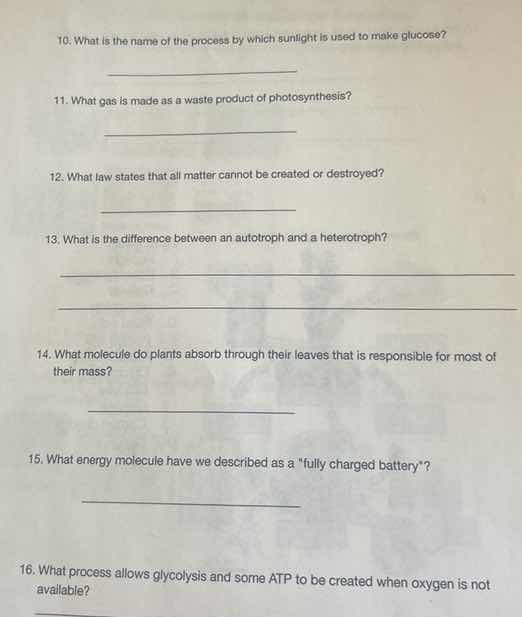
- what is the name of the process by which sunlight is used to make glucose?11. what gas is made as a waste product of photosynthesis?12. what law states that all matter cannot be created or destroyed?13. what is the difference between an autotroph and a heterotroph?14. what molecule do plants absorb through their leaves that is responsible for most of their mass?15. what energy molecule have we described as a fully charged battery?16. what process allows glycolysis and some atp to be created when oxygen is not available?
Brief Explanations
- Identifies the core biological process for glucose production from sunlight.
- Notes the byproduct released during photosynthesis.
- Refers to the fundamental conservation law for matter.
- Distinguishes organisms by their food/energy source.
- Names the key molecule plants take in via leaves for mass gain.
- Identifies the high-energy cellular molecule compared to a battery.
- Specifies the anaerobic process for ATP production without oxygen.

Snap & solve any problem in the app
Get step-by-step solutions on Sovi AI
Photo-based solutions with guided steps
Explore more problems and detailed explanations
- Photosynthesis
- Oxygen (O₂)
- Law of Conservation of Mass
- Autotrophs produce their own food (e.g., via photosynthesis), while heterotrophs must consume other organisms for food/energy.
- Carbon dioxide (CO₂)
- Adenosine triphosphate (ATP)
- Fermentation