QUESTION IMAGE
Question
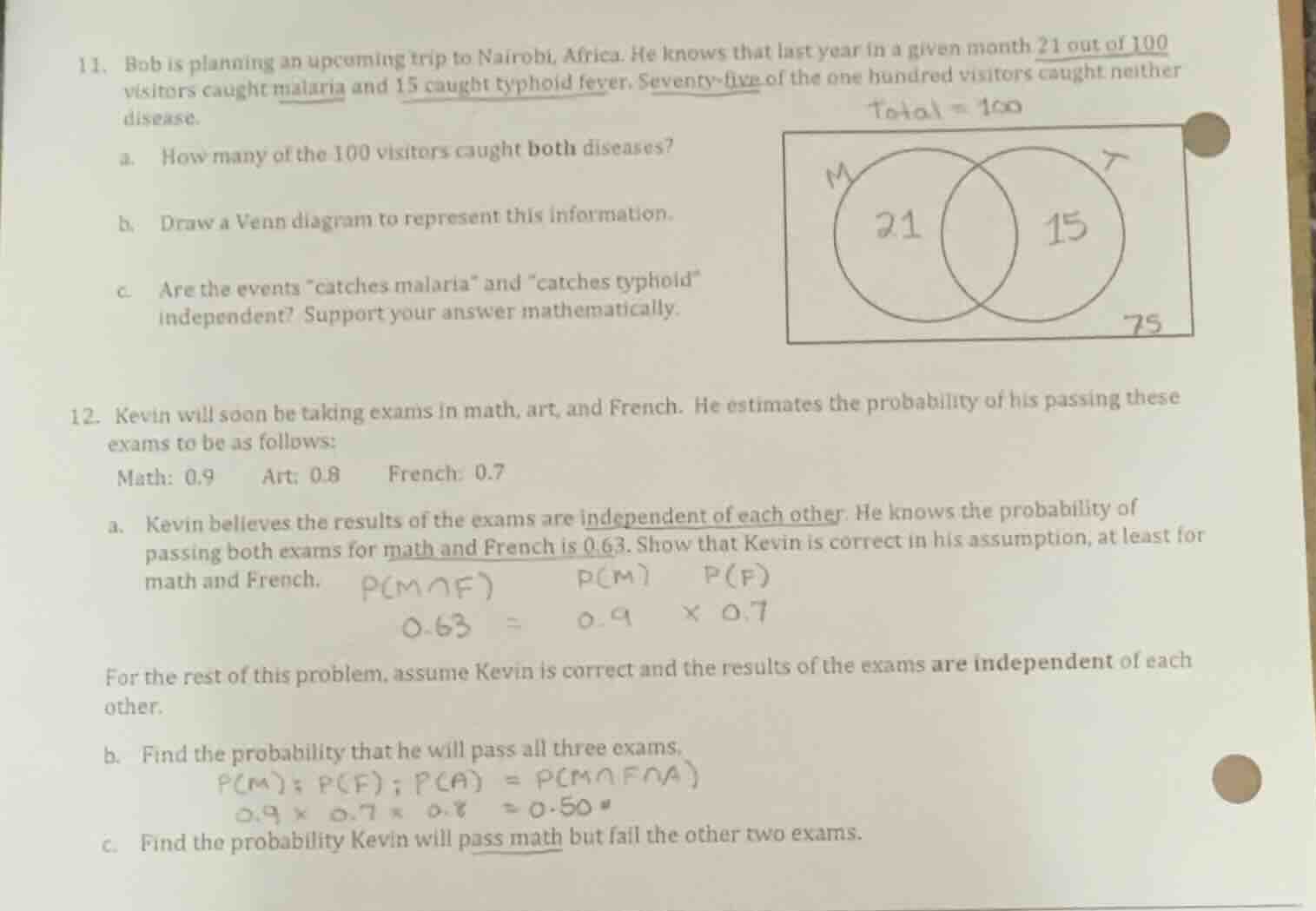
- bob is planning an upcoming trip to nairobi, africa. he knows that last year in a given month 21 out of 100 visitors caught malaria and 15 caught typhoid fever. seventy - five of the one hundred visitors caught neither disease.
a. how many of the 100 visitors caught both diseases?
b. draw a venn diagram to represent this information.
c. are the events \catches malaria\ and \catches typhoid\ independent? support your answer mathematically.
- kevin will soon be taking exams in math, art, and french. he estimates the probability of his passing these exams to be as follows:
math: 0.9 art: 0.8 french: 0.7
a. kevin believes the results of the exams are independent of each other. he knows the probability of passing both exams for math and french is 0.63. show that kevin is correct in his assumption, at least for math and french.
for the rest of this problem, assume kevin is correct and the results of the exams are independent of each other.
b. find the probability that he will pass all three exams.
c. find the probability kevin will pass math but fail the other two exams.
Problem 11
Step1: Define given values
Let total visitors $n(U)=100$, malaria cases $n(M)=21$, typhoid cases $n(T)=15$, neither $n(\text{neither})=75$.
Step2: Calculate total with at least one disease
$n(M \cup T) = n(U) - n(\text{neither}) = 100 - 75 = 25$
Step3: Use union formula for both diseases
Use $n(M \cup T) = n(M) + n(T) - n(M \cap T)$
Rearrange: $n(M \cap T) = n(M) + n(T) - n(M \cup T)$
$n(M \cap T) = 21 + 15 - 25 = 11$
Step4: Check independence rule
For independence, $P(M \cap T) = P(M) \times P(T)$
$P(M)=\frac{21}{100}=0.21$, $P(T)=\frac{15}{100}=0.15$, $P(M \cap T)=\frac{11}{100}=0.11$
$P(M) \times P(T) = 0.21 \times 0.15 = 0.0315$
Since $0.11
eq 0.0315$, events are not independent.
Step1: Verify math-French independence
For independent events, $P(M \cap F) = P(M) \times P(F)$
$P(M)=0.9$, $P(F)=0.7$, so $0.9 \times 0.7 = 0.63$, which matches the given value.
Step2: Calculate pass all three exams
$P(M \cap A \cap F) = P(M) \times P(A) \times P(F)$
$= 0.9 \times 0.8 \times 0.7 = 0.504$
Step3: Calculate pass math, fail others
First find fail probabilities: $P(\text{fail } A)=1-0.8=0.2$, $P(\text{fail } F)=1-0.7=0.3$
Probability = $P(M) \times P(\text{fail } A) \times P(\text{fail } F)$
$= 0.9 \times 0.2 \times 0.3 = 0.054$

Snap & solve any problem in the app
Get step-by-step solutions on Sovi AI
Photo-based solutions with guided steps
Explore more problems and detailed explanations
a. 11
b. (Venn diagram: Left circle (Malaria) has 10 in non-overlap, overlap has 11, right circle (Typhoid) has 4 in non-overlap, outside both has 75)
c. No, the events are not independent, as $P(M \cap T)
eq P(M) \times P(T)$.
---