QUESTION IMAGE
Question
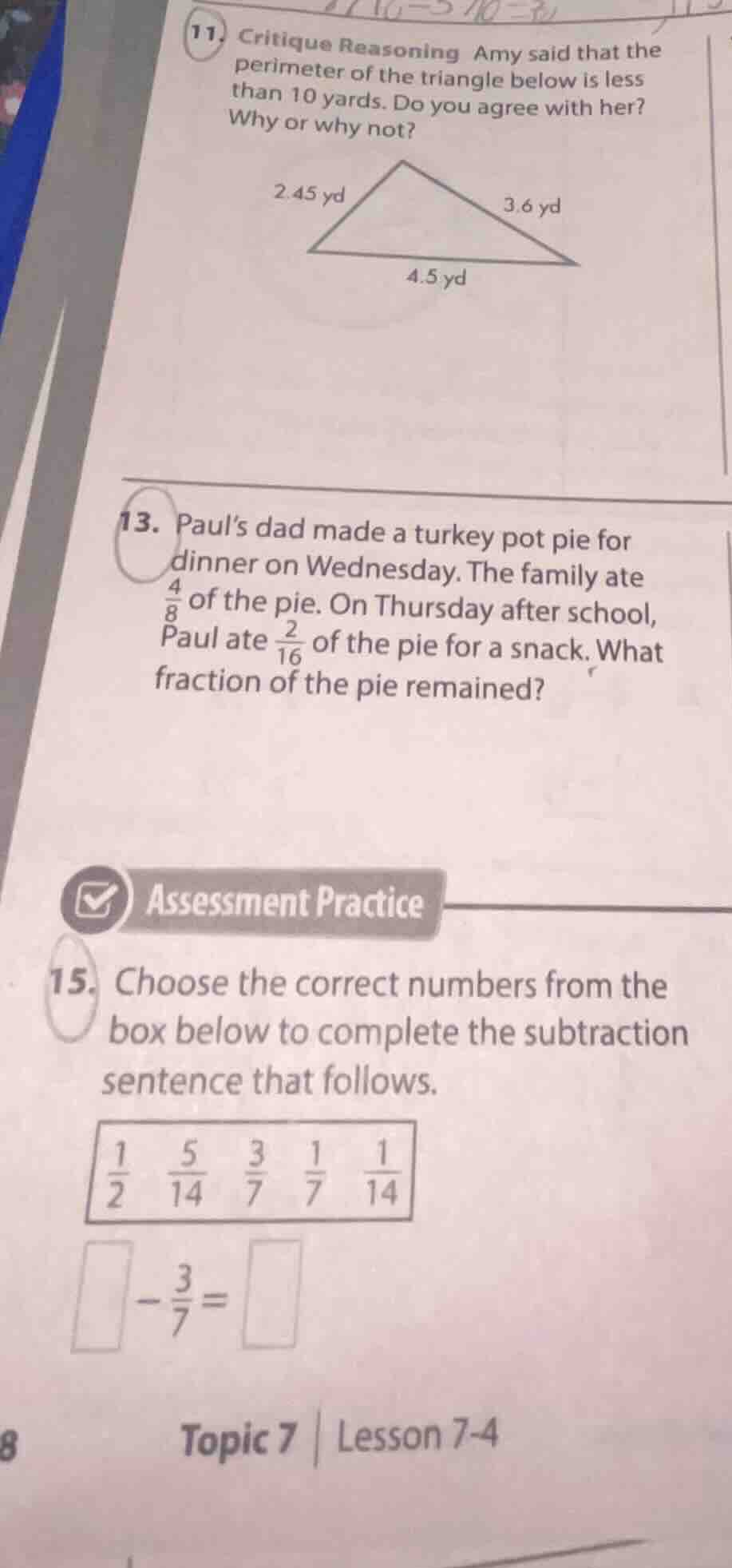
- critique reasoning amy said that the perimeter of the triangle below is less than 10 yards. do you agree with her? why or why not?
(image of a triangle with sides 2.45 yd, 3.6 yd, 4.5 yd)
- paul’s dad made a turkey pot pie for dinner on wednesday. the family ate \\(\frac{4}{8}\\) of the pie. on thursday after school, paul ate \\(\frac{2}{16}\\) of the pie for a snack. what fraction of the pie remained?
- choose the correct numbers from the box below to complete the subtraction sentence that follows.
box: \\(\frac{1}{2}\\), \\(\frac{5}{14}\\), \\(\frac{3}{7}\\), \\(\frac{1}{7}\\), \\(\frac{1}{14}\\)
\\(\square - \frac{3}{7} = \square\\)
Question 11
Step1: Calculate the perimeter
To find the perimeter of a triangle, we sum the lengths of its three sides. The sides are \(2.45\) yd, \(3.6\) yd, and \(4.5\) yd. So we calculate \(2.45 + 3.6 + 4.5\).
First, add \(2.45\) and \(3.6\): \(2.45+3.6 = 6.05\).
Then, add the result to \(4.5\): \(6.05 + 4.5=10.55\) yards.
Step2: Compare with 10 yards
Now we compare the perimeter (\(10.55\) yards) with \(10\) yards. Since \(10.55> 10\), the perimeter is greater than \(10\) yards.
Step1: Simplify the fractions (optional but helpful)
First, simplify \(\frac{4}{8}\) to \(\frac{1}{2}\) (dividing numerator and denominator by 4) and \(\frac{2}{16}\) to \(\frac{1}{8}\) (dividing numerator and denominator by 2). But we can also work with the original fractions by finding a common denominator. The common denominator of 8 and 16 is 16.
Convert \(\frac{4}{8}\) to sixteenths: \(\frac{4}{8}=\frac{4\times2}{8\times2}=\frac{8}{16}\).
The fraction Paul ate is \(\frac{2}{16}\).
Step2: Find the total fraction eaten
Add the fractions of the pie that were eaten: \(\frac{8}{16}+\frac{2}{16}=\frac{8 + 2}{16}=\frac{10}{16}=\frac{5}{8}\) (simplifying by dividing numerator and denominator by 2).
Step3: Find the remaining fraction
The whole pie is represented by \(1\) (or \(\frac{16}{16}\) in sixteenths or \(\frac{8}{8}\) in eighths). To find the remaining fraction, we subtract the total fraction eaten from \(1\). Using eighths, \(1=\frac{8}{8}\), so \(\frac{8}{8}-\frac{5}{8}=\frac{8 - 5}{8}=\frac{3}{8}\). (If we used sixteenths: \(\frac{16}{16}-\frac{10}{16}=\frac{6}{16}=\frac{3}{8}\) after simplifying.)
Step1: Recall subtraction of fractions
We need to find a fraction from the box such that when we subtract \(\frac{3}{7}\) from it, the result is also a fraction in the box. Let's convert all fractions to fourteenths to make it easier (since the denominators in the box are 2, 14, 7; 14 is a common denominator).
- \(\frac{1}{2}=\frac{7}{14}\)
- \(\frac{5}{14}\) remains \(\frac{5}{14}\)
- \(\frac{3}{7}=\frac{6}{14}\)
- \(\frac{1}{7}=\frac{2}{14}\)
- \(\frac{1}{14}\) remains \(\frac{1}{14}\)
Now we check each fraction:
- If we take \(\frac{1}{2}=\frac{7}{14}\), then \(\frac{7}{14}-\frac{6}{14}=\frac{1}{14}\), and \(\frac{1}{14}\) is in the box.
Let's verify with the original fractions. \(\frac{1}{2}-\frac{3}{7}\). The common denominator of 2 and 7 is 14. So \(\frac{1}{2}=\frac{7}{14}\) and \(\frac{3}{7}=\frac{6}{14}\). Then \(\frac{7}{14}-\frac{6}{14}=\frac{1}{14}\), which is in the box.
Let's check other fractions:
- \(\frac{5}{14}-\frac{3}{7}=\frac{5}{14}-\frac{6}{14}=-\frac{1}{14}\) (not in the box)
- \(\frac{3}{7}-\frac{3}{7}=0\) (not in the box)
- \(\frac{1}{7}-\frac{3}{7}=-\frac{2}{7}\) (not in the box)
- \(\frac{1}{14}-\frac{3}{7}=\frac{1}{14}-\frac{6}{14}=-\frac{5}{14}\) (not in the box)
So the only valid pair is \(\frac{1}{2}-\frac{3}{7}=\frac{1}{14}\).

Snap & solve any problem in the app
Get step-by-step solutions on Sovi AI
Photo-based solutions with guided steps
Explore more problems and detailed explanations
I do not agree with Amy. The perimeter of the triangle is \(2.45 + 3.6+4.5 = 10.55\) yards, which is greater than 10 yards.