QUESTION IMAGE
Question
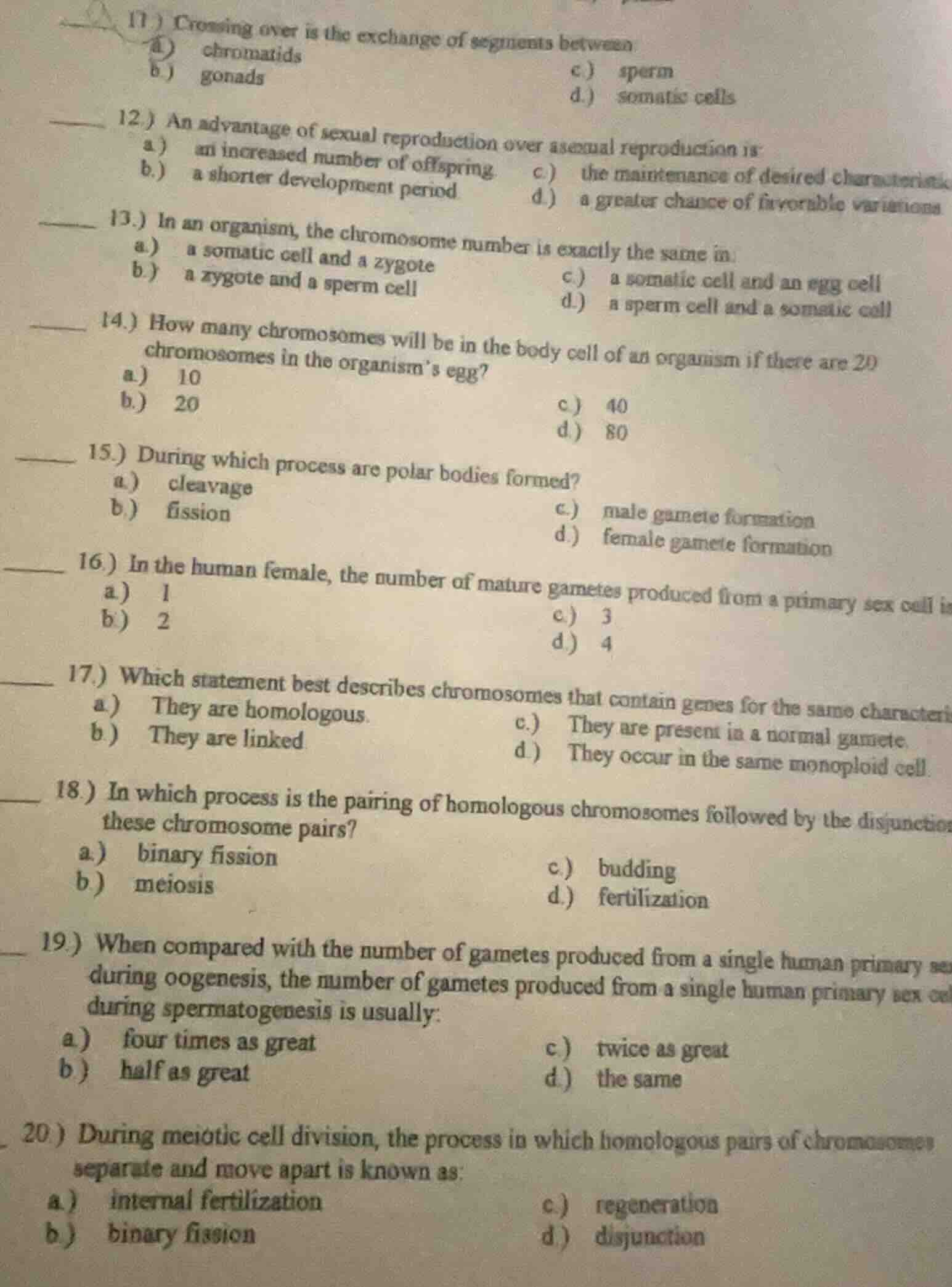
- crossing over is the exchange of segments between
a) chromatids c) sperm
b) gonads d) somatic cells
- an advantage of sexual reproduction over asexual reproduction is
a) an increased number of offspring c) the maintenance of desired characteristics
b) a shorter development period d) a greater chance of favorable variations
- in an organism, the chromosome number is exactly the same in
a) a somatic cell and a zygote c) a somatic cell and an egg cell
b) a zygote and a sperm cell d) a sperm cell and a somatic cell
- how many chromosomes will be in the body cell of an organism if there are 20 chromosomes in the organism’s egg?
a) 10 c) 40
b) 20 d) 80
- during which process are polar bodies formed?
a) cleavage c) male gamete formation
b) fission d) female gamete formation
- in the human female, the number of mature gametes produced from a primary sex cell is
a) 1 c) 3
b) 2 d) 4
- which statement best describes chromosomes that contain genes for the same characteristics?
a) they are homologous. c) they are present in a normal gamete.
b) they are linked d) they occur in the same monoploid cell.
- in which process is the pairing of homologous chromosomes followed by the disjunction of these chromosome pairs?
a) binary fission c) budding
b) meiosis d) fertilization
- when compared with the number of gametes produced from a single human primary sex cell during oogenesis, the number of gametes produced from a single human primary sex cell during spermatogenesis is usually:
a) four times as great c) twice as great
b) half as great d) the same
- during meiotic cell division, the process in which homologous pairs of chromosomes separate and move apart is known as:
a) internal fertilization c) regeneration
b) binary fission d) disjunction
Question 11
Crossing over occurs during meiosis when homologous chromosomes pair up, and segments are exchanged between non - sister chromatids. Gonads are organs that produce gametes, sperm are male gametes, and somatic cells are body cells (where crossing over does not occur in the context of sexual reproduction's genetic variation). So the correct answer is about chromatids.
Sexual reproduction involves the combination of genetic material from two parents, leading to more genetic variation. Asexual reproduction produces more offspring (a is wrong), has a shorter development period in many cases (b is wrong), and asexual reproduction is better for maintaining desired characteristics (c is wrong). Sexual reproduction gives a greater chance of favorable variations.
Somatic cells are diploid, zygotes are formed by the fusion of sperm and egg (both haploid), so zygotes are diploid and have the same chromosome number as somatic cells. Sperm cells are haploid, egg cells are haploid, so b, c, d have different ploidy levels.

Snap & solve any problem in the app
Get step-by-step solutions on Sovi AI
Photo-based solutions with guided steps
Explore more problems and detailed explanations
a. chromatids