QUESTION IMAGE
Question
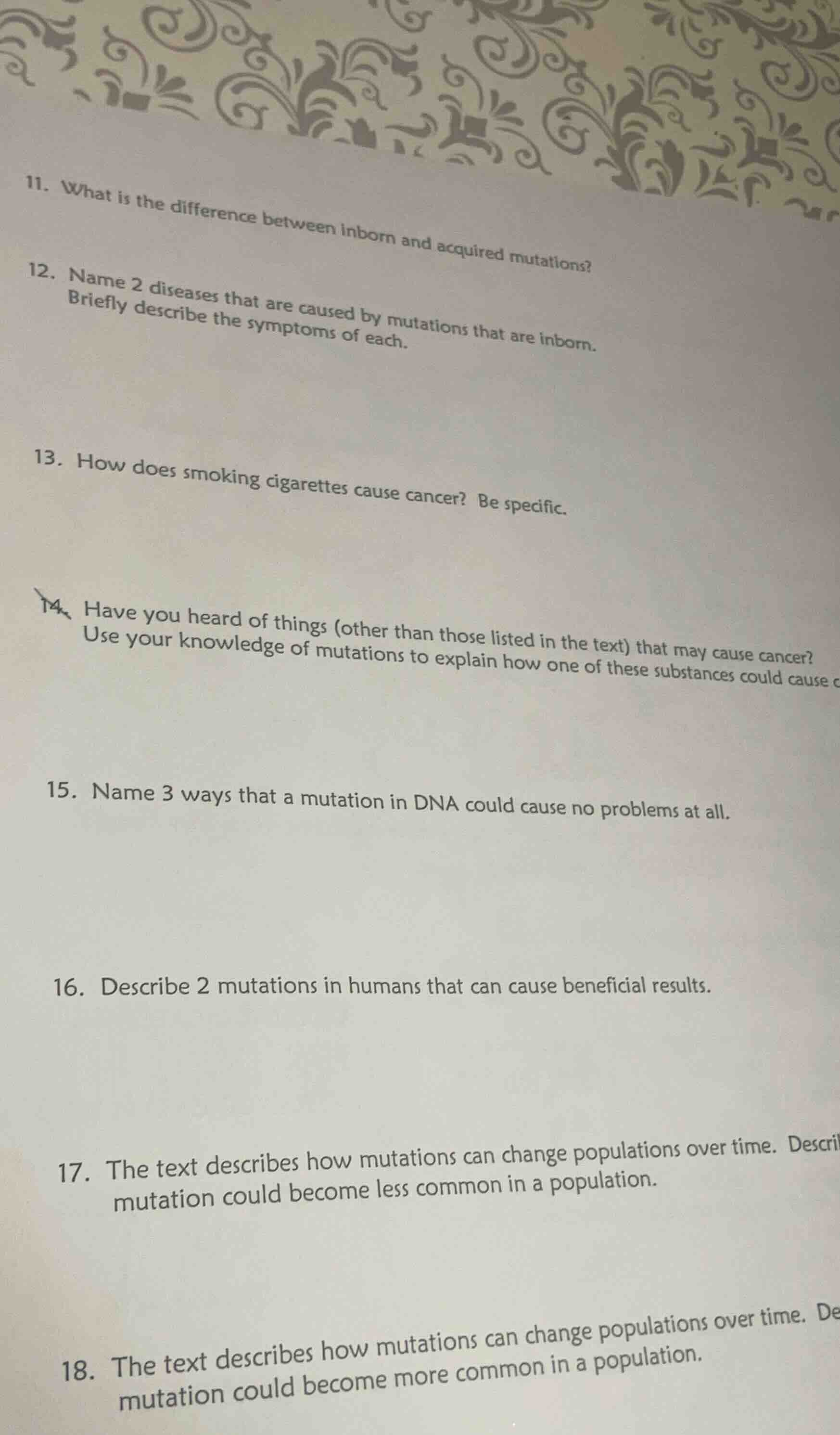
- what is the difference between inborn and acquired mutations?
- name 2 diseases that are caused by mutations that are inborn. briefly describe the symptoms of each.
- how does smoking cigarettes cause cancer? be specific.
- have you heard of things (other than those listed in the text) that may cause cancer? use your knowledge of mutations to explain how one of these substances could cause c
- name 3 ways that a mutation in dna could cause no problems at all.
- describe 2 mutations in humans that can cause beneficial results.
- the text describes how mutations can change populations over time. descri mutation could become less common in a population.
- the text describes how mutations can change populations over time. de mutation could become more common in a population.
Brief Explanations
- Question 11: Inborn mutations are present from birth, inherited from parents in germ cells, and can be passed to offspring. Acquired mutations happen after birth in body cells, from environmental factors, and cannot be inherited.
- Question 12:
- Cystic Fibrosis: Caused by a mutation in the CFTR gene; symptoms include persistent lung infections, difficulty breathing, and digestive issues from blocked pancreatic ducts.
- Sickle Cell Anemia: Caused by a mutation in the HBB gene; symptoms include pain crises, anemia, increased infection risk, and organ damage from misshapen red blood cells.
- Question 13: Cigarettes contain carcinogens like benzopyrene and nitrosamines. These chemicals enter the bloodstream, reach cells, and damage DNA. They can mutate genes that regulate cell growth (tumor suppressor genes like p53) or activate oncogenes, leading to uncontrolled cell division and tumor formation.
- Question 14: One example is ultraviolet (UV) radiation from sunlight. UV radiation causes thymine dimers in DNA, which disrupt normal DNA replication and repair. Unrepaired dimers lead to mutations in genes controlling cell growth, increasing cancer risk (e.g., skin cancer).
- Question 15:
- Mutation in non-coding DNA: Most DNA does not code for proteins, so changes here often have no effect.
- Silent mutation: A base change that does not alter the amino acid sequence of the encoded protein, so protein function stays normal.
- Mutation with redundant effect: A change that produces a protein with the same function as the original.
- Question 16:
- Lactase persistence: A mutation keeps the lactase gene active into adulthood, allowing people to digest lactose in dairy, a nutritional benefit.
- Sickle cell trait (heterozygous mutation): Carriers have some sickle-shaped red blood cells but are resistant to malaria, reducing infection risk in malaria-prone regions.
- Question 17: A mutation can become less common if it reduces an organism's fitness (survival/reproductive success). For example, a mutation causing a genetic disease that leads to early death means carriers are less likely to pass the mutation to offspring. Natural selection acts against the trait, and over generations, its frequency drops in the population.
- Question 18: A mutation can become more common if it increases an organism's fitness. For example, a mutation that confers resistance to a disease (like the sickle cell trait for malaria resistance) means carriers survive longer and have more offspring, passing the mutation on. Over time, natural selection favors the trait, raising its frequency in the population.

Snap & solve any problem in the app
Get step-by-step solutions on Sovi AI
Photo-based solutions with guided steps
Explore more problems and detailed explanations
- Inborn mutations are inherited, present at birth, and transmissible to offspring; acquired mutations occur post-birth in somatic cells, come from environmental factors, and are non-heritable.
2.
- Cystic Fibrosis: Symptoms include chronic lung infections, breathing difficulties, and impaired digestion.
- Sickle Cell Anemia: Symptoms include painful crises, anemia, increased infection susceptibility, and organ damage.
- Cigarette carcinogens damage DNA, mutating tumor suppressor genes (e.g., p53) and activating oncogenes, leading to uncontrolled cell division and cancer.
- UV radiation from sunlight causes thymine dimers in DNA, disrupting replication/repair; unrepaired dimers mutate growth-regulating genes, increasing skin cancer risk.
5.
- Mutation in non-coding DNA
- Silent mutation (no amino acid change)
- Mutation with redundant protein function
6.
- Lactase persistence: Lets adults digest lactose for extra nutrition.
- Sickle cell trait: Confers malaria resistance in carriers.
- A mutation that reduces fitness (e.g., early death from a genetic disease) is selected against, so carriers pass it on less, lowering its population frequency over time.
- A mutation that boosts fitness (e.g., disease resistance) lets carriers survive/reproduce more, so the mutation is passed on more, increasing its population frequency over time.