QUESTION IMAGE
Question
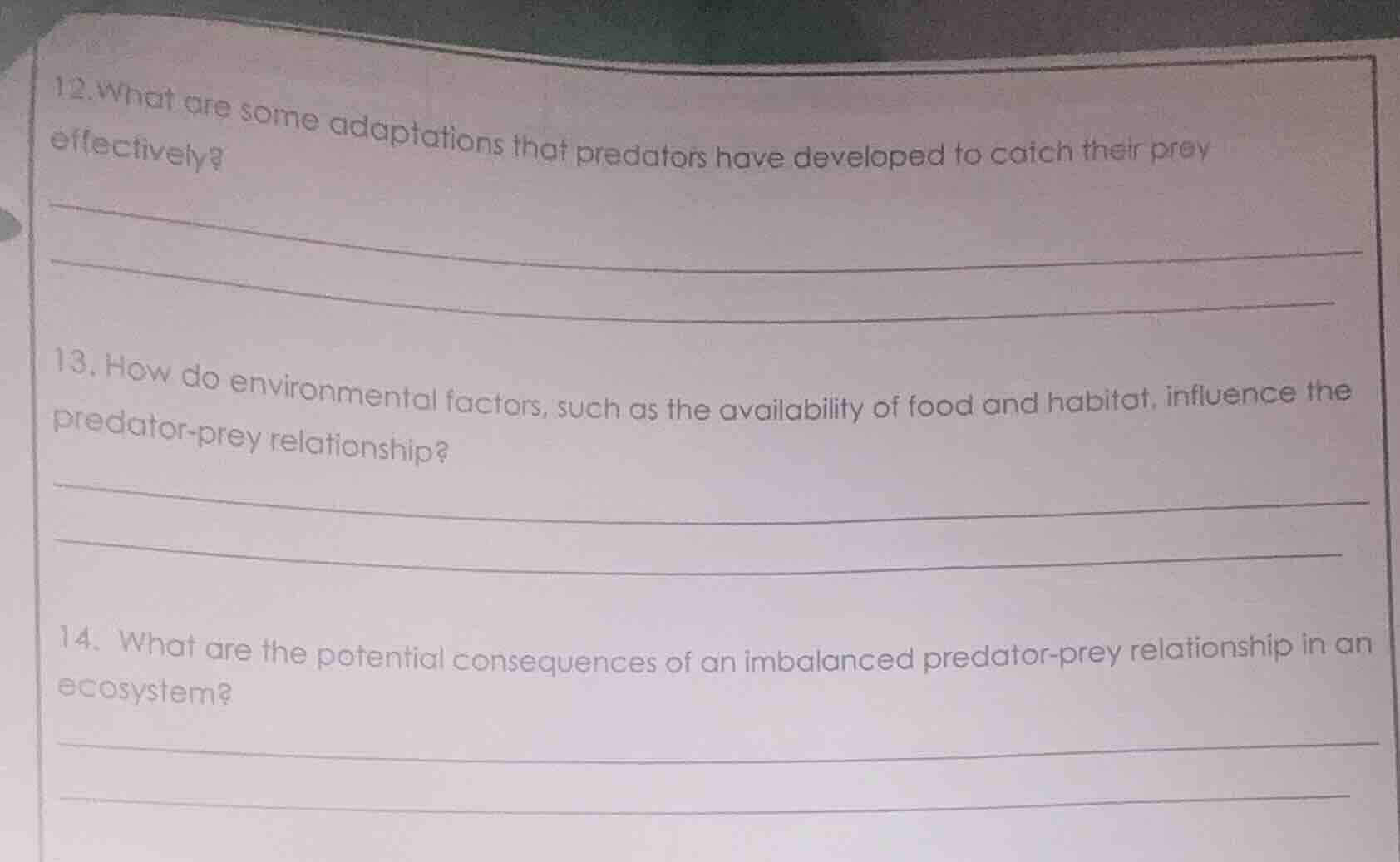
- what are some adaptations that predators have developed to catch their prey effectively?
- how do environmental factors, such as the availability of food and habitat, influence the predator - prey relationship?
- what are the potential consequences of an imbalanced predator - prey relationship in an ecosystem?
Question 12
Predators have various adaptations. Physical adaptations like sharp teeth/claws for grasping, speed/agility (e.g., cheetahs) to chase. Sensory adaptations: keen eyesight (eagles) to spot prey, acute hearing (owls) to detect movements. Camouflage (tigers’ stripes) to ambush. Some use venom (snakes) to immobilize. Behavioral adaptations: cooperative hunting (wolves) to take down larger prey.
Food availability: If prey’s food (e.g., plants for herbivores) is scarce, prey population drops, reducing predators’ food, so predator numbers decline. Abundant prey food increases prey, supporting more predators. Habitat: Suitable habitat (e.g., forests for deer) provides prey shelter; if habitat shrinks, prey is exposed, increasing predation. If habitat is fragmented, predator-prey interactions change (e.g., isolation affects population dynamics). Also, habitat loss can reduce both populations, disrupting the relationship.
Imbalanced predator-prey (e.g., too many predators, too few prey): Prey population crashes, then predators starve/decrease. Too few predators: Prey overpopulates, overgrazes (herbivores) or depletes resources, causing prey population crash. Ecosystem impacts: Loss of species diversity (e.g., prey overpopulation outcompetes other species). Trophic cascade: E.g., wolves (predator) removal led to deer overgrazing, changing vegetation and other species. Disrupted nutrient cycling, altered habitat structure.

Snap & solve any problem in the app
Get step-by-step solutions on Sovi AI
Photo-based solutions with guided steps
Explore more problems and detailed explanations
Examples of predator adaptations include: 1. Physical: Sharp teeth/claws (e.g., lions) for seizing, speed (cheetahs) to chase. 2. Sensory: Keen eyesight (eagles) to spot, acute hearing (owls) to detect. 3. Camouflage (tigers) for ambushing. 4. Venom (snakes) to immobilize. 5. Behavioral: Cooperative hunting (wolves) to tackle large prey.