QUESTION IMAGE
Question
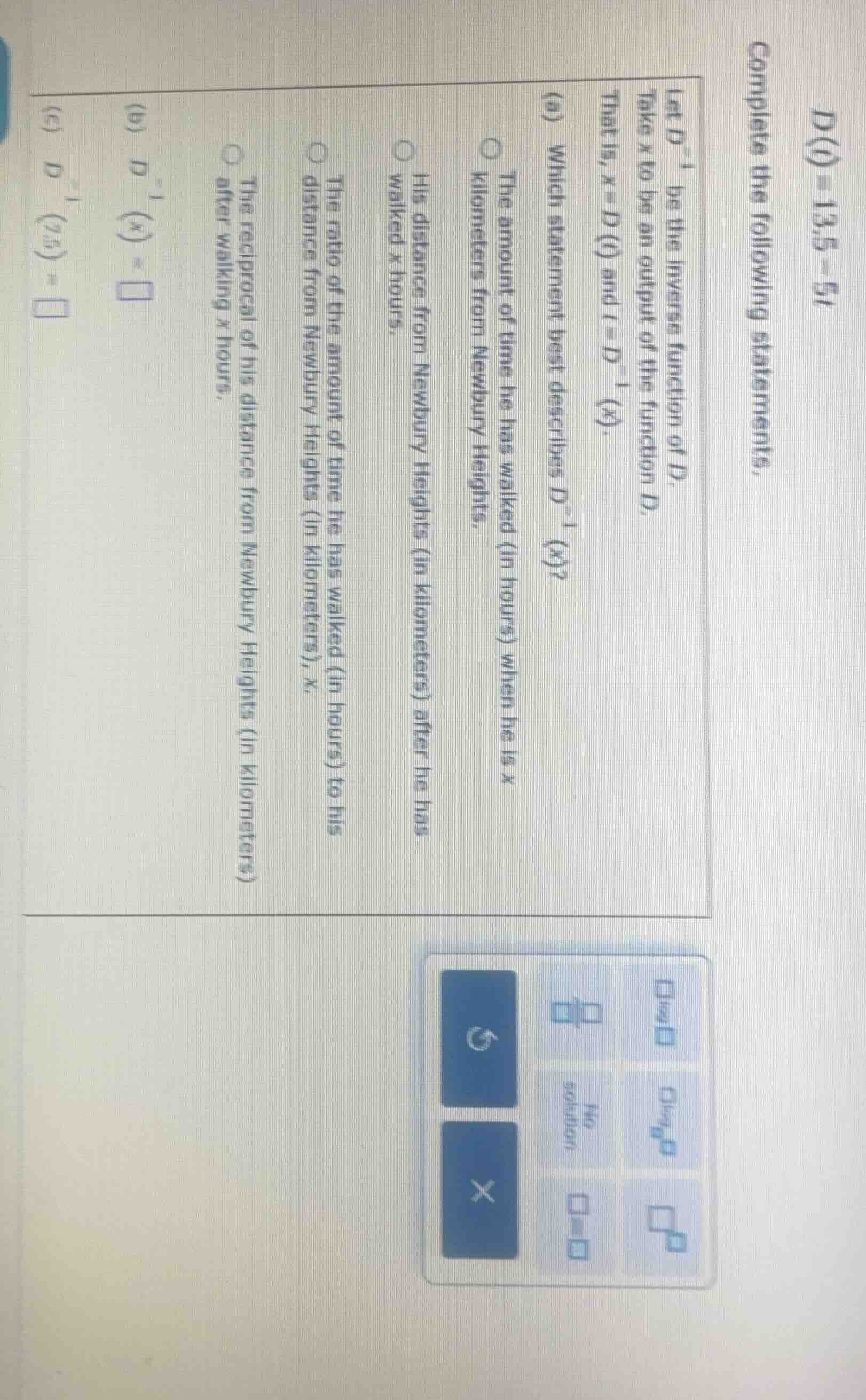
d(t) = 13.5 - 5t
complete the following statements.
let ( d^{-1} ) be the inverse function of ( d ).
take ( x ) to be an output of the function ( d ).
that is, ( x = d(t) ) and ( t = d^{-1}(x) ).
(a) which statement best describes ( d^{-1}(x) )?
- the amount of time he has walked (in hours) when he is ( x ) kilometers from newbury heights.
- his distance from newbury heights (in kilometers) after he has walked ( x ) hours.
- the ratio of the amount of time he has walked (in hours) to his distance from newbury heights (in kilometers), ( x ).
- the reciprocal of his distance from newbury heights (in kilometers) after walking ( x ) hours.
(b) ( d^{-1}(x) = square )
(c) ( d^{-1}(7.5) = square )
Step1: Interpret inverse function meaning
The original function $D(t)=13.5-5t$ gives distance $x$ from Newbury Heights after $t$ hours. The inverse $t=D^{-1}(x)$ swaps the input and output, so it represents time walked when distance is $x$.
Step2: Solve for inverse function
Start with $x=13.5-5t$. Isolate $t$:
$5t=13.5-x$
$t=\frac{13.5-x}{5}$
So $D^{-1}(x)=\frac{13.5-x}{5}$
Step3: Calculate $D^{-1}(7.5)$
Substitute $x=7.5$ into the inverse function:
$D^{-1}(7.5)=\frac{13.5-7.5}{5}=\frac{6}{5}=1.2$

Snap & solve any problem in the app
Get step-by-step solutions on Sovi AI
Photo-based solutions with guided steps
Explore more problems and detailed explanations
(a) The amount of time he has walked (in hours) when he is x kilometers from Newbury Heights.
(b) $\frac{13.5-x}{5}$
(c) $1.2$