QUESTION IMAGE
Question
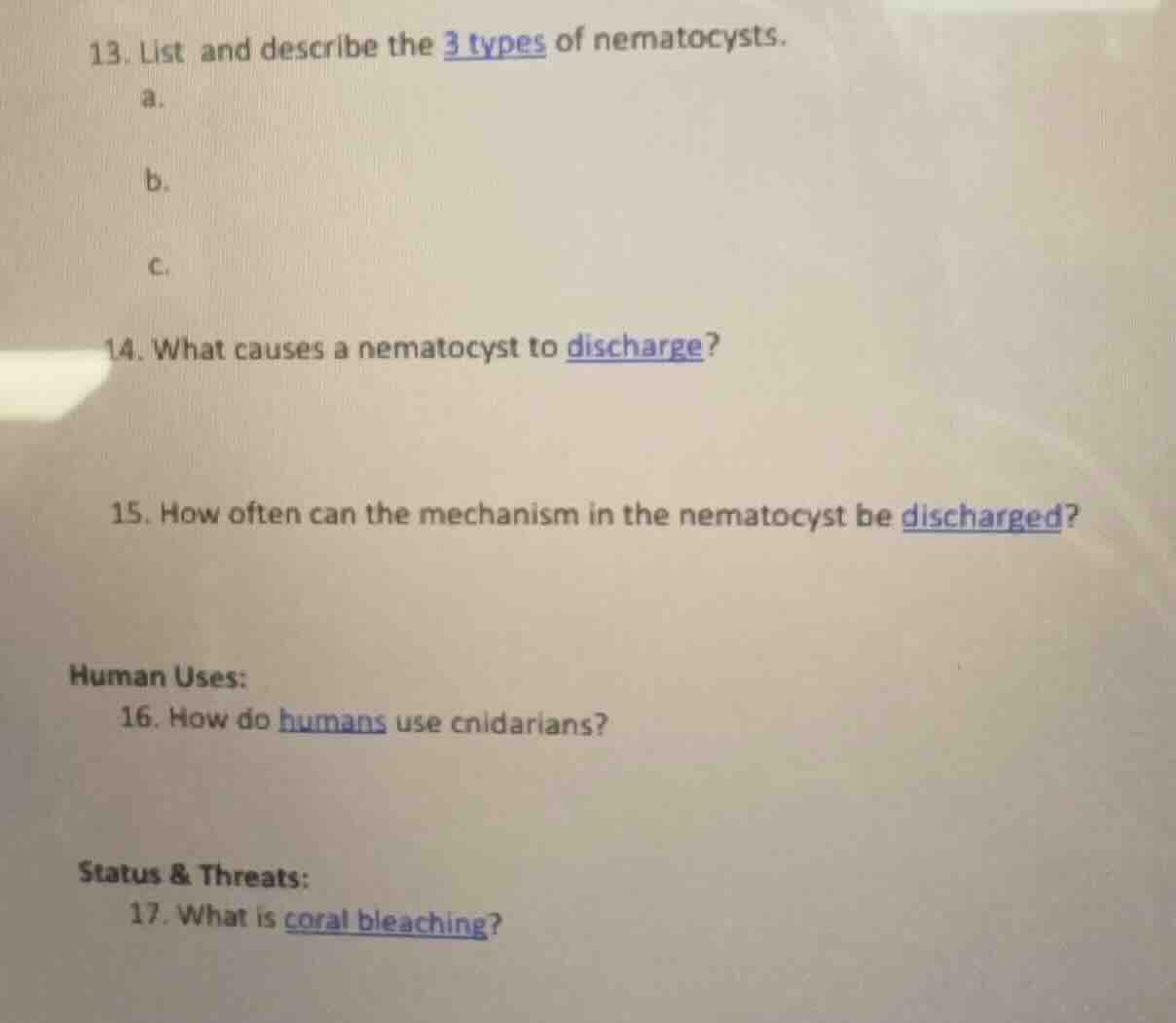
- list and describe the 3 types of nematocysts.
a.
b.
c.
- what causes a nematocyst to discharge?
- how often can the mechanism in the nematocyst be discharged?
human uses:
- how do humans use cnidarians?
status & threats:
- what is coral bleaching?
Question 13
- a. Penetrant (or Stenotele): These nematocysts have a long, hollow thread that can penetrate the prey's body. They are used to inject toxins into the prey, helping in immobilizing or killing it. The thread is coiled within the capsule and, upon discharge, extends rapidly to pierce the target.
- b. Volvent (or Desmoneme): These have a shorter, thicker thread that is not hollow. They are used to coil around the prey, such as the appendages of small organisms, to hold them in place. The thread wraps around the target, aiding in capturing the prey.
- c. Glutinant (or Holotrichous Isorhiza): These nematocysts have a sticky thread that is used for attachment, defense, or locomotion. The thread can adhere to surfaces or prey, helping in anchoring the cnidarian or capturing small particles or prey.
A nematocyst discharges when it is triggered by a combination of mechanical and chemical stimuli. Mechanical stimuli can be contact with prey or other objects, and chemical stimuli can be substances (like certain chemicals on the prey's surface) that the cnidarian's cnidocyte (the cell containing the nematocyst) detects. This triggers a rapid change in the osmotic pressure within the nematocyst capsule, causing the thread to evert (turn inside out) and discharge.
The mechanism in a nematocyst can be discharged only once. After discharge, the nematocyst is spent and cannot be reused. The cnidocyte containing the discharged nematocyst will eventually be replaced by a new one as the cnidarian produces new nematocysts.

Snap & solve any problem in the app
Get step-by-step solutions on Sovi AI
Photo-based solutions with guided steps
Explore more problems and detailed explanations
a. Penetrant (Stenotele): Long hollow thread, injects toxins to immobilize/kill prey.
b. Volvent (Desmoneme): Short thick thread, coils around prey to hold it.
c. Glutinant (Holotrichous Isorhiza): Sticky thread, used for attachment, defense, or locomotion.