QUESTION IMAGE
Question
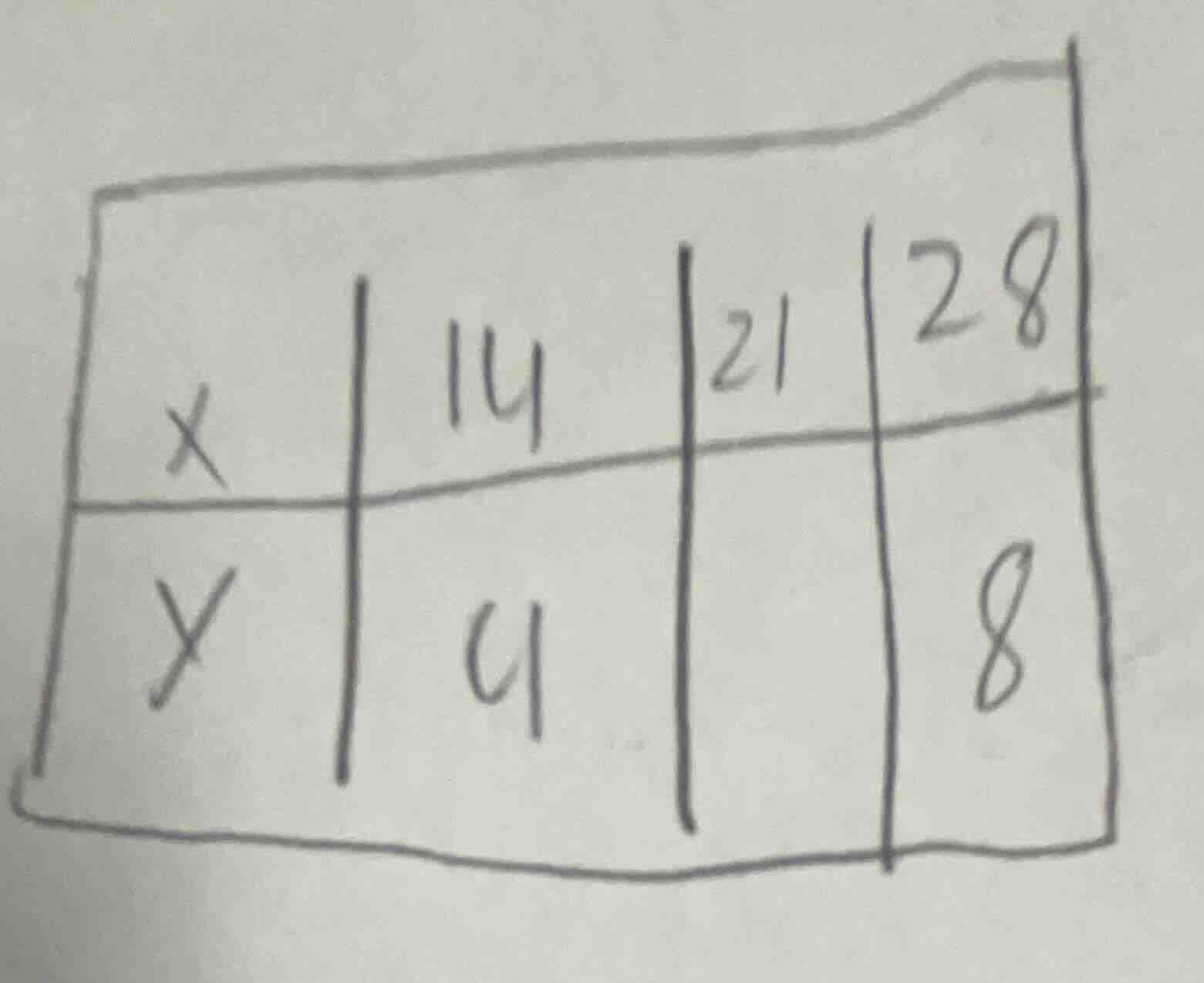
x | 14 | 21 | 28
y | 9 | | 8
Step1: Analyze the table structure
We can see that this is a table with two rows (x and y) and three columns (14, 21, 28 for the x - row; 9,?, 8 for the y - row). It seems to be a proportional relationship problem, that is, \(x\times y=\text{constant}\) (product of corresponding x and y values is the same). First, let's find the constant using the first pair of values (x = 14, y = 9). The product is \(14\times9 = 126\).
Step2: Find the missing y - value for x = 21
Since the product of x and y should be constant (126), when \(x = 21\), we can find \(y\) by the formula \(y=\frac{126}{x}\). Substitute \(x = 21\) into the formula, we get \(y=\frac{126}{21}\).
Step3: Calculate the value of \(\frac{126}{21}\)
\(126\div21 = 6\). We can also verify with the third pair: \(28\times8=224\)? Wait, no, that's a mistake. Wait, the first pair is (14, 9), product is 126. The third pair: if x = 28, y = 8, then \(28\times8 = 224
eq126\). Wait, maybe I misinterpret the table. Maybe it's a ratio relationship, that is, \(\frac{x}{y}=\text{constant}\) (ratio of x and y is the same). Let's check the ratio of the first pair: \(\frac{14}{9}\approx1.555\), the third pair: \(\frac{28}{8}=3.5\), not the same. Wait, maybe the table is about a linear relationship? Wait, maybe the table is a multiplication table where the first row is x, the second row is y, and we need to find the missing value in the y - row when x = 21, given that when x = 14, y = 9 and when x = 28, y = 8. Wait, maybe it's a pattern in the y - row. Let's see the x - row values: 14, 21, 28. The difference between 14 and 21 is 7, between 21 and 28 is 7. The y - row values: 9,?, 8. The difference between 9 and 8 is - 1, but the number of steps between 9 and 8 is 2 (from 9 to? to 8). So the common difference would be \(\frac{8 - 9}{2}=\frac{- 1}{2}=- 0.5\). But that seems odd. Wait, going back to the product idea, maybe I made a mistake in the first pair. Wait, maybe the first pair is (14, 9), the third pair is (28, 8). Let's check the product of 14 and 9 is 126, 28 and 8 is 224, not the same. Ratio of 14/9≈1.555, 28/8 = 3.5, which is double. Oh! Wait, 14 to 28 is a factor of 2 (28 = 14×2), and 9 to 8 is not. Wait, maybe the table is a division or multiplication with a different pattern. Wait, another approach: maybe the table is about a function where y is related to x such that when x = 14, y = 9; x = 21, y =?; x = 28, y = 8. Let's see the x values: 14, 21, 28 are multiples of 7 (14 = 7×2, 21 = 7×3, 28 = 7×4). The y values: 9,?, 8. Let's list the x as 7×2, 7×3, 7×4 and y as 9,?, 8. Maybe the y values are related to the coefficients of 7. For x = 7×2, y = 9; x = 7×3, y =?; x = 7×4, y = 8. Let's assume a linear relationship between the coefficient of 7 (let's call it n, where n = 2, 3, 4) and y. So we have two points: (n = 2, y = 9) and (n = 4, y = 8). The slope of the line is \(m=\frac{8 - 9}{4 - 2}=\frac{-1}{2}=-0.5\). Then the equation of the line is \(y - 9=-0.5(n - 2)\). When n = 3 (for x = 21, n = 3), substitute n = 3 into the equation: \(y-9=-0.5(3 - 2)\), \(y-9=-0.5\), \(y = 9 - 0.5=8.5\). But that's a decimal. Alternatively, maybe the product of x and y is a multiple. Wait, 14×9 = 126, 21×6 = 126, 28×4.5 = 126. Ah! Wait, 28×4.5 = 126, but the given y for x = 28 is 8, which is not 4.5. So maybe the table has a typo, or my initial assumption is wrong. Wait, maybe the table is a multiplication table where the first column is x, the second column is 14 and 9, the third is 21 and?, the fourth is 28 and 8, and we need to find the value in the y - row (second row) for the x - value 21…

Snap & solve any problem in the app
Get step-by-step solutions on Sovi AI
Photo-based solutions with guided steps
Explore more problems and detailed explanations
6