QUESTION IMAGE
Question
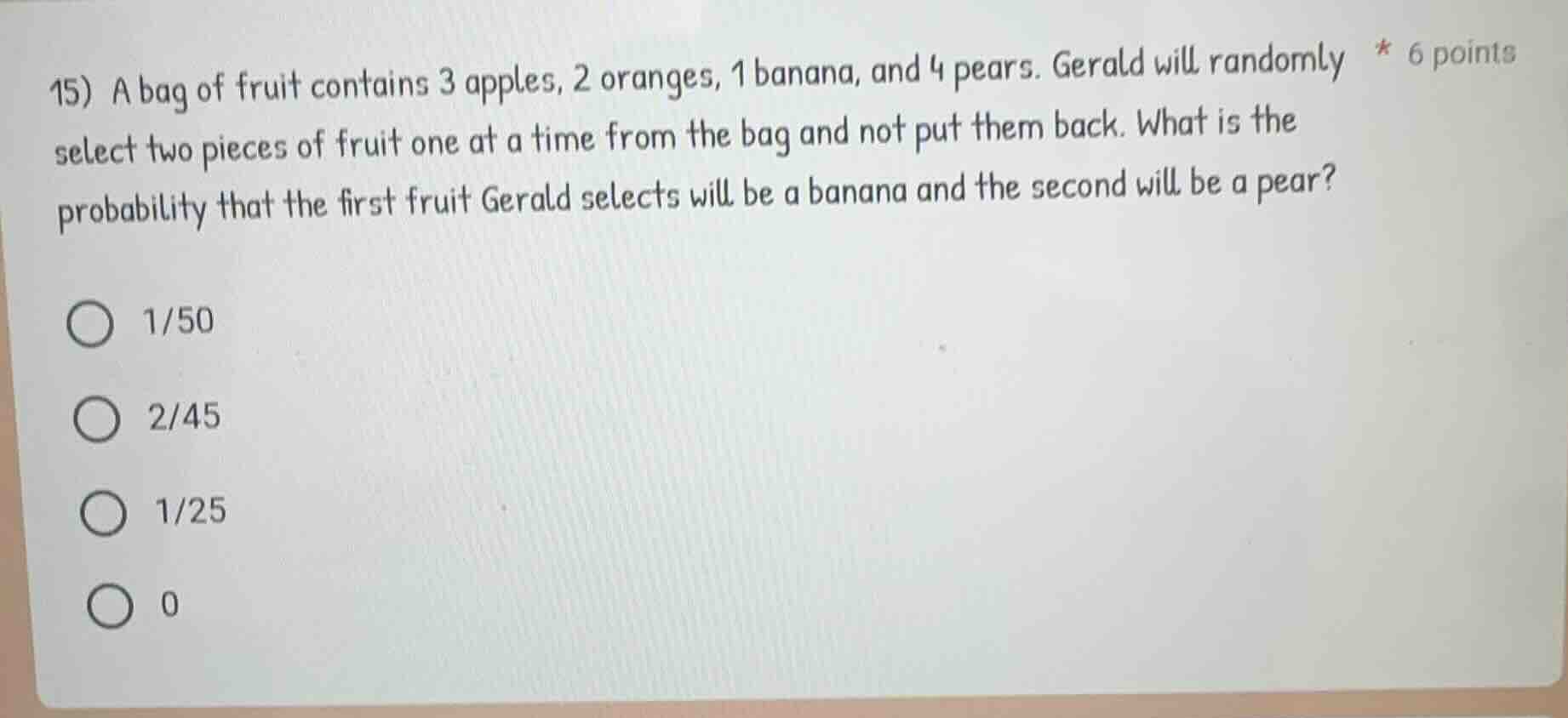
- a bag of fruit contains 3 apples, 2 oranges, 1 banana, and 4 pears. gerald will randomly select two pieces of fruit one at a time from the bag and not put them back. what is the probability that the first fruit gerald selects will be a banana and the second will be a pear? \\(\bigcirc\\) 1/50 \\(\bigcirc\\) 2/45 \\(\bigcirc\\) 1/25 \\(\bigcirc\\) 0
Step1: Calculate total number of fruits
First, find the total number of fruits in the bag. We have 3 apples, 2 oranges, 1 banana, and 4 pears. So the total number of fruits is \(3 + 2 + 1 + 4 = 10\).
Step2: Probability of selecting a banana first
The probability of selecting a banana first is the number of bananas divided by the total number of fruits. There is 1 banana, so the probability \(P(\text{banana first})=\frac{1}{10}\).
Step3: Probability of selecting a pear second (without replacement)
After selecting a banana, the total number of fruits left is \(10 - 1 = 9\). The number of pears is still 4. So the probability of selecting a pear second is \(P(\text{pear second})=\frac{4}{9}\).
Step4: Probability of both events happening
To find the probability of both events (selecting a banana first and then a pear) happening, we multiply the probabilities of each event. So \(P(\text{banana then pear}) = P(\text{banana first}) \times P(\text{pear second})=\frac{1}{10}\times\frac{4}{9}=\frac{4}{90}=\frac{2}{45}\).

Snap & solve any problem in the app
Get step-by-step solutions on Sovi AI
Photo-based solutions with guided steps
Explore more problems and detailed explanations
B. 2/45