QUESTION IMAGE
Question
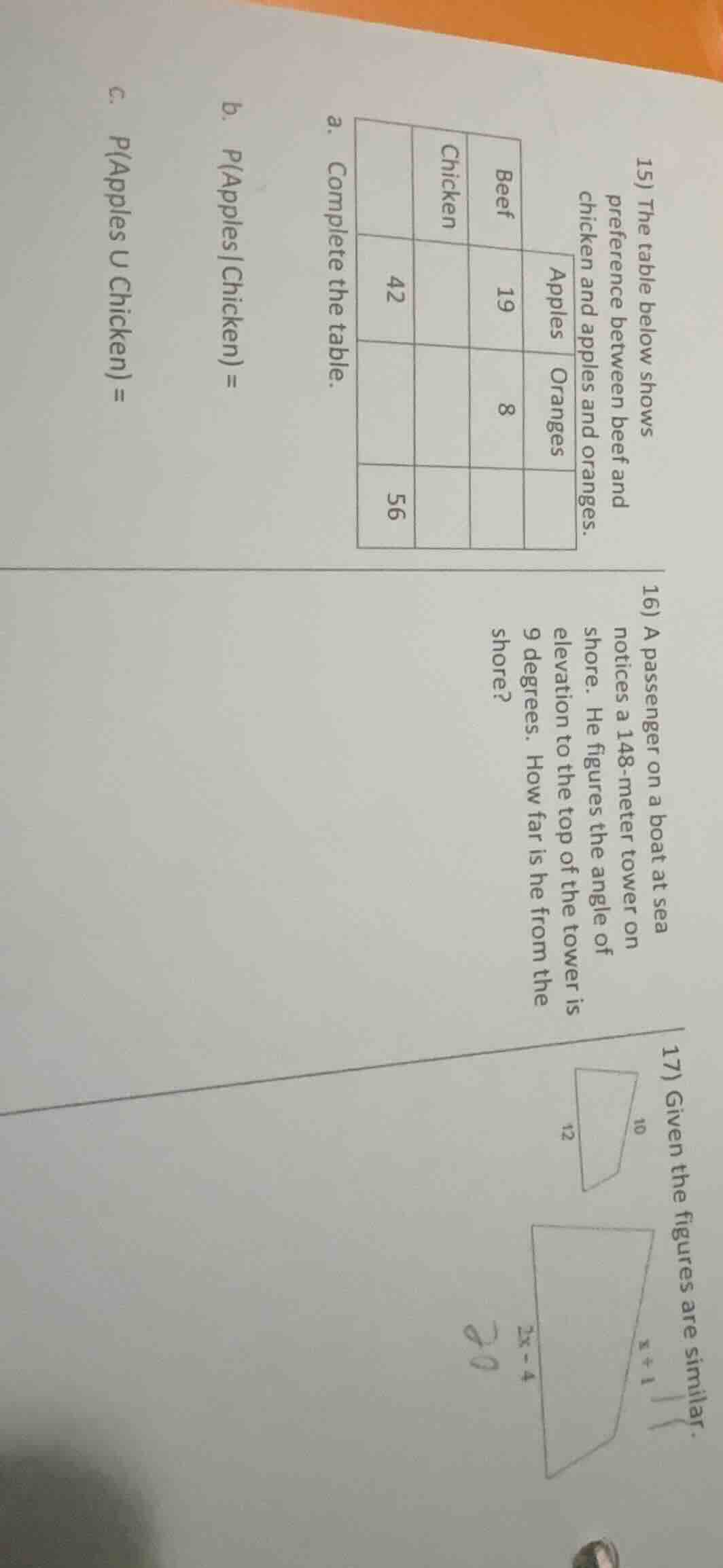
- the table below shows preference between beef and chicken and apples and oranges. beef apples 19 oranges 8 chicken 42 56 a. complete the table. b. p(apples|chicken) = c. p(apples ∪ chicken) = 16) a passenger on a boat at sea notices a 148 - meter tower on shore. he figures the angle of elevation to the top of the tower is 9 degrees. how far is he from the shore? 17) given the figures are similar. (with figures showing sides 10, 12 and x + 1, 2x - 4)
Problem 15a: Complete the table
We have a contingency table for preferences between beef/chicken and apples/oranges. Let's define the rows as Apples, Oranges, and the columns as Beef, Chicken, with totals.
First, let's find the total for the Beef column. The Beef row for Apples is 19, for Oranges is 8, so total Beef is \(19 + 8 = 27\).
For the Chicken column, the total is 56 (given at the bottom). The Apples row for Chicken: let's call it \(x\). The total for Apples row is \(19 + x\), and for Oranges row, let's call the Chicken value \(y\), so \(8 + y\), and total Chicken is \(x + y = 56\). Also, the total for Apples row: we know the total for Apples (including Beef and Chicken) should relate to the Chicken total? Wait, maybe the table is:
Rows: Apples, Oranges, (maybe Total row? Wait, the given table has:
Columns: Beef, Chicken, (maybe Total column? Wait, the original table:
First column (rows): Apples, Oranges, (maybe a total row? Wait, the cells:
Apples - Beef: 19
Apples - Chicken:?
Oranges - Beef: 8
Oranges - Chicken:?
Total Chicken: 56 (bottom cell of Chicken column)
Total Apples? Wait, maybe the "42" is the total for Apples row? Wait, the user's table:
Looking at the image:
The table has:
Rows: Apples, Oranges, (maybe a row with 42 and 56? Wait, the first column (after Beef, Chicken) has 42 (under Apples row, maybe total Apples), and 56 (under Chicken column, total Chicken). Wait, let's re-express:
Let’s denote:
- Apples & Beef: 19
- Apples & Chicken: \(A\)
- Oranges & Beef: 8
- Oranges & Chicken: \(O\)
- Total Apples: \(19 + A = 42\) (since 42 is under Apples row, maybe total Apples)
- Total Chicken: \(A + O = 56\)
- Total Beef: \(19 + 8 = 27\)
- Total Oranges: \(8 + O\)
- Grand Total: \(42 + (8 + O)\) or \(27 + 56 = 83\)
So first, find \(A\) from Apples total: \(19 + A = 42\) ⇒ \(A = 42 - 19 = 23\)
Then, from Chicken total: \(A + O = 56\) ⇒ \(23 + O = 56\) ⇒ \(O = 56 - 23 = 33\)
Then, total Oranges: \(8 + 33 = 41\)
Grand Total: \(42 + 41 = 83\) or \(27 + 56 = 83\), which matches.
So the completed table:
| Beef | Chicken | Total | |
|---|---|---|---|
| Oranges | 8 | 33 | 41 |
| Total | 27 | 56 | 83 |
Problem 15b: \( P(\text{Apples} | \text{Chicken}) \)
Conditional probability formula: \( P(A | B) = \frac{P(A \cap B)}{P(B)} \)
From the table:
- \( n(\text{Apples} \cap \text{Chicken}) = 23 \)
- \( n(\text{Chicken}) = 56 \)
So \( P(\text{Apples} | \text{Chicken}) = \frac{23}{56} \approx 0.4107 \)
Problem 15c: \( P(\text{Apples} \cup \text{Chicken}) \)
Using the principle of inclusion - exclusion: \( P(A \cup B) = P(A) + P(B) - P(A \cap B) \)
From the table:
- \( n(\text{Apples}) = 42 \)
- \( n(\text{Chicken}) = 56 \)
- \( n(\text{Apples} \cap \text{Chicken}) = 23 \)
- Grand Total \( N = 83 \)
So \( P(\text{Apples} \cup \text{Chicken}) = \frac{42 + 56 - 23}{83} = \frac{75}{83} \approx 0.9036 \)
Problem 16: Angle of elevation
We have a right triangle where:
- Height of tower (opposite side to angle): \( h = 148 \) meters
- Angle of elevation: \( \theta = 9^\circ \)
- Distance from boat to shore (adjacent side): \( d \)
We use the tangent function: \( \tan(\theta) = \frac{\text{opposite}}{\text{adjacent}} = \frac{h}{d} \)
So \( \tan(9^\circ) = \frac{148}{d} \)
Solving for \( d \): \( d = \frac{148}{\tan(9^\circ)} \)
Calculate \( \tan(9^\circ) \approx 0.1584 \)
So \( d \approx \frac{148}{0.1584} \approx 934.35 \) meters
Problem 17: Similar figures
The figures are similar t…

Snap & solve any problem in the app
Get step-by-step solutions on Sovi AI
Photo-based solutions with guided steps
Explore more problems and detailed explanations
Problem 15a: Complete the table
We have a contingency table for preferences between beef/chicken and apples/oranges. Let's define the rows as Apples, Oranges, and the columns as Beef, Chicken, with totals.
First, let's find the total for the Beef column. The Beef row for Apples is 19, for Oranges is 8, so total Beef is \(19 + 8 = 27\).
For the Chicken column, the total is 56 (given at the bottom). The Apples row for Chicken: let's call it \(x\). The total for Apples row is \(19 + x\), and for Oranges row, let's call the Chicken value \(y\), so \(8 + y\), and total Chicken is \(x + y = 56\). Also, the total for Apples row: we know the total for Apples (including Beef and Chicken) should relate to the Chicken total? Wait, maybe the table is:
Rows: Apples, Oranges, (maybe Total row? Wait, the given table has:
Columns: Beef, Chicken, (maybe Total column? Wait, the original table:
First column (rows): Apples, Oranges, (maybe a total row? Wait, the cells:
Apples - Beef: 19
Apples - Chicken:?
Oranges - Beef: 8
Oranges - Chicken:?
Total Chicken: 56 (bottom cell of Chicken column)
Total Apples? Wait, maybe the "42" is the total for Apples row? Wait, the user's table:
Looking at the image:
The table has:
Rows: Apples, Oranges, (maybe a row with 42 and 56? Wait, the first column (after Beef, Chicken) has 42 (under Apples row, maybe total Apples), and 56 (under Chicken column, total Chicken). Wait, let's re-express:
Let’s denote:
- Apples & Beef: 19
- Apples & Chicken: \(A\)
- Oranges & Beef: 8
- Oranges & Chicken: \(O\)
- Total Apples: \(19 + A = 42\) (since 42 is under Apples row, maybe total Apples)
- Total Chicken: \(A + O = 56\)
- Total Beef: \(19 + 8 = 27\)
- Total Oranges: \(8 + O\)
- Grand Total: \(42 + (8 + O)\) or \(27 + 56 = 83\)
So first, find \(A\) from Apples total: \(19 + A = 42\) ⇒ \(A = 42 - 19 = 23\)
Then, from Chicken total: \(A + O = 56\) ⇒ \(23 + O = 56\) ⇒ \(O = 56 - 23 = 33\)
Then, total Oranges: \(8 + 33 = 41\)
Grand Total: \(42 + 41 = 83\) or \(27 + 56 = 83\), which matches.
So the completed table:
| Beef | Chicken | Total | |
|---|---|---|---|
| Oranges | 8 | 33 | 41 |
| Total | 27 | 56 | 83 |
Problem 15b: \( P(\text{Apples} | \text{Chicken}) \)
Conditional probability formula: \( P(A | B) = \frac{P(A \cap B)}{P(B)} \)
From the table:
- \( n(\text{Apples} \cap \text{Chicken}) = 23 \)
- \( n(\text{Chicken}) = 56 \)
So \( P(\text{Apples} | \text{Chicken}) = \frac{23}{56} \approx 0.4107 \)
Problem 15c: \( P(\text{Apples} \cup \text{Chicken}) \)
Using the principle of inclusion - exclusion: \( P(A \cup B) = P(A) + P(B) - P(A \cap B) \)
From the table:
- \( n(\text{Apples}) = 42 \)
- \( n(\text{Chicken}) = 56 \)
- \( n(\text{Apples} \cap \text{Chicken}) = 23 \)
- Grand Total \( N = 83 \)
So \( P(\text{Apples} \cup \text{Chicken}) = \frac{42 + 56 - 23}{83} = \frac{75}{83} \approx 0.9036 \)
Problem 16: Angle of elevation
We have a right triangle where:
- Height of tower (opposite side to angle): \( h = 148 \) meters
- Angle of elevation: \( \theta = 9^\circ \)
- Distance from boat to shore (adjacent side): \( d \)
We use the tangent function: \( \tan(\theta) = \frac{\text{opposite}}{\text{adjacent}} = \frac{h}{d} \)
So \( \tan(9^\circ) = \frac{148}{d} \)
Solving for \( d \): \( d = \frac{148}{\tan(9^\circ)} \)
Calculate \( \tan(9^\circ) \approx 0.1584 \)
So \( d \approx \frac{148}{0.1584} \approx 934.35 \) meters
Problem 17: Similar figures
The figures are similar trapezoids (or similar quadrilaterals) with corresponding sides:
Smaller figure: sides 10 and 12
Larger figure: sides \( x + 1 \) and \( 2x - 4 \)
Since similar figures have proportional sides, the ratio of corresponding sides is equal.
Assuming 10 corresponds to \( x + 1 \), and 12 corresponds to \( 2x - 4 \), so:
\( \frac{10}{x + 1} = \frac{12}{2x - 4} \)
Cross - multiply: \( 10(2x - 4) = 12(x + 1) \)
Expand: \( 20x - 40 = 12x + 12 \)
Subtract \( 12x \): \( 8x - 40 = 12 \)
Add 40: \( 8x = 52 \)
Divide by 8: \( x = \frac{52}{8} = 6.5 \)
Check:
Smaller ratio: \( \frac{10}{6.5 + 1} = \frac{10}{7.5} = \frac{4}{3} \)
Larger ratio: \( \frac{12}{2(6.5) - 4} = \frac{12}{13 - 4} = \frac{12}{9} = \frac{4}{3} \), which matches.
Final Answers
15a: Completed Table
| Beef | Chicken | Total | |
|---|---|---|---|
| Oranges | 8 | 33 | 41 |
| Total | 27 | 56 | 83 |
15b: \( P(\text{Apples} | \text{Chicken}) \)
\( \frac{23}{56} \approx 0.411 \)
15c: \( P(\text{Apples} \cup \text{Chicken}) \)
\( \frac{75}{83} \approx 0.904 \)
16: Distance from shore
\( \approx 934.35 \) meters
17: \( x \)
\( x = 6.5 \)