QUESTION IMAGE
Question
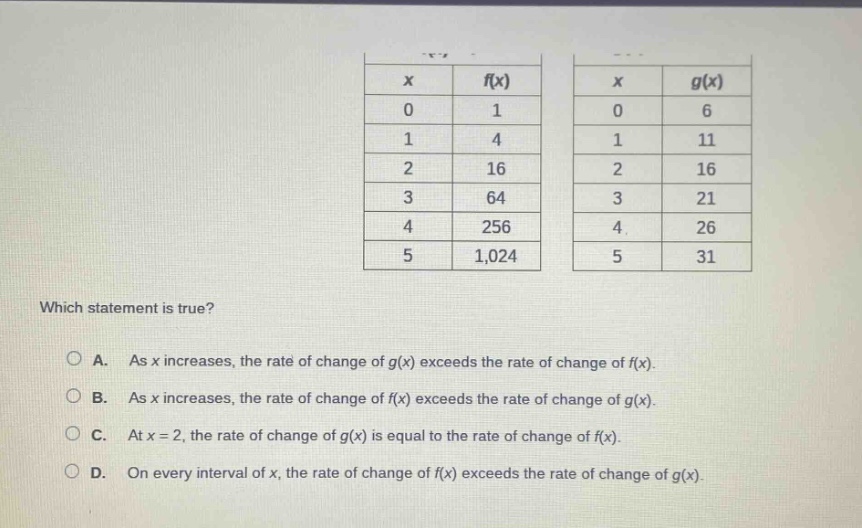
x f(x) 0 1 1 4 2 16 3 64 4 256 5 1,024 x g(x) 0 6 1 11 2 16 3 21 4 26 5 31 which statement is true? a. as x increases, the rate of change of g(x) exceeds the rate of change of f(x). b. as x increases, the rate of change of f(x) exceeds the rate of change of g(x). c. at x = 2, the rate of change of g(x) is equal to the rate of change of f(x). d. on every interval of x, the rate of change of f(x) exceeds the rate of change of g(x).
Step1: Identify g(x) rate of change
The function \(g(x)\) has a constant difference between consecutive values: \(11-6=5\), \(16-11=5\), etc. So it is linear with a constant rate of change of \(5\).
Step2: Identify f(x) rate of change
The function \(f(x)\) is exponential: \(f(x)=4^x\). Calculate its interval rates of change:
- From \(x=0\) to \(1\): \(4-1=3\)
- From \(x=1\) to \(2\): \(16-4=12\)
- From \(x=2\) to \(3\): \(64-16=48\)
- From \(x=3\) to \(4\): \(256-64=192\)
- From \(x=4\) to \(5\): \(1024-256=768\)
Step3: Compare the rates
For early intervals, \(f(x)\) has a lower rate, but as \(x\) increases, its rate grows rapidly and surpasses \(g(x)\)'s constant rate of 5, and continues to exceed it more as \(x\) increases.
Step4: Evaluate all options
- A: False, \(g(x)\)'s rate does not exceed \(f(x)\)'s as \(x\) increases.
- C: False, at \(x=2\) (interval 1-2), \(f(x)\) rate is 12, \(g(x)\) is 5.
- D: False, first interval (0-1) has \(f(x)\) rate 3 < 5.
- B: True, as \(x\) increases, \(f(x)\)'s rate becomes and stays greater than \(g(x)\)'s.

Snap & solve any problem in the app
Get step-by-step solutions on Sovi AI
Photo-based solutions with guided steps
Explore more problems and detailed explanations
B. As x increases, the rate of change of f(x) exceeds the rate of change of g(x).