QUESTION IMAGE
Question
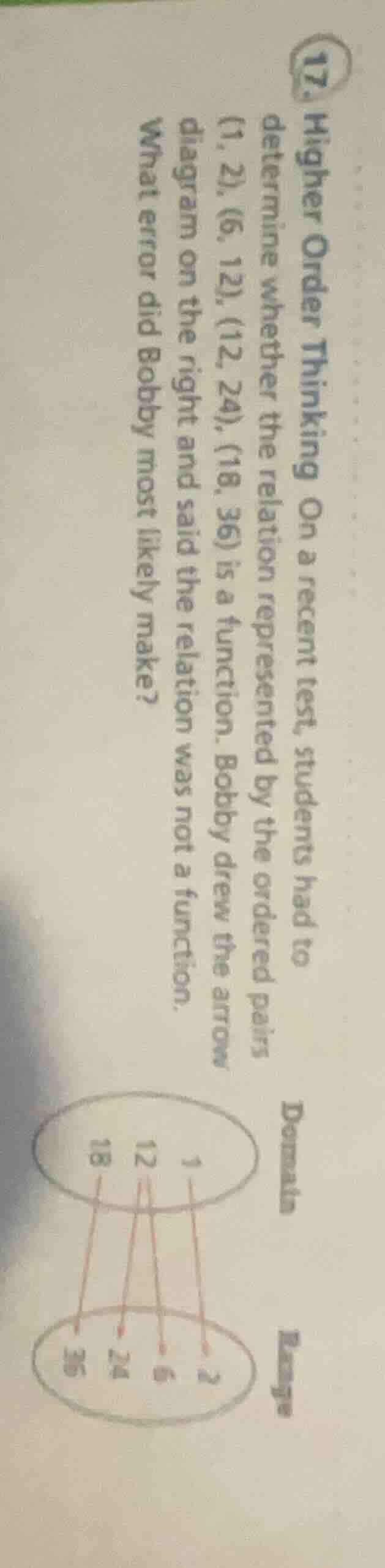
- higher order thinking on a recent test, students had to determine whether the relation represented by the ordered pairs (1, 2), (6, 12), (12, 24), (18, 36) is a function. bobby drew the arrow diagram on the right and said the relation was not a function. what error did bobby most likely make?
Step1: Recall function definition
A function is a relation where each input (domain value) has exactly one output (range value).
Step2: Analyze given ordered pairs
The ordered pairs are \((1, 2)\), \((6, 12)\), \((12, 24)\), \((18, 36)\). Let's list domain (\(x\)) and range (\(y\)):
- \(x = 1\), \(y = 2\)
- \(x = 6\), \(y = 12\)
- \(x = 12\), \(y = 24\)
- \(x = 18\), \(y = 36\)
Each domain value has one range value. But in Bobby's diagram, looking at the domain and range circles (assuming the diagram has incorrect arrows, maybe he misassigned arrows, like maybe he thought a domain value maps to multiple range values, but actually each \(x\) has one \(y\). Wait, maybe he included an extra domain value or misread the ordered pairs. Wait, the ordered pairs don't have a domain value repeated. Wait, maybe the diagram has a domain value (like 12) mapped to multiple range values? Wait, the ordered pairs are \((1,2)\), \((6,12)\), \((12,24)\), \((18,36)\) – wait, the original problem's ordered pairs: wait, the user's image has ordered pairs (1,2), (6,12), (12,24), (18,36)? Wait, no, the text says: "(1, 2), (6, 12), (12, 24), (18, 36)"? Wait, maybe I misread. Wait, the user's problem: "the relation represented by the ordered pairs (1, 2), (6, 12), (12, 24), (18, 36) is a function. Bobby drew the arrow diagram on the right and said the relation was not a function."
Wait, maybe in Bobby's diagram, he incorrectly mapped a domain element to more than one range element. Let's check the domain elements: 1, 6, 12, 18. Range elements: 2, 12, 24, 36. Wait, no, the ordered pairs are (1,2), (6,12), (12,24), (18,36). So each domain element (1,6,12,18) has exactly one range element. So a function requires each input (domain) has one output (range). So if Bobby's diagram shows a domain element (like 12) mapped to two range elements, or maybe he included an extra domain element (like maybe he thought 12 is in domain and mapped to two, but actually 12 maps to 24 only). Alternatively, maybe he misread the ordered pairs and included a pair where a domain element is repeated. Wait, no, the ordered pairs given have unique domain elements. So the error is that Bobby probably drew an arrow from a domain element to more than one range element (violating the function's definition of each input having one output), or maybe he included a domain element that's not in the ordered pairs' domain, or misassigned arrows.
Wait, let's re-express:
Function definition: A relation is a function if each input (x - value) has exactly one output (y - value).
Given ordered pairs:
- \(x = 1\) → \(y = 2\)
- \(x = 6\) → \(y = 12\)
- \(x = 12\) → \(y = 24\)
- \(x = 18\) → \(y = 36\)
Each \(x\) has one \(y\), so it's a function. Bobby said it's not a function, so he must have made a mistake in the arrow diagram, likely by mapping a domain element to more than one range element (e.g., maybe he drew an arrow from 12 to two different range values, or from 6 to two, etc.), or maybe he included an extra ordered pair where a domain element is repeated. But since the given ordered pairs have unique domain elements, the error is that Bobby incorrectly represented the mapping, probably by showing a domain element with multiple arrows (i.e., multiple outputs), which would mean he thought a domain element has more than one range element, but in reality, each has one.

Snap & solve any problem in the app
Get step-by-step solutions on Sovi AI
Photo-based solutions with guided steps
Explore more problems and detailed explanations
Bobby most likely made the error of incorrectly drawing the arrow diagram to show a domain element (input) mapping to more than one range element (output), violating the definition of a function (where each input must have exactly one output). He probably misassigned arrows, making it seem like a domain value has multiple outputs, but in reality, each domain value (1, 6, 12, 18) has exactly one range value (2, 12, 24, 36) respectively.