QUESTION IMAGE
Question
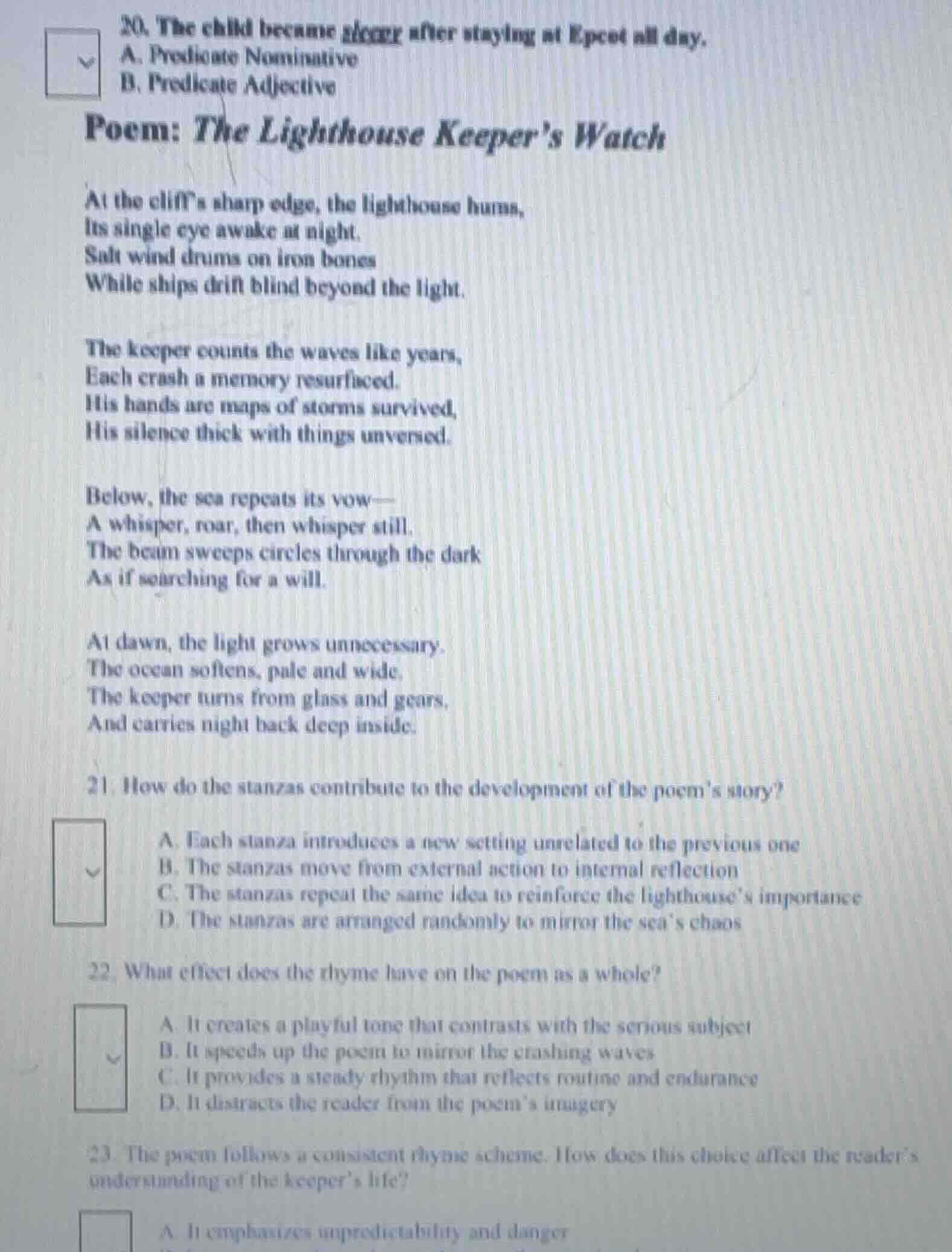
- the child became sleepy after staying at epcot all day. a. predicate nominative b. predicate adjective poem: the lighthouse keeper’s watch at the cliff’s sharp edge, the lighthouse hums, its single eye awake at night. salt wind drums on iron bones while ships drift blind beyond the light. the keeper counts the waves like years, each crash a memory resurfaced. his hands are maps of storms survived, his silence thick with things unvoiced. below, the sea repeats its vow— a whisper, roar, then whisper still. the beam sweeps circles through the dark as if searching for a will. at dawn, the light grows unnecessary. the ocean softens, pale and wide. the keeper turns from glass and gears, and carries night back deep inside. 21. how do the stanzas contribute to the development of the poem’s story? a. each stanza introduces a new setting unrelated to the previous one b. the stanzas move from external action to internal reflection c. the stanzas repeat the same idea to reinforce the lighthouse’s importance d. the stanzas are arranged randomly to mirror the sea’s chaos 22. what effect does the rhyme have on the poem as a whole? a. it creates a playful tone that contrasts with the serious subject b. it speeds up the poem to mirror the crashing waves c. it provides a steady rhythm that reflects routine and endurance d. it distracts the reader from the poem’s imagery 23. the poem follows a consistent rhyme scheme. how does this choice affect the reader’s understanding of the keeper’s life? a. it emphasizes unpredictability and danger
Brief Explanations
- "Sleepy" describes the subject "the child" and follows the linking verb "became", so it is a predicate adjective.
- The first stanzas focus on external details of the lighthouse and sea; later stanzas shift to the keeper's internal state and quiet routine, moving from external to internal focus.
- The consistent rhyme scheme creates a steady, rhythmic flow that mirrors the lighthouse keeper's regular, enduring nightly watch.
- (Note: Option A is incorrect; the consistent rhyme scheme emphasizes the keeper's structured, persistent routine, not unpredictability. The full correct option text is cut off, but based on the logic of the poem, the correct answer would align with the idea of routine/endurance. However, based on the visible options, we address the clear correct answers for 20-22, and note the partial 23.)

Snap & solve any problem in the app
Get step-by-step solutions on Sovi AI
Photo-based solutions with guided steps
Explore more problems and detailed explanations
- B. Predicate Adjective
- B. The stanzas move from external action to internal reflection
- C. It provides a steady rhythm that reflects routine and endurance
- (Incomplete option text; the consistent rhyme scheme would emphasize the keeper's steady, enduring routine, so the correct answer would be an option aligned with this idea, not A. It emphasizes unpredictability and danger)