QUESTION IMAGE
Question
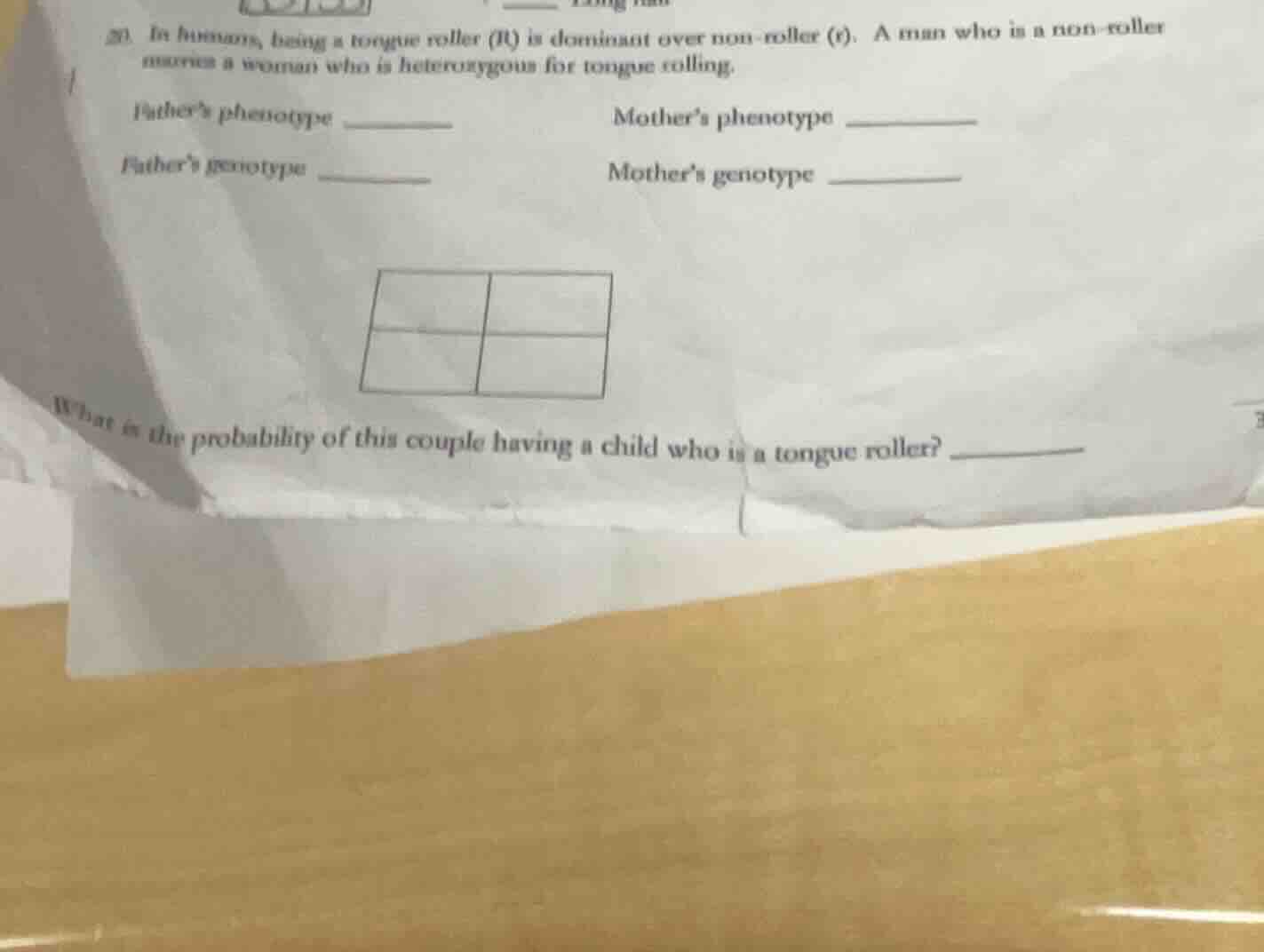
- in humans, being a tongue roller (r) is dominant over non - roller (r). a man who is a non - roller marries a woman who is heterozygous for tongue rolling.
father’s phenotype ____ mother’s phenotype ____
father’s genotype ____ mother’s genotype ____
what is the probability of this couple having a child who is a tongue roller? ______
Step1: Determine Genotypes
The father is a non - roller. Since non - roller is recessive (r), his genotype must be \( rr \) (phenotype: non - tongue roller). The mother is heterozygous for tongue rolling, so her genotype is \( Rr \) (phenotype: tongue roller).
Step2: Set up Punnett Square
The father can only produce \( r \) gametes. The mother can produce \( R \) and \( r \) gametes.
| R | r | |
|---|---|---|
| r | Rr | rr |
Step3: Calculate Probability of Tongue Roller (Rr)
From the Punnett square, out of 4 possible offspring genotypes, 2 are \( Rr \) (tongue rollers) and 2 are \( rr \) (non - rollers). The probability is \( \frac{2}{4}=\frac{1}{2} \) or 50%.
Father's phenotype: non - tongue roller
Mother's phenotype: tongue roller
Father's genotype: \( rr \)
Mother's genotype: \( Rr \)

Snap & solve any problem in the app
Get step-by-step solutions on Sovi AI
Photo-based solutions with guided steps
Explore more problems and detailed explanations
Father's phenotype: non - tongue roller; Mother's phenotype: tongue roller; Father's genotype: \( rr \); Mother's genotype: \( Rr \); Probability of tongue - roller child: 50% (or \( \frac{1}{2} \))