QUESTION IMAGE
Question
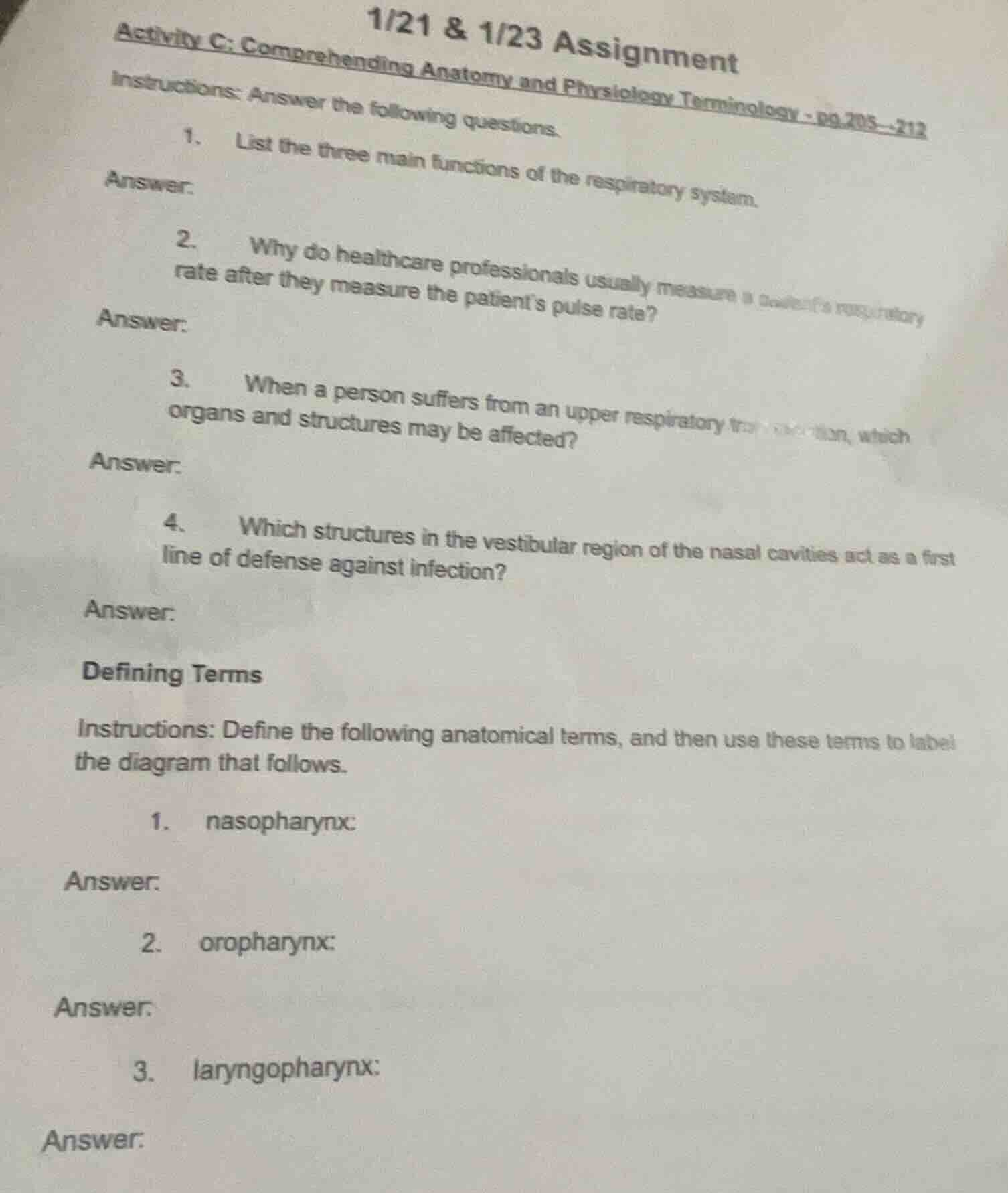
1/21 & 1/23 assignment
activity c: comprehending anatomy and physiology terminology - pp.205--212
instructions: answer the following questions.
- list the three main functions of the respiratory system.
answer:
- why do healthcare professionals usually measure a patients respiratory rate after they measure the patients pulse rate?
answer:
- when a person suffers from an upper respiratory tract infection, which organs and structures may be affected?
answer:
- which structures in the vestibular region of the nasal cavities act as a first line of defense against infection?
answer:
defining terms
instructions: define the following anatomical terms, and then use these terms to label the diagram that follows.
- nasopharynx:
answer:
- oropharynx:
answer:
- laryngopharynx:
answer:
Brief Explanations
Comprehending Anatomy and Physiology Terminology
- The three core functions of the respiratory system focus on gas exchange, protection, and vocalization/olfaction support.
- Measuring respiratory rate after pulse rate avoids altering the patient's natural breathing pattern, as awareness of being observed can change respiratory rate.
- Upper respiratory tract infections target structures above the larynx, including nasal and oral passage-related organs.
- The vestibular region of the nasal cavities has physical barriers that trap pathogens before they enter deeper respiratory structures.
Defining Terms
- The nasopharynx is a specific segment of the pharynx located behind the nasal cavity, with a clear anatomical position and function.
- The oropharynx is the middle part of the pharynx, positioned behind the oral cavity, serving as a shared passage for food and air.
- The laryngopharynx is the lowest segment of the pharynx, connecting to the larynx and esophagus, directing air and food to their respective pathways.

Snap & solve any problem in the app
Get step-by-step solutions on Sovi AI
Photo-based solutions with guided steps
Explore more problems and detailed explanations
Comprehending Anatomy and Physiology Terminology
- 1. Gas exchange: $\text{O}_2$ uptake and $\text{CO}_2$ removal
- Protection: Filtering, warming, humidifying air; trapping pathogens
- Sound production: Assisting vocal cord vibration (phonation)
- Patients may alter their breathing if they know it is being measured, so measuring respiratory rate after pulse rate ensures the reading reflects their natural, unaltered respiratory pattern.
- Nasal cavities, paranasal sinuses, pharynx (nasopharynx, oropharynx), larynx, and trachea (upper portion) may be affected.
- Nasal hairs (vibrissae) and the moist, mucus-coated epithelial lining of the vestibular region act as the first line of defense.
Defining Terms
- nasopharynx: The uppermost part of the pharynx, located posterior to the nasal cavity and superior to the soft palate; it serves as a passage for air and connects to the eustachian tubes.
- oropharynx: The middle portion of the pharynx, located posterior to the oral cavity, extending from the soft palate to the hyoid bone; it is a shared passage for both air and food.
- laryngopharynx: The lowermost segment of the pharynx, located inferior to the hyoid bone and posterior to the larynx; it directs air to the larynx and food to the esophagus.