QUESTION IMAGE
Question
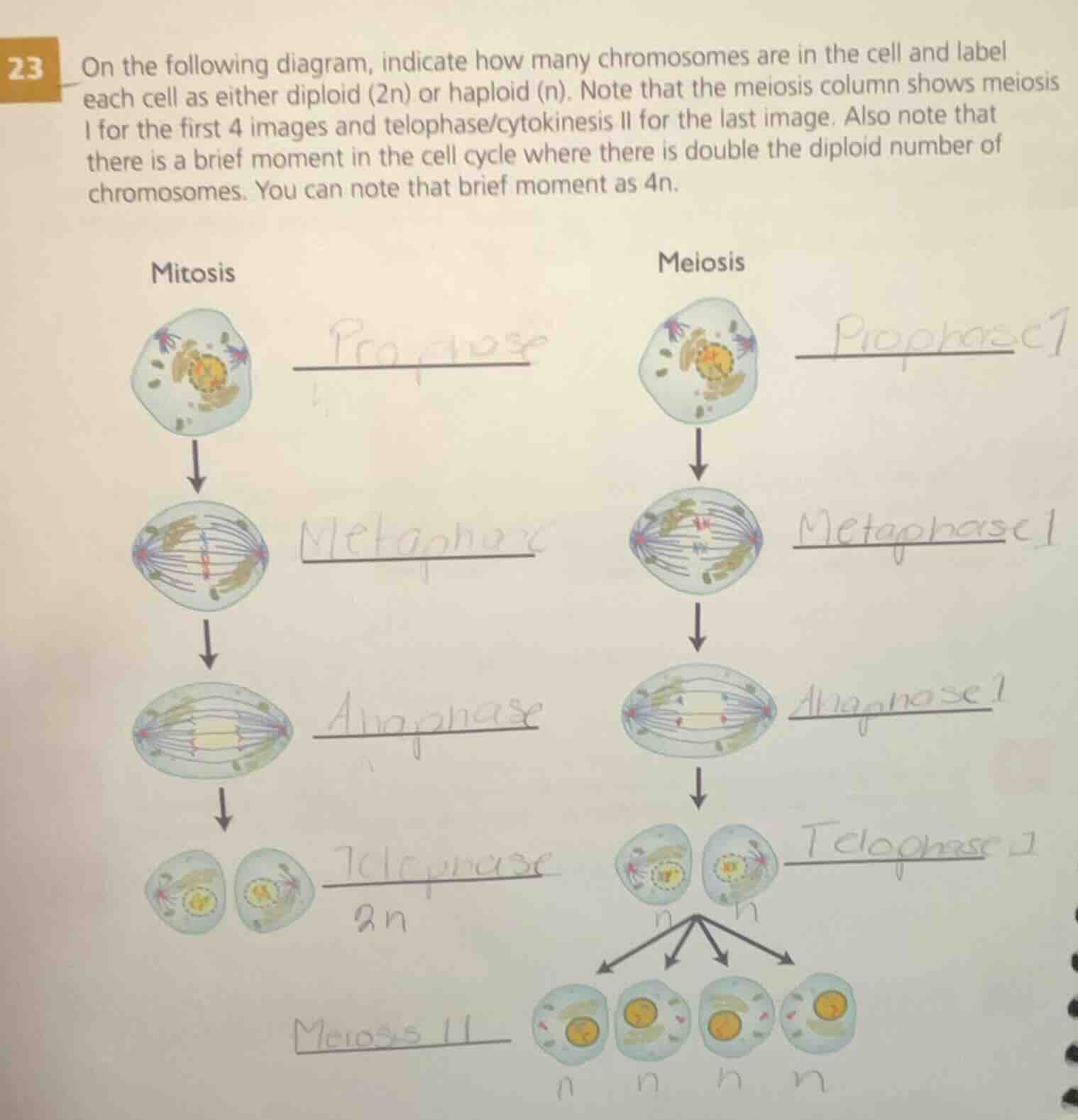
23 on the following diagram, indicate how many chromosomes are in the cell and label each cell as either diploid (2n) or haploid (n). note that the meiosis column shows meiosis i for the first 4 images and telophase/cytokinesis ii for the last image. also note that there is a brief moment in the cell cycle where there is double the diploid number of chromosomes. you can note that brief moment as 4n.
Step1: Analyze Mitosis Prophase
Chromosomes replicated, cell is diploid with 2n (chromosome count is 2n, DNA is 4n but chromosome number remains 2n as sister chromatids are attached)
Step2: Analyze Mitosis Metaphase
Chromosomes aligned, still diploid 2n
Step3: Analyze Mitosis Anaphase
Sister chromatids separate, this is the brief 4n moment (chromosome count doubles temporarily as chromatids are now independent chromosomes)
Step4: Analyze Mitosis Telophase/Cytokinesis
Cells split, each is diploid 2n
Step5: Analyze Meiosis Prophase I
Cell is diploid, homologous pairs present: 2n
Step6: Analyze Meiosis Metaphase I
Homologous pairs aligned, diploid 2n
Step7: Analyze Meiosis Anaphase I
Homologous pairs separate, cell still has 2n chromosomes (chromatids attached)
Step8: Analyze Meiosis Telophase I
Cells split, each is haploid n
Step9: Analyze Meiosis II Telophase/Cytokinesis
Cells split again, all 4 cells are haploid n

Snap & solve any problem in the app
Get step-by-step solutions on Sovi AI
Photo-based solutions with guided steps
Explore more problems and detailed explanations
Mitosis Column:
- Prophase: 2n (diploid)
- Metaphase: 2n (diploid)
- Anaphase: 4n (temporary double diploid)
- Telophase/Cytokinesis: 2n (diploid, each new cell)
Meiosis Column:
- Prophase I: 2n (diploid)
- Metaphase I: 2n (diploid)
- Anaphase I: 2n (diploid)
- Telophase I: n (haploid, each new cell)
- Telophase/Cytokinesis II: n (haploid, each of the 4 cells)