QUESTION IMAGE
Question
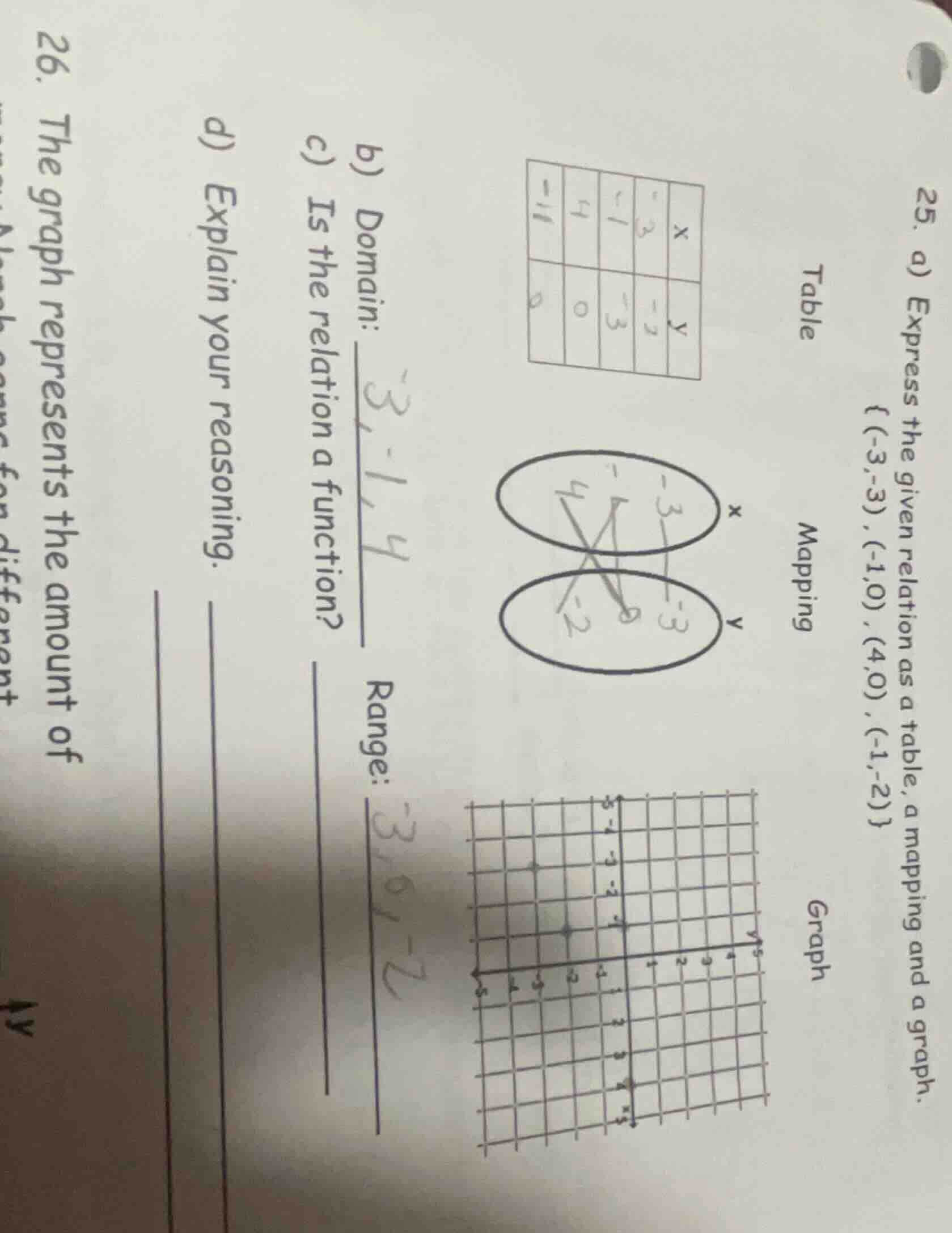
- a) express the given relation as a table, a mapping and a graph. {(-3,-3), (-1,0), (4,0), (-1,-2)}
table
mapping
graph
b) domain:
range:
c) is the relation a function?
d) explain your reasoning.
- the graph represents the amount of
Part a) Table
To create the table, we list the \( x \)-values (first elements of the ordered pairs) in one column and the corresponding \( y \)-values (second elements) in another column. The ordered pairs are \((-3, -3)\), \((-1, 0)\), \((4, 0)\), \((-1, -2)\).
| \( x \) | \( y \) |
|---|---|
| \(-1\) | \( 0 \) |
| \( 4 \) | \( 0 \) |
| \(-1\) | \(-2\) |
Part b) Mapping
For the mapping, we have two ovals: one for the domain (set of \( x \)-values) and one for the range (set of \( y \)-values). We draw arrows from each \( x \)-value to its corresponding \( y \)-value(s).
- Domain ( \( x \)-values): \(\{-3, -1, 4\}\)
- Range ( \( y \)-values): \(\{-3, 0, -2\}\)
Mapping:
- \(-3\) maps to \(-3\)
- \(-1\) maps to \( 0 \) and \(-2\)
- \( 4 \) maps to \( 0 \)
Part c) Graph
To plot the graph, we use a coordinate plane. The \( x \)-axis is horizontal and the \( y \)-axis is vertical. We plot each ordered pair as a point:
- For \((-3, -3)\): Move 3 units left on the \( x \)-axis and 3 units down on the \( y \)-axis.
- For \((-1, 0)\): Move 1 unit left on the \( x \)-axis and stay on the \( x \)-axis (since \( y = 0 \)).
- For \((4, 0)\): Move 4 units right on the \( x \)-axis and stay on the \( x \)-axis.
- For \((-1, -2)\): Move 1 unit left on the \( x \)-axis and 2 units down on the \( y \)-axis.
Part b) Domain and Range
- Domain: The domain is the set of all \( x \)-values from the ordered pairs. The \( x \)-values are \(-3\), \(-1\), \( 4 \), \(-1\). Removing duplicates, the domain is \(\{-3, -1, 4\}\).
- Range: The range is the set of all \( y \)-values from the ordered pairs. The \( y \)-values are \(-3\), \( 0 \), \( 0 \), \(-2\). Removing duplicates, the range is \(\{-3, 0, -2\}\).
Part c) Is the relation a function?
A relation is a function if each input ( \( x \)-value) has exactly one output ( \( y \)-value). Here, the \( x \)-value \(-1\) is paired with two different \( y \)-values: \( 0 \) and \(-2\). So, the relation is not a function.
Part d) Explanation for part c)
A function requires that every element in the domain (each \( x \)-value) is associated with exactly one element in the range (one \( y \)-value). In this relation, the \( x \)-value \(-1\) is mapped to two different \( y \)-values (\( 0 \) and \(-2\)). This violates the definition of a function, so the relation is not a function.
Final Answers
- a) Table: As shown above.
- b) Domain: \(\boldsymbol{\{-3, -1, 4\}}\), Range: \(\boldsymbol{\{-3, 0, -2\}}\)
- c) The relation is \(\boldsymbol{\text{not a function}}\).
- d) Explanation: The \( x \)-value \(-1\) has two \( y \)-values, violating the function definition.

Snap & solve any problem in the app
Get step-by-step solutions on Sovi AI
Photo-based solutions with guided steps
Explore more problems and detailed explanations
Part a) Table
To create the table, we list the \( x \)-values (first elements of the ordered pairs) in one column and the corresponding \( y \)-values (second elements) in another column. The ordered pairs are \((-3, -3)\), \((-1, 0)\), \((4, 0)\), \((-1, -2)\).
| \( x \) | \( y \) |
|---|---|
| \(-1\) | \( 0 \) |
| \( 4 \) | \( 0 \) |
| \(-1\) | \(-2\) |
Part b) Mapping
For the mapping, we have two ovals: one for the domain (set of \( x \)-values) and one for the range (set of \( y \)-values). We draw arrows from each \( x \)-value to its corresponding \( y \)-value(s).
- Domain ( \( x \)-values): \(\{-3, -1, 4\}\)
- Range ( \( y \)-values): \(\{-3, 0, -2\}\)
Mapping:
- \(-3\) maps to \(-3\)
- \(-1\) maps to \( 0 \) and \(-2\)
- \( 4 \) maps to \( 0 \)
Part c) Graph
To plot the graph, we use a coordinate plane. The \( x \)-axis is horizontal and the \( y \)-axis is vertical. We plot each ordered pair as a point:
- For \((-3, -3)\): Move 3 units left on the \( x \)-axis and 3 units down on the \( y \)-axis.
- For \((-1, 0)\): Move 1 unit left on the \( x \)-axis and stay on the \( x \)-axis (since \( y = 0 \)).
- For \((4, 0)\): Move 4 units right on the \( x \)-axis and stay on the \( x \)-axis.
- For \((-1, -2)\): Move 1 unit left on the \( x \)-axis and 2 units down on the \( y \)-axis.
Part b) Domain and Range
- Domain: The domain is the set of all \( x \)-values from the ordered pairs. The \( x \)-values are \(-3\), \(-1\), \( 4 \), \(-1\). Removing duplicates, the domain is \(\{-3, -1, 4\}\).
- Range: The range is the set of all \( y \)-values from the ordered pairs. The \( y \)-values are \(-3\), \( 0 \), \( 0 \), \(-2\). Removing duplicates, the range is \(\{-3, 0, -2\}\).
Part c) Is the relation a function?
A relation is a function if each input ( \( x \)-value) has exactly one output ( \( y \)-value). Here, the \( x \)-value \(-1\) is paired with two different \( y \)-values: \( 0 \) and \(-2\). So, the relation is not a function.
Part d) Explanation for part c)
A function requires that every element in the domain (each \( x \)-value) is associated with exactly one element in the range (one \( y \)-value). In this relation, the \( x \)-value \(-1\) is mapped to two different \( y \)-values (\( 0 \) and \(-2\)). This violates the definition of a function, so the relation is not a function.
Final Answers
- a) Table: As shown above.
- b) Domain: \(\boldsymbol{\{-3, -1, 4\}}\), Range: \(\boldsymbol{\{-3, 0, -2\}}\)
- c) The relation is \(\boldsymbol{\text{not a function}}\).
- d) Explanation: The \( x \)-value \(-1\) has two \( y \)-values, violating the function definition.