QUESTION IMAGE
Question
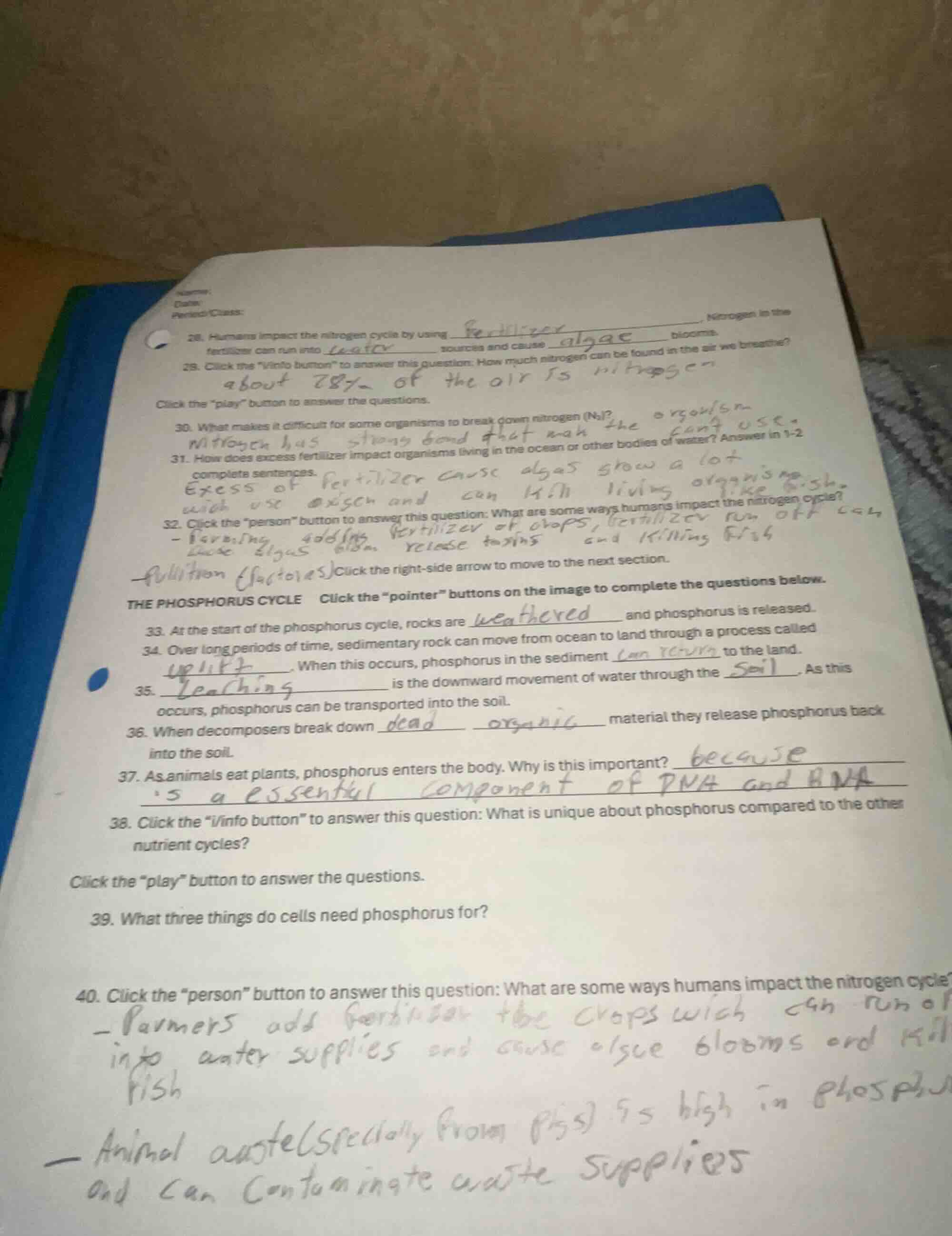
- humans impact the nitrogen cycle by using __, nitrogen in the fertilizer can run into sources and cause blooms. 29. click the \info button\ to answer this question: how much nitrogen can be found in the air we breathe? click the \play\ button to answer the questions. 30. what makes it difficult for some organisms to break down nitrogen (n₂)? 31. how does excess fertilizer impact organisms living in the ocean or other bodies of water? answer in 1 - 2 complete sentences. 32. click the \person\ button to answer this question: what are some ways humans impact the nitrogen cycle? the phosphorus cycle click the \pointer\ buttons on the image to complete the questions below. 33. at the start of the phosphorus cycle, rocks are and phosphorus is released. 34. over long periods of time, sedimentary rock can move from ocean to land through a process called . when this occurs, phosphorus in the sediment to the land. 35. is the downward movement of water through the . as this occurs, phosphorus can be transported into the soil. 36. when decomposers break down material they release phosphorus back into the soil. 37. as animals eat plants, phosphorus enters the body. why is this important? __ 38. click the \info button\ to answer this question: what is unique about phosphorus compared to the other nutrient cycles? click the \play\ button to answer the questions. 39. what three things do cells need phosphorus for? 40. click the \person\ button to answer this question: what are some ways humans impact the nitrogen cycle
Response
To answer these questions, we analyze each one based on ecological and biogeochemical cycle concepts:
Question 28
- Explanation: Humans use fertilizer (rich in nitrogen) which runs into water sources, causing algae blooms.
- Answer: fertilizer; water; algae
Question 29
- Explanation: Earth’s atmosphere is ~78% nitrogen gas ($\ce{N2}$).
- Answer: About 78% of the air we breathe is nitrogen.
Question 30
- Explanation: $\ce{N2}$ has a strong triple bond, making it hard for most organisms to break down (only certain bacteria can fix it).
- Answer: Nitrogen gas ($\ce{N2}$) has a strong triple bond that most organisms cannot break.
Question 31
- Explanation: Excess fertilizer runoff causes eutrophication: algae blooms grow rapidly, deplete oxygen, and harm aquatic life.
- Answer: Excess fertilizer runoff causes algae blooms, which deplete oxygen and kill aquatic organisms.
Question 32
- Explanation: Human impacts on the nitrogen cycle include fertilizer use (runoff), burning fossil fuels (releases nitrogen oxides), and deforestation (disrupts natural cycles).
- Answer: Examples: using fertilizer (runoff causes eutrophication), burning fossil fuels (releases nitrogen oxides), and deforestation.
Question 33
- Explanation: The phosphorus cycle starts with weathering of rocks (physical/chemical breakdown) to release phosphorus.
- Answer: weathered
Question 34
- Explanation: Sedimentary rock moves from ocean to land via uplift (geological process). Phosphorus in sediment can return to land.
- Answer: uplift; can return
Question 35
- Explanation: Leaching is water moving downward through soil, transporting phosphorus.
- Answer: Leaching; soil
Question 36
- Explanation: Decomposers break down dead organic material, releasing phosphorus back into the soil.
- Answer: dead; organic
Question 37
- Explanation: Phosphorus is essential for DNA, RNA, and ATP (energy), so animals need it for growth and metabolism.
- Answer: Phosphorus is essential for DNA, RNA, and ATP (energy), so it supports growth and metabolism.
Question 38
- Explanation: The phosphorus cycle does not involve the atmosphere (unlike nitrogen/carbon cycles); it cycles through rocks, water, soil, and organisms.
- Answer: The phosphorus cycle does not include a gaseous phase (no atmospheric component).
Question 39
- Explanation: Cells need phosphorus for DNA/RNA (genetic material), ATP (energy), and cell membranes (phospholipids).
- Answer: Cells need phosphorus for DNA, RNA, and cell membranes (or ATP).
Question 40
- Explanation: Human impacts on the nitrogen cycle: fertilizer use (runoff), burning fossil fuels, and animal waste (high in nitrogen/phosphorus).
- Answer: Examples: farmers use fertilizer (runoff causes eutrophication), burning fossil fuels (releases nitrogen oxides), and animal waste (contaminates water).
(Note: For questions requiring “click” actions, the written answers reflect the conceptual understanding needed.)

Snap & solve any problem in the app
Get step-by-step solutions on Sovi AI
Photo-based solutions with guided steps
Explore more problems and detailed explanations
To answer these questions, we analyze each one based on ecological and biogeochemical cycle concepts:
Question 28
- Explanation: Humans use fertilizer (rich in nitrogen) which runs into water sources, causing algae blooms.
- Answer: fertilizer; water; algae
Question 29
- Explanation: Earth’s atmosphere is ~78% nitrogen gas ($\ce{N2}$).
- Answer: About 78% of the air we breathe is nitrogen.
Question 30
- Explanation: $\ce{N2}$ has a strong triple bond, making it hard for most organisms to break down (only certain bacteria can fix it).
- Answer: Nitrogen gas ($\ce{N2}$) has a strong triple bond that most organisms cannot break.
Question 31
- Explanation: Excess fertilizer runoff causes eutrophication: algae blooms grow rapidly, deplete oxygen, and harm aquatic life.
- Answer: Excess fertilizer runoff causes algae blooms, which deplete oxygen and kill aquatic organisms.
Question 32
- Explanation: Human impacts on the nitrogen cycle include fertilizer use (runoff), burning fossil fuels (releases nitrogen oxides), and deforestation (disrupts natural cycles).
- Answer: Examples: using fertilizer (runoff causes eutrophication), burning fossil fuels (releases nitrogen oxides), and deforestation.
Question 33
- Explanation: The phosphorus cycle starts with weathering of rocks (physical/chemical breakdown) to release phosphorus.
- Answer: weathered
Question 34
- Explanation: Sedimentary rock moves from ocean to land via uplift (geological process). Phosphorus in sediment can return to land.
- Answer: uplift; can return
Question 35
- Explanation: Leaching is water moving downward through soil, transporting phosphorus.
- Answer: Leaching; soil
Question 36
- Explanation: Decomposers break down dead organic material, releasing phosphorus back into the soil.
- Answer: dead; organic
Question 37
- Explanation: Phosphorus is essential for DNA, RNA, and ATP (energy), so animals need it for growth and metabolism.
- Answer: Phosphorus is essential for DNA, RNA, and ATP (energy), so it supports growth and metabolism.
Question 38
- Explanation: The phosphorus cycle does not involve the atmosphere (unlike nitrogen/carbon cycles); it cycles through rocks, water, soil, and organisms.
- Answer: The phosphorus cycle does not include a gaseous phase (no atmospheric component).
Question 39
- Explanation: Cells need phosphorus for DNA/RNA (genetic material), ATP (energy), and cell membranes (phospholipids).
- Answer: Cells need phosphorus for DNA, RNA, and cell membranes (or ATP).
Question 40
- Explanation: Human impacts on the nitrogen cycle: fertilizer use (runoff), burning fossil fuels, and animal waste (high in nitrogen/phosphorus).
- Answer: Examples: farmers use fertilizer (runoff causes eutrophication), burning fossil fuels (releases nitrogen oxides), and animal waste (contaminates water).
(Note: For questions requiring “click” actions, the written answers reflect the conceptual understanding needed.)