QUESTION IMAGE
Question
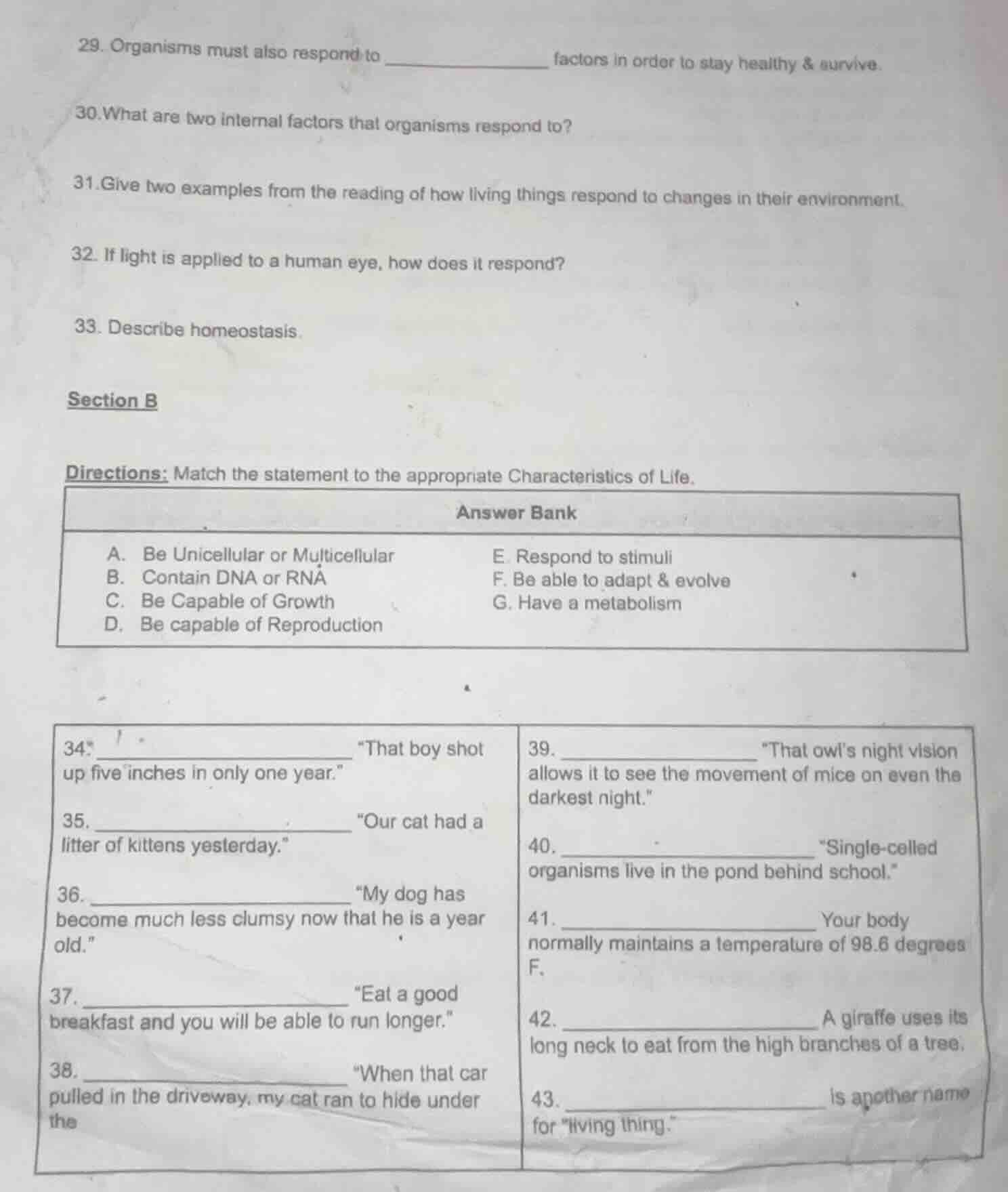
- organisms must also respond to ____________ factors in order to stay healthy & survive.
- what are two internal factors that organisms respond to?
- give two examples from the reading of how living things respond to changes in their environment.
- if light is applied to a human eye, how does it respond?
- describe homeostasis.
section b
directions: match the statement to the appropriate characteristics of life.
answer bank
a. be unicellular or multicellular e. respond to stimuli
b. contain dna or rna f. be able to adapt & evolve
c. be capable of growth g. have a metabolism
d. be capable of reproduction
- ________________ “that boy shot up five inches in only one year.”
- ________________ “our cat had a litter of kittens yesterday.”
- ________________ “my dog has become much less clumsy now that he is a year old.”
- ________________ “eat a good breakfast and you will be able to run longer.”
- ________________ “when that car pulled in the driveway, my cat ran to hide under the
- ________________ “that owl’s night vision allows it to see the movement of mice on even the darkest night.”
- ________________ “single - celled organisms live in the pond behind school.”
- ________________ your body normally maintains a temperature of 98.6 degrees f.
- ________________ a giraffe uses its long neck to eat from the high branches of a tree.
- ________________ is another name for \living thing\.
Question 29
Organisms need to respond to environmental factors (both internal and external) to maintain health and survive. The blank likely refers to "environmental" (including internal and external, but in the context of the following questions about internal factors, this is about the general factors organisms respond to, with environmental being a broad term covering both internal and external, but more precisely, internal and external factors, but the question is asking for the type of factors, so "environmental" or "stimuli - related" but more accurately, organisms respond to both internal and external factors, but the blank here is likely for "environmental" or "internal and external", but given the next question about internal factors, this is about the factors (stimuli) organisms respond to, so the answer is "environmental" (or "internal and external", but more precisely, the term is "environmental" or "stimuli - related", but in the context of biology, organisms respond to environmental (including internal and external) factors.
Internal factors that organisms respond to are factors within the organism's body. Examples include changes in hormone levels (e.g., insulin levels regulating blood sugar) and changes in cellular conditions (e.g., the concentration of nutrients or waste products within cells). Another example is the body's internal temperature (though temperature can also be regulated, but the response to internal temperature changes, or the level of carbon dioxide in the blood (which triggers changes in breathing rate).
Since the reading is not provided, we can give general examples of how living things respond to environmental changes. For example, plants bend towards light (phototropism) - this is a response to the environmental factor of light. Another example is a dog panting when it is hot - a response to the environmental factor of high temperature. Or a plant closing its stomata when water is scarce - a response to the environmental factor of water availability.

Snap & solve any problem in the app
Get step-by-step solutions on Sovi AI
Photo-based solutions with guided steps
Explore more problems and detailed explanations
environmental (or stimuli - related, but the standard answer is "environmental" or more precisely, "internal and external" but in the context of the question, the answer is "environmental" or "stimuli" - related, but the most appropriate is "environmental" or "internal and external", but the correct term here is "environmental" (as organisms respond to environmental factors which include internal and external).