QUESTION IMAGE
Question
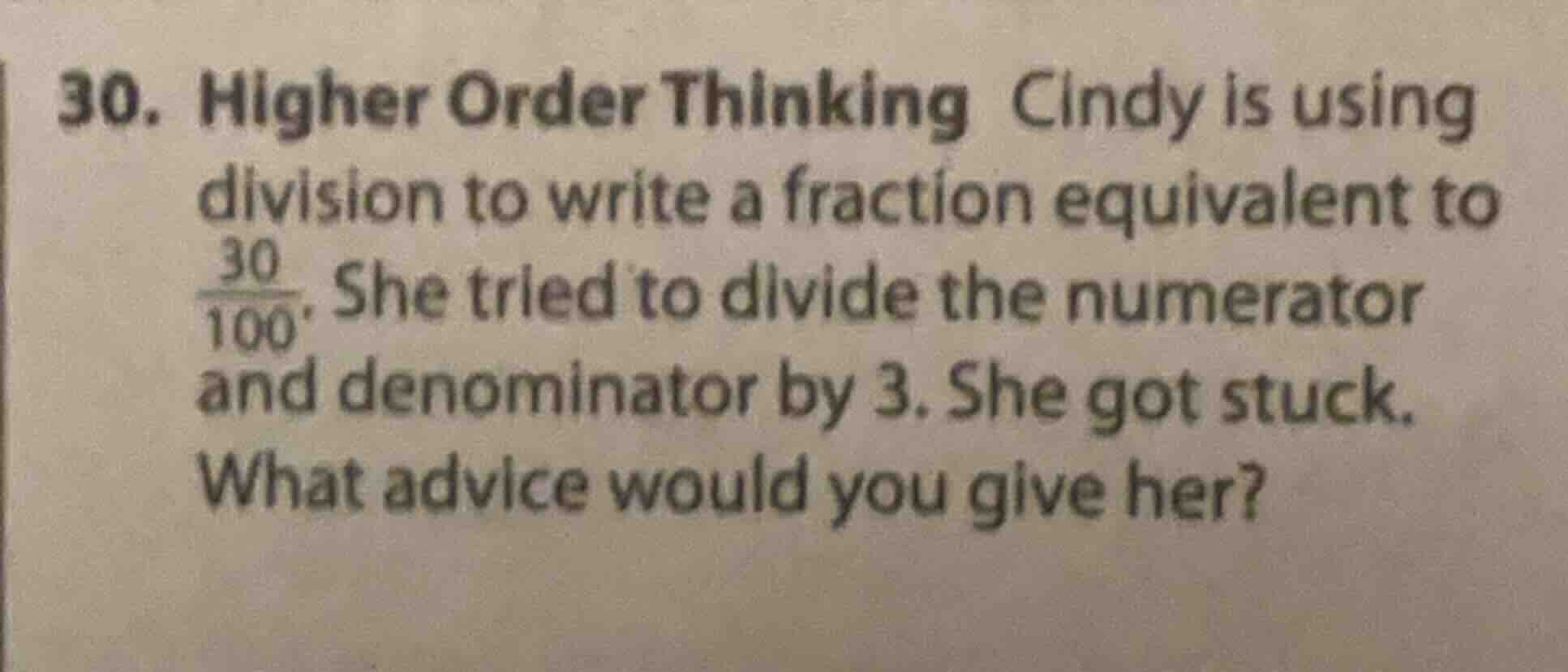
- higher order thinking cindy is using division to write a fraction equivalent to \\(\frac{30}{100}\\). she tried to divide the numerator and denominator by 3. she got stuck. what advice would you give her?
Step1: Check divisibility by 3
To determine if a number is divisible by 3, we can use the rule that the sum of its digits should be divisible by 3. For the numerator 30: \(3 + 0 = 3\), which is divisible by 3. For the denominator 100: \(1 + 0 + 0 = 1\), which is not divisible by 3. So, 100 is not divisible by 3, which is why Cindy got stuck.
Step2: Find a common divisor
We need to find a number that divides both 30 and 100. Let's list the factors of 30: 1, 2, 3, 5, 6, 10, 15, 30. And the factors of 100: 1, 2, 4, 5, 10, 20, 25, 50, 100. The common factors (other than 1) are 2, 5, 10. Let's choose 10.
Step3: Divide by the common divisor
Divide both the numerator and the denominator by 10. So, \(\frac{30\div10}{100\div10}=\frac{3}{10}\).

Snap & solve any problem in the app
Get step-by-step solutions on Sovi AI
Photo-based solutions with guided steps
Explore more problems and detailed explanations
Cindy should find a number that divides both 30 and 100 (a common divisor). Since 100 is not divisible by 3, she can use a different common divisor like 10. Dividing both 30 and 100 by 10 gives \(\frac{3}{10}\), which is an equivalent fraction to \(\frac{30}{100}\).