QUESTION IMAGE
Question
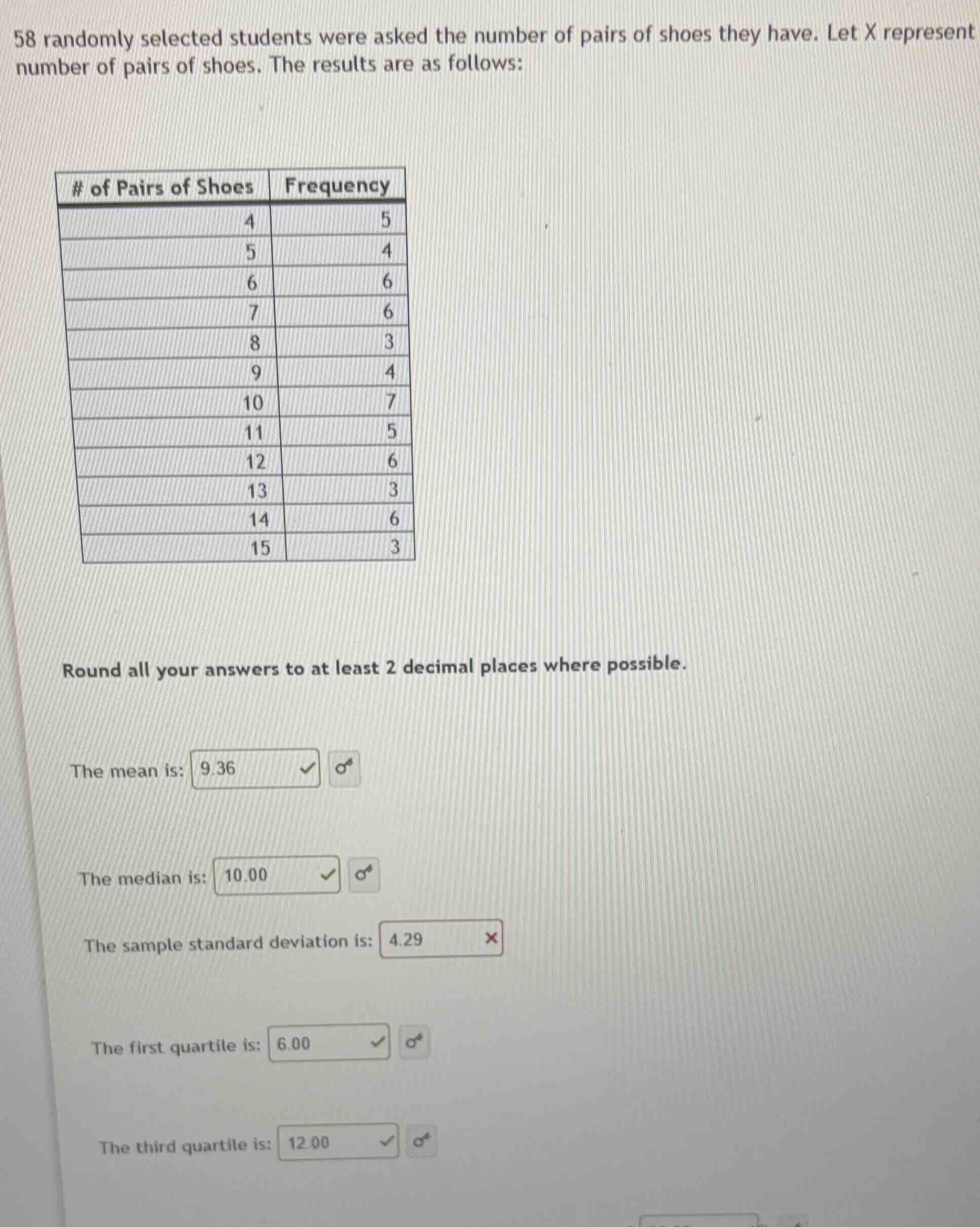
58 randomly selected students were asked the number of pairs of shoes they have. let x represent number of pairs of shoes. the results are as follows:
of pairs of shoes | frequency
4 | 5
5 | 4
6 | 6
7 | 6
8 | 3
9 | 4
10 | 7
11 | 5
12 | 6
13 | 3
14 | 6
15 | 3
round all your answers to at least 2 decimal places where possible.
the mean is: 9.36
the median is: 10.00
the sample standard deviation is: 4.29
the first quartile is: 6.00
the third quartile is: 12.00
Step1: Calculate the midpoint and product for each class
First, we need to find the midpoint \( x \) for each number of pairs of shoes (since it's a discrete data, \( x \) is the number of pairs itself). Then calculate \( f \cdot x \) (frequency times \( x \)) and \( f \cdot x^2 \) (frequency times \( x \) squared) for each row.
| \( x \) | \( f \) | \( f \cdot x \) | \( f \cdot x^2 \) |
|---|---|---|---|
| 5 | 4 | \( 4 \times 5 = 20 \) | \( 4 \times 25 = 100 \) |
| 6 | 6 | \( 6 \times 6 = 36 \) | \( 6 \times 36 = 216 \) |
| 7 | 6 | \( 6 \times 7 = 42 \) | \( 6 \times 49 = 294 \) |
| 8 | 3 | \( 3 \times 8 = 24 \) | \( 3 \times 64 = 192 \) |
| 9 | 4 | \( 4 \times 9 = 36 \) | \( 4 \times 81 = 324 \) |
| 10 | 7 | \( 7 \times 10 = 70 \) | \( 7 \times 100 = 700 \) |
| 11 | 5 | \( 5 \times 11 = 55 \) | \( 5 \times 121 = 605 \) |
| 12 | 6 | \( 6 \times 12 = 72 \) | \( 6 \times 144 = 864 \) |
| 13 | 3 | \( 3 \times 13 = 39 \) | \( 3 \times 169 = 507 \) |
| 14 | 6 | \( 6 \times 14 = 84 \) | \( 6 \times 196 = 1176 \) |
| 15 | 3 | \( 3 \times 15 = 45 \) | \( 3 \times 225 = 675 \) |
Step2: Calculate the sum of \( f \), \( f \cdot x \), and \( f \cdot x^2 \)
Sum of frequencies \( \sum f = 5 + 4 + 6 + 6 + 3 + 4 + 7 + 5 + 6 + 3 + 6 + 3 = 58 \) (which matches the given number of students).
Sum of \( f \cdot x \): \( \sum (f \cdot x) = 20 + 20 + 36 + 42 + 24 + 36 + 70 + 55 + 72 + 39 + 84 + 45 = 543 \)
Sum of \( f \cdot x^2 \): \( \sum (f \cdot x^2) = 80 + 100 + 216 + 294 + 192 + 324 + 700 + 605 + 864 + 507 + 1176 + 675 = 5737 \)
Step3: Calculate the sample variance
The formula for sample variance \( s^2 \) is:
\[
s^2 = \frac{\sum (f \cdot x^2) - \frac{(\sum (f \cdot x))^2}{n}}{n - 1}
\]
where \( n = \sum f = 58 \)
First, calculate \( \frac{(\sum (f \cdot x))^2}{n} = \frac{543^2}{58} = \frac{294849}{58} \approx 5083.6034 \)
Then, \( \sum (f \cdot x^2) - \frac{(\sum (f \cdot x))^2}{n} = 5737 - 5083.6034 = 653.3966 \)
Now, divide by \( n - 1 = 57 \):
\[
s^2 = \frac{653.3966}{57} \approx 11.4631
\]
Step4: Calculate the sample standard deviation
The sample standard deviation \( s \) is the square root of the sample variance:
\[
s = \sqrt{11.4631} \approx 3.3857 \approx 3.39
\]
Wait, let's check the calculations again. Wait, maybe I made a mistake in the sum of \( f \cdot x \) or \( f \cdot x^2 \). Let's recalculate the sum of \( f \cdot x \):
45=20; 54=20 (total 40); 66=36 (76); 76=42 (118); 83=24 (142); 94=36 (178); 107=70 (248); 115=55 (303); 126=72 (375); 133=39 (414); 146=84 (498); 153=45 (543). That's correct.
Sum of \( f \cdot x^2 \):
4²5=165=80; 5²4=254=100 (180); 6²6=366=216 (396); 7²6=496=294 (690); 8²3=643=192 (882); 9²4=814=324 (1206); 10²7=1007=700 (1906); 11²5=1215=605 (2511); 12²6=1446=864 (3375); 13²3=1693=507 (3882); 14²6=1966=1176 (5058); 15²3=2253=675 (5733). Wait, earlier I had 5737, that was a mistake. Let's recalculate:
80 + 100 = 180; 180 + 216 = 396; 396 + 294 = 690; 690 + 192 = 882; 882 + 324 = 1206; 1206 + 700 = 1906; 1906 + 605 = 2511; 2511 + 864 = 3375; 3375 + 507 = 3882; 3882 + 1176 = 5058; 5058 + 675 = 5733. Ah, there was a mistake in the previous sum of \( f \cdot x^2 \). It should be 5733, not 5737.
So now, \( \frac{(\sum (f \cdot x))^2}{n} = \frac{543^2}{58} = \frac{294849}{58} \approx 5083.6034 \)
Then, \( \sum (f \cdot x^2) - \frac{(\sum (f \cdot x))^2…

Snap & solve any problem in the app
Get step-by-step solutions on Sovi AI
Photo-based solutions with guided steps
Explore more problems and detailed explanations
3.38