QUESTION IMAGE
Question
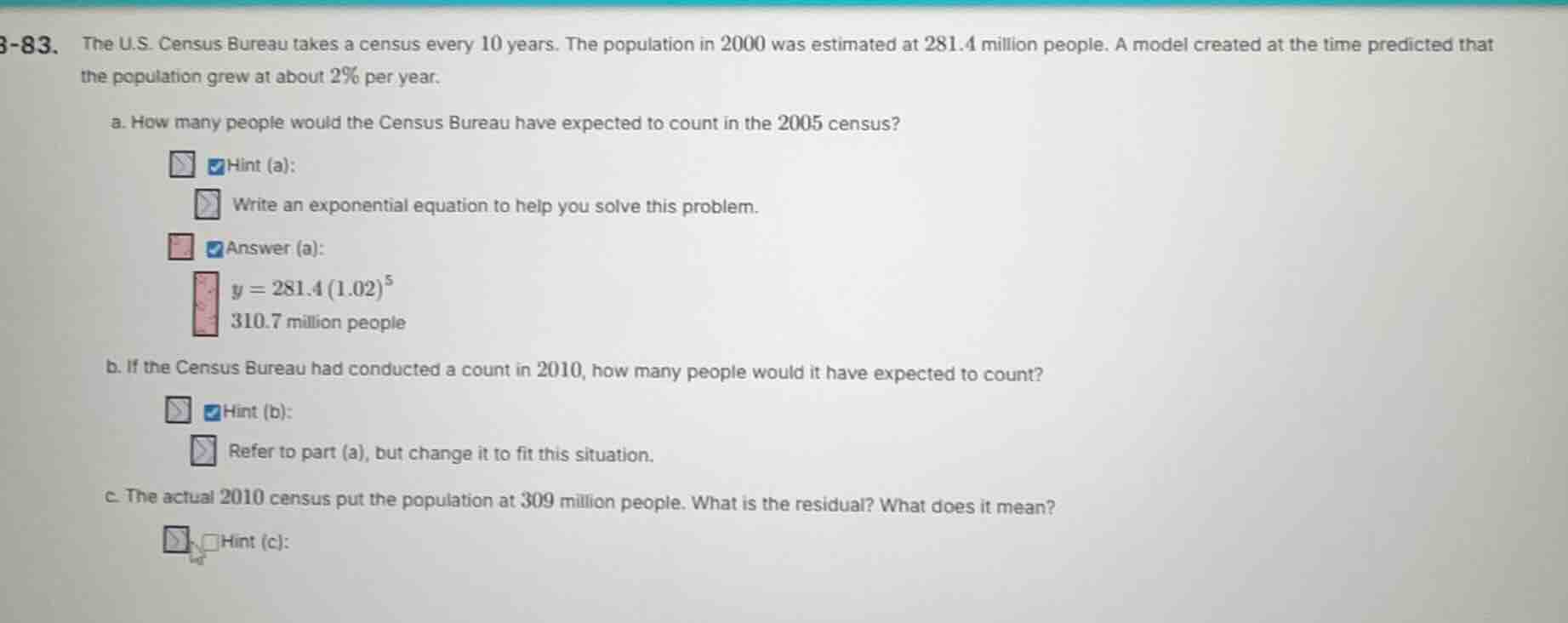
8 - 83. the u.s. census bureau takes a census every 10 years. the population in 2000 was estimated at 281.4 million people. a model created at the time predicted that the population grew at about 2% per year.
a. how many people would the census bureau have expected to count in the 2005 census?
hint (a):
write an exponential equation to help you solve this problem.
answer (a):
$y = 281.4(1.02)^5$
310.7 million people
b. if the census bureau had conducted a count in 2010, how many people would it have expected to count?
hint (b):
refer to part (a), but change it to fit this situation.
c. the actual 2010 census put the population at 309 million people. what is the residual? what does it mean?
hint (c):
Part (b)
Step 1: Identify the formula
The exponential growth formula is \( y = a(1 + r)^t \), where \( a \) is the initial amount, \( r \) is the growth rate, and \( t \) is the time in years. Here, \( a = 281.4 \) million, \( r = 0.02 \) (2% growth rate), and the time from 2000 to 2010 is \( t = 10 \) years.
Step 2: Substitute values into the formula
Substitute \( a = 281.4 \), \( r = 0.02 \), and \( t = 10 \) into the formula: \( y = 281.4(1 + 0.02)^{10}=281.4(1.02)^{10} \)
Step 3: Calculate the value
First, calculate \( (1.02)^{10}\approx1.2190 \). Then, multiply by 281.4: \( y = 281.4\times1.2190\approx343.0 \) (million people)
Step 1: Recall the formula for residual
The residual is calculated as \( \text{Residual}=\text{Actual value}-\text{Predicted value} \)
Step 2: Identify actual and predicted values
From part (b), the predicted value (for 2010) is approximately \( 343.0 \) million (wait, no, wait, there is a mistake above. Wait, in part (a), time from 2000 to 2005 is 5 years, for 2010 it's 10 years. Wait, let's recalculate part (b) correctly. Wait, \( (1.02)^{10} \):
Calculate \( 1.02^{10} \):
\( 1.02^1 = 1.02 \)
\( 1.02^2=1.02\times1.02 = 1.0404 \)
\( 1.02^3=1.0404\times1.02 = 1.061208 \)
\( 1.02^4=1.061208\times1.02 = 1.08243216 \)
\( 1.02^5=1.08243216\times1.02 = 1.104080803 \) (which matches the part (a) calculation where \( 281.4\times1.104080803\approx310.7 \))
\( 1.02^6=1.104080803\times1.02 = 1.126162419 \)
\( 1.02^7=1.126162419\times1.02 = 1.148685667 \)
\( 1.02^8=1.148685667\times1.02 = 1.171659380 \)
\( 1.02^9=1.171659380\times1.02 = 1.195092568 \)
\( 1.02^{10}=1.195092568\times1.02 = 1.218994419 \)
Now, \( 281.4\times1.218994419\approx281.4\times1.219\approx281.4\times1.2 + 281.4\times0.019 = 337.68+5.3466 = 343.0266\approx343.0 \) million (predicted value for 2010)
The actual value is 309 million.
Step 3: Calculate the residual
Residual \( = \text{Actual}-\text{Predicted}=309 - 343.0=- 34.0 \) (million people)
The negative residual means that the actual population was 34.0 million less than the predicted population by the model.

Snap & solve any problem in the app
Get step-by-step solutions on Sovi AI
Photo-based solutions with guided steps
Explore more problems and detailed explanations
The expected population in 2010 is approximately \( 343.0 \) million people (using the formula \( y = 281.4(1.02)^{10} \))