QUESTION IMAGE
Question
activity #4: understanding lactase gene regulation
directions: read and annotate the text, using the following annotations. when you are finished reading, answer the questions.
highlight vocabulary words
underline definitions
circle words that you don’t know
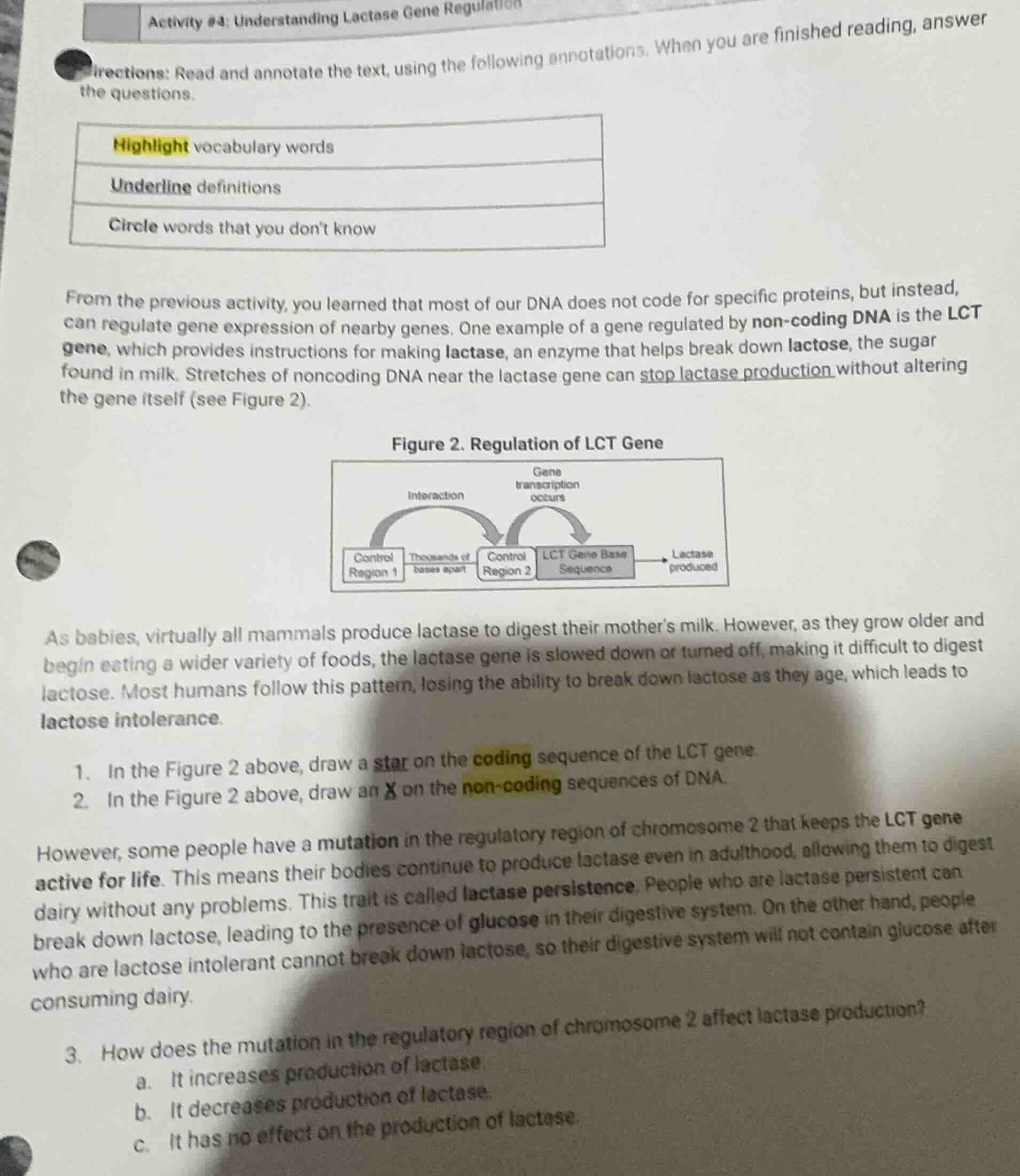
from the previous activity, you learned that most of our dna does not code for specific proteins, but instead, can regulate gene expression of nearby genes. one example of a gene regulated by non - coding dna is the lct gene, which provides instructions for making lactase, an enzyme that helps break down lactose, the sugar found in milk. stretches of noncoding dna near the lactase gene can stop lactase production without altering the gene itself (see figure 2).
figure 2. regulation of lct gene
image of the regulation of lct gene diagram
as babies, virtually all mammals produce lactase to digest their mother’s milk. however, as they grow older and begin eating a wider variety of foods, the lactase gene is slowed down or turned off, making it difficult to digest lactose. most humans follow this pattern, losing the ability to break down lactose as they age, which leads to lactose intolerance.
- in the figure 2 above, draw a star on the coding sequence of the lct gene.
- in the figure 2 above, draw an x on the non - coding sequences of dna.
however, some people have a mutation in the regulatory region of chromosome 2 that keeps the lct gene active for life. this means their bodies continue to produce lactase even in adulthood, allowing them to digest dairy without any problems. this trait is called lactase persistence. people who are lactase persistent can break down lactose, leading to the presence of glucose in their digestive system. on the other hand, people who are lactose intolerant cannot break down lactose, so their digestive system will not contain glucose after consuming dairy.
- how does the mutation in the regulatory region of chromosome 2 affect lactase production?
a. it increases production of lactase.
b. it decreases production of lactase.
c. it has no effect on the production of lactase.
- The coding sequence of the LCT gene is the segment that provides instructions for making lactase, which is labeled "LCT Gene Base Sequence" in Figure 2.
- Non-coding DNA sequences regulate gene expression without coding for proteins; in Figure 2, these are "Control Region 1" and "Control Region 2".
- The text states the mutation keeps the LCT gene active for life, so lactase production continues into adulthood (increased/ sustained compared to non-mutated individuals who lose lactase production with age).

Snap & solve any problem in the app
Get step-by-step solutions on Sovi AI
Photo-based solutions with guided steps
Explore more problems and detailed explanations
- Draw a star on the box labeled "LCT Gene Base Sequence" in Figure 2.
- Draw an X on the boxes labeled "Control Region 1" and "Control Region 2" in Figure 2.
- a. It increases production of lactase.