QUESTION IMAGE
Question
additional example #1
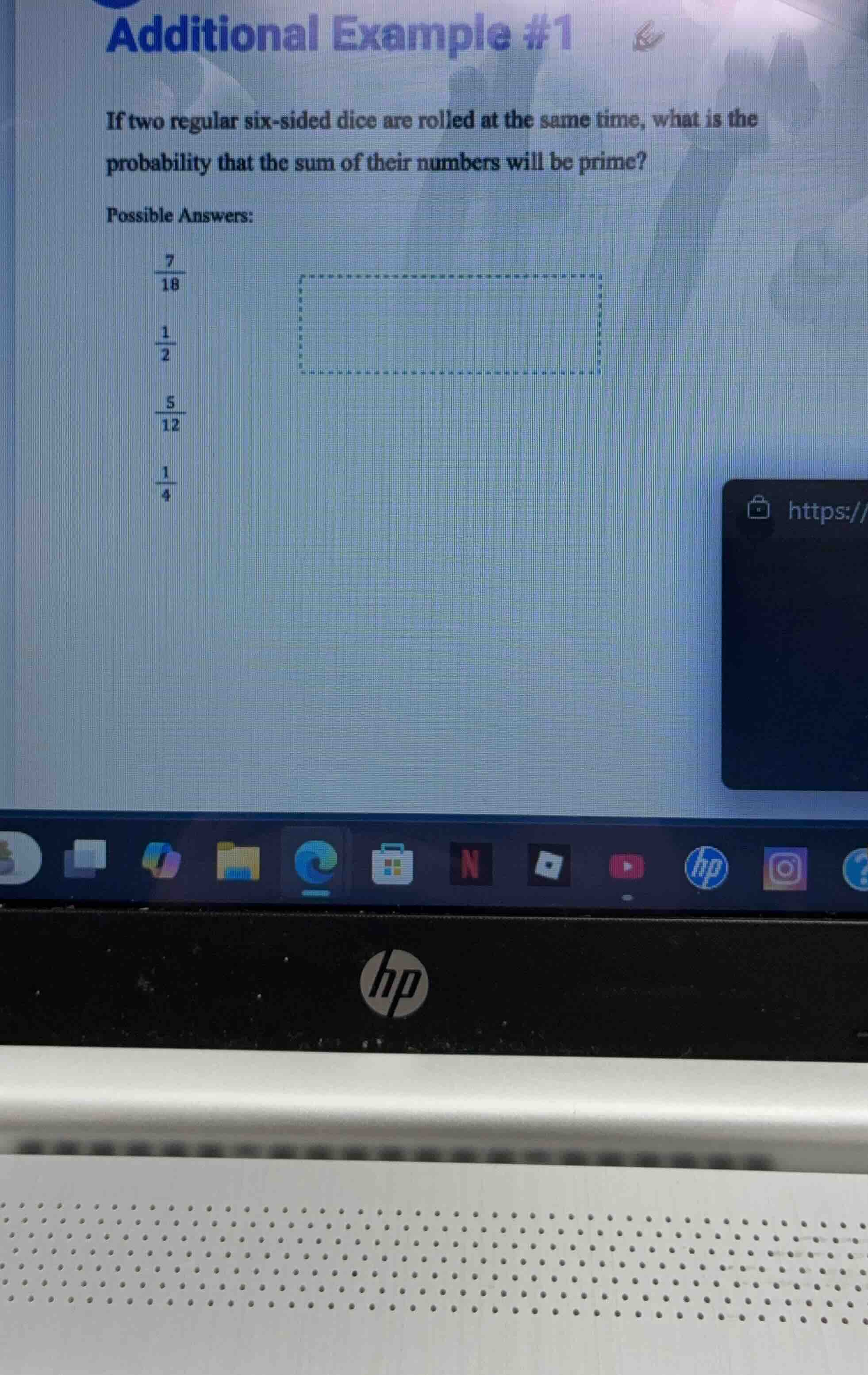
if two regular six - sided dice are rolled at the same time, what is the probability that the sum of their numbers will be prime?
possible answers:
\\(\frac{7}{18}\\)
\\(\frac{1}{2}\\)
\\(\frac{5}{12}\\)
\\(\frac{1}{4}\\)
Step1: Find total possible outcomes
When rolling two six - sided dice, each die has 6 possible outcomes. By the fundamental counting principle, the total number of possible outcomes when rolling two dice is $6\times6 = 36$.
Step2: Identify prime sums
The possible sums when rolling two dice range from $2(1 + 1)$ to $12(6+6)$. The prime numbers in this range are 2, 3, 5, 7, 11.
- For sum = 2: There is 1 way $(1,1)$.
- For sum = 3: There are 2 ways $(1,2),(2,1)$.
- For sum = 5: There are 4 ways $(1,4),(2,3),(3,2),(4,1)$.
- For sum = 7: There are 6 ways $(1,6),(2,5),(3,4),(4,3),(5,2),(6,1)$.
- For sum = 11: There are 2 ways $(5,6),(6,5)$.
Now, we calculate the total number of favorable outcomes by adding the number of ways for each prime sum: $1 + 2+4 + 6+2=15$.
Step3: Calculate probability
The probability $P$ of an event is given by the formula $P=\frac{\text{Number of favorable outcomes}}{\text{Total number of possible outcomes}}$. Substituting the values we found, we get $P = \frac{15}{36}=\frac{5}{12}$.

Snap & solve any problem in the app
Get step-by-step solutions on Sovi AI
Photo-based solutions with guided steps
Explore more problems and detailed explanations
$\frac{5}{12}$ (corresponding to the option with $\frac{5}{12}$)