QUESTION IMAGE
Question
after the revolutionary war, great britain banned american ships from trading at british ports in the west indies. some americans wanted the united states to take revenge by banning british ships from american ports.
but under the articles of confederation, each state was in charge of regulating its own trade with other states and countries. so, british ships still traded at american ports.
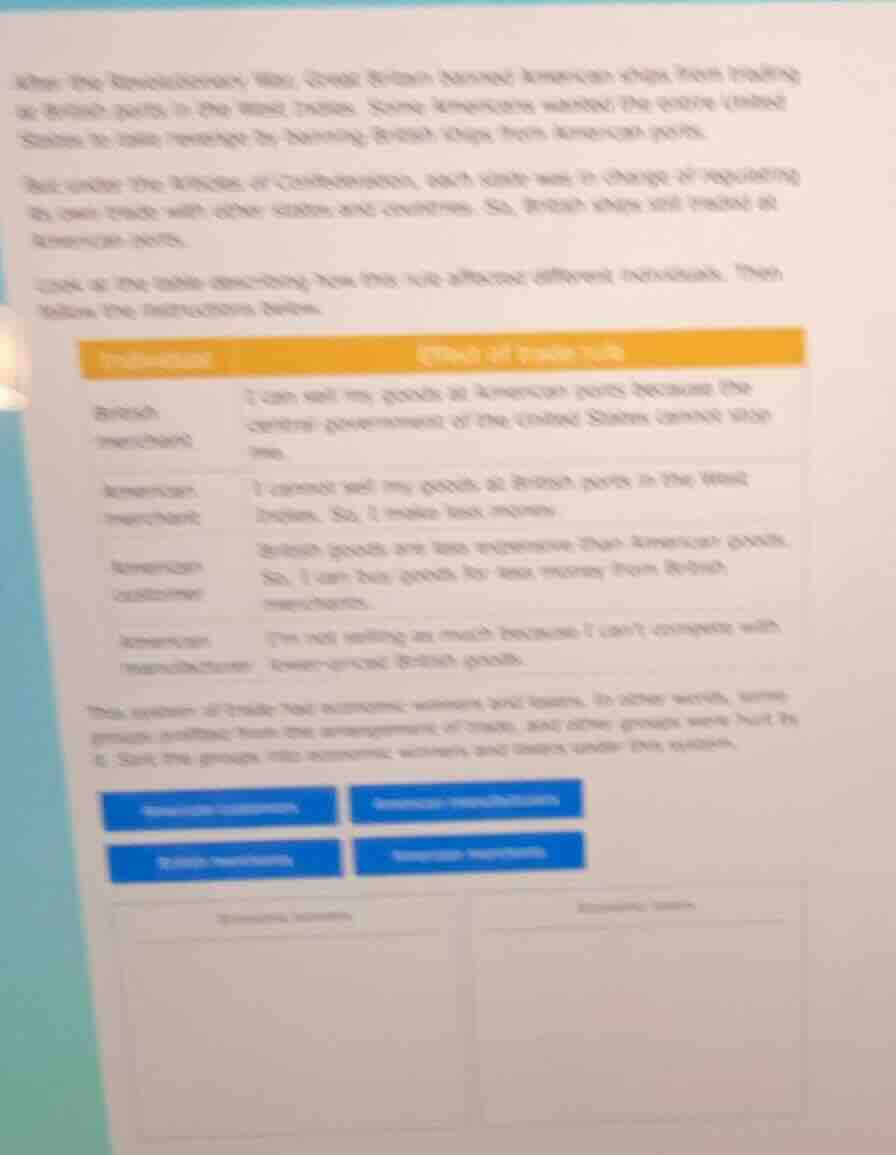
look at the table describing how the rule affected different individuals. then follow the instructions below.
(table with columns: individual, effect of trade rule. rows:
british merchant: i can sell my goods at american ports because the central government of the united states cannot stop me.
american merchant: i cannot sell my goods at british ports in the west indies. so, i make less income.
american customer: british goods are less expensive than american goods. so, i can buy goods for less money from british merchants.
american manufacturer: i’m not selling as much because i can’t compete with lower - priced british goods.)
this system of trade had economic winners and losers. in other words, some groups profited from the arrangement of trade, and other groups were hurt by it.
- sort the groups into economic winners and losers under this system.
(buttons: american customers, american manufacturers, british merchants, american merchants)
(economic winners and economic losers sections to fill)
- Economic winners: These groups benefit financially from the trade rule. British merchants can sell in US ports without restriction, and American customers get cheaper goods from British merchants.
- Economic losers: These groups face financial harm. American merchants can't sell in British West Indies ports, reducing their income, and American manufacturers can't compete with low-cost British goods, cutting their sales.

Snap & solve any problem in the app
Get step-by-step solutions on Sovi AI
Photo-based solutions with guided steps
Explore more problems and detailed explanations
Economic Winners:
British merchants, American customers
Economic Losers:
American merchants, American manufacturers