QUESTION IMAGE
Question
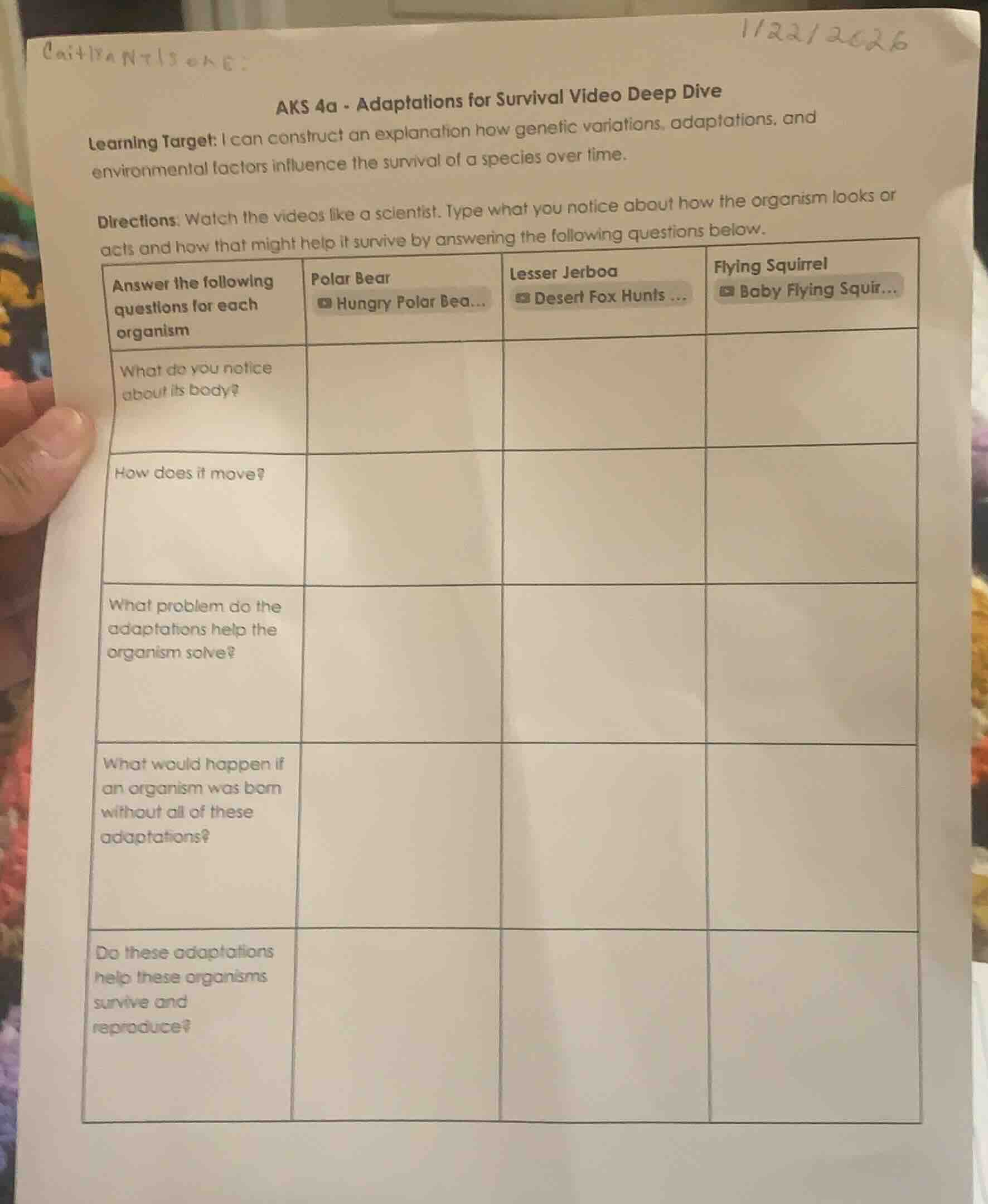
aks 4a - adaptations for survival video deep dive
learning target: i can construct an explanation how genetic variations, adaptations, and environmental factors influence the survival of a species over time.
directions: watch the videos like a scientist. type what you notice about how the organism looks or acts and how that might help it survive by answering the following questions below.
| answer the following questions for each organism | polar bear
hungry polar bea... | lesser jerboa
desert fox hunts... | flying squirrel
baby flying squir... |
| what do you notice about its body? | |||
| how does it move? | |||
| what problem do the adaptations help the organism solve? | |||
| what would happen if an organism was born without all of these adaptations? | |||
| do these adaptations help these organisms survive and reproduce? |
To solve this, we analyze each organism's adaptations:
Polar Bear
What do you notice about its body?
It has thick white fur, a large body, and a thick layer of blubber. The white fur helps it blend into the snowy Arctic environment, and the blubber and large body help it retain heat in the cold climate.
How does it move?
It walks on four legs, can swim in the water (using its large paws to paddle), and sometimes runs.
What problem do the adaptations help the organism solve?
The thick fur and blubber solve the problem of staying warm in the extremely cold Arctic temperatures. The white fur helps with camouflage while hunting seals (its primary prey) on the ice or in the snow. The large body and strength help it overpower prey and also retain heat.
What would happen if an organism was born without all of these adaptations?
If a polar bear was born without thick fur or blubber, it would not be able to stay warm in the Arctic cold and would likely freeze to death. Without white fur, it would be easily spotted by prey (like seals) or predators (though adult polar bears have few natural predators), making it hard to hunt. A smaller, weaker body would make it difficult to catch prey or defend itself.
Do these adaptations help these organisms survive and reproduce?
Yes. The adaptations for warmth (fur, blubber) allow it to survive in its cold habitat. The camouflage and strength help it hunt successfully, which provides the energy needed to grow, survive, and reproduce. Healthy, well - adapted polar bears are more likely to find mates and raise offspring.
Lesser Jerboa
What do you notice about its body?
It has long hind legs, a small body, large ears, and a long tail. The long hind legs are adapted for jumping, the large ears may help with thermoregulation in the desert (releasing heat) and hearing predators or prey, and the small body requires less water and energy.
How does it move?
It moves by hopping or jumping using its long hind legs, similar to a kangaroo. It can also use its front legs for small movements, but the primary mode is hopping.
What problem do the adaptations help the organism solve?
In the desert environment, water is scarce and temperatures are high. The small body size reduces water and energy requirements. The long hind legs allow it to move quickly over the sand to escape predators (like desert foxes) and to find food (seeds, insects). The large ears help it detect predators and also cool down by radiating heat.
What would happen if an organism was born without all of these adaptations?
If a lesser jerboa was born without long hind legs, it would be slow and unable to escape from predators in the open desert. Without large ears, it would have trouble detecting predators or prey, and might overheat more easily. A larger body would require more water and energy, which is difficult to obtain in the desert, leading to dehydration and starvation.
Do these adaptations help these organisms survive and reproduce?
Yes. The ability to jump quickly helps it avoid predators, increasing its chances of survival. The adaptations for water conservation (small body) and thermoregulation (large ears) allow it to live in the harsh desert environment. Surviving long enough to reach reproductive age, it can then find a mate and reproduce, passing on these beneficial adaptations.
Flying Squirrel
What do you notice about its body?
It has a membrane (patagium) stretching between its front and back legs, a bushy tail, and sharp claws. The patagium is the key adaptation for…

Snap & solve any problem in the app
Get step-by-step solutions on Sovi AI
Photo-based solutions with guided steps
Explore more problems and detailed explanations
To solve this, we analyze each organism's adaptations:
Polar Bear
What do you notice about its body?
It has thick white fur, a large body, and a thick layer of blubber. The white fur helps it blend into the snowy Arctic environment, and the blubber and large body help it retain heat in the cold climate.
How does it move?
It walks on four legs, can swim in the water (using its large paws to paddle), and sometimes runs.
What problem do the adaptations help the organism solve?
The thick fur and blubber solve the problem of staying warm in the extremely cold Arctic temperatures. The white fur helps with camouflage while hunting seals (its primary prey) on the ice or in the snow. The large body and strength help it overpower prey and also retain heat.
What would happen if an organism was born without all of these adaptations?
If a polar bear was born without thick fur or blubber, it would not be able to stay warm in the Arctic cold and would likely freeze to death. Without white fur, it would be easily spotted by prey (like seals) or predators (though adult polar bears have few natural predators), making it hard to hunt. A smaller, weaker body would make it difficult to catch prey or defend itself.
Do these adaptations help these organisms survive and reproduce?
Yes. The adaptations for warmth (fur, blubber) allow it to survive in its cold habitat. The camouflage and strength help it hunt successfully, which provides the energy needed to grow, survive, and reproduce. Healthy, well - adapted polar bears are more likely to find mates and raise offspring.
Lesser Jerboa
What do you notice about its body?
It has long hind legs, a small body, large ears, and a long tail. The long hind legs are adapted for jumping, the large ears may help with thermoregulation in the desert (releasing heat) and hearing predators or prey, and the small body requires less water and energy.
How does it move?
It moves by hopping or jumping using its long hind legs, similar to a kangaroo. It can also use its front legs for small movements, but the primary mode is hopping.
What problem do the adaptations help the organism solve?
In the desert environment, water is scarce and temperatures are high. The small body size reduces water and energy requirements. The long hind legs allow it to move quickly over the sand to escape predators (like desert foxes) and to find food (seeds, insects). The large ears help it detect predators and also cool down by radiating heat.
What would happen if an organism was born without all of these adaptations?
If a lesser jerboa was born without long hind legs, it would be slow and unable to escape from predators in the open desert. Without large ears, it would have trouble detecting predators or prey, and might overheat more easily. A larger body would require more water and energy, which is difficult to obtain in the desert, leading to dehydration and starvation.
Do these adaptations help these organisms survive and reproduce?
Yes. The ability to jump quickly helps it avoid predators, increasing its chances of survival. The adaptations for water conservation (small body) and thermoregulation (large ears) allow it to live in the harsh desert environment. Surviving long enough to reach reproductive age, it can then find a mate and reproduce, passing on these beneficial adaptations.
Flying Squirrel
What do you notice about its body?
It has a membrane (patagium) stretching between its front and back legs, a bushy tail, and sharp claws. The patagium is the key adaptation for gliding, the bushy tail helps with balance during gliding and also for communication, and the sharp claws help it climb trees.
How does it move?
It climbs trees using its sharp claws. To move between trees, it spreads out the patagium and glides, using its tail for balance and steering.
What problem do the adaptations help the organism solve?
In a forest environment with many trees, the ability to glide between trees helps it escape from predators (like owls, hawks, or snakes) quickly. It also helps it access food sources (like nuts, seeds, or insects) in different trees without having to come down to the ground (where it is more vulnerable). The sharp claws help it climb trees to reach safety or food.
What would happen if an organism was born without all of these adaptations?
If a flying squirrel was born without the patagium, it would have to travel between trees by coming down to the ground, which is dangerous as it would be exposed to ground - dwelling predators. Without sharp claws, it would have difficulty climbing trees to reach food or safety. A less bushy tail would make gliding less stable, increasing the risk of injury during glides.
Do these adaptations help these organisms survive and reproduce?
Yes. The gliding ability and climbing claws help it avoid predators and access food, which are essential for survival. Organisms that survive are more likely to find mates, and the adaptations are passed on to offspring, helping the species continue.