QUESTION IMAGE
Question
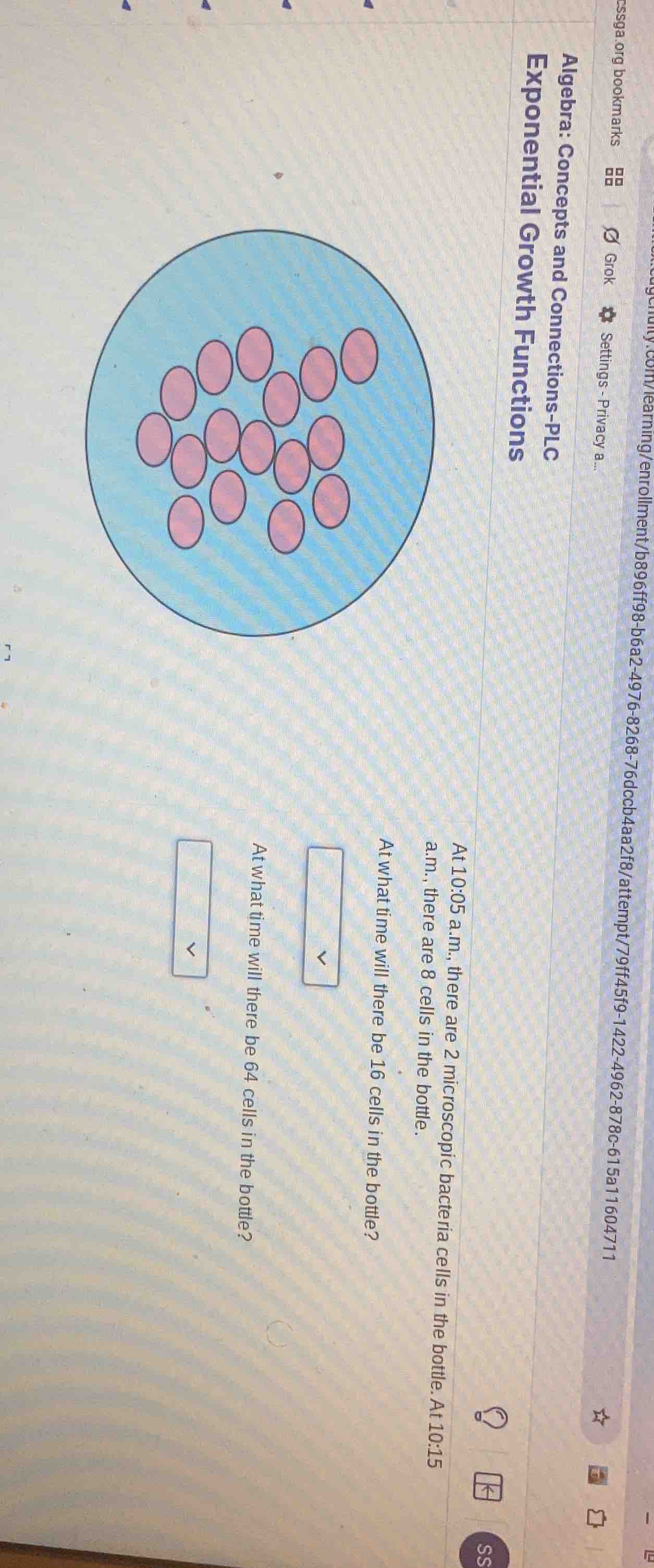
algebra: concepts and connections - plc exponential growth functions at 10:05 a.m., there are 2 microscopic bacteria cells in the bottle. at 10:15 a.m., there are 8 cells in the bottle. at what time will there be 16 cells in the bottle? at what time will there be 64 cells in the bottle?
Step1: Find growth rate/time interval
First, identify the time and cell count changes: from 10:05 a.m. (2 cells) to 10:15 a.m. (8 cells). The time elapsed is $10:15 - 10:05 = 10$ minutes. The cell count multiplies by $\frac{8}{2}=4$ in 10 minutes, which means it doubles every 5 minutes (since $2^2=4$, so 10 minutes / 2 doubling periods = 5 minutes per doubling).
Step2: Calculate time for 16 cells
Start from 10:15 a.m. (8 cells). To reach 16 cells, the count needs to double once. Since doubling takes 5 minutes, add 5 minutes to 10:15 a.m.
$10:15 + 0:05 = 10:20$ a.m.
Step3: Calculate time for 64 cells
From 10:20 a.m. (16 cells), we need to double to 32 (5 more minutes, 10:25 a.m.), then double again to 64 (another 5 minutes). Alternatively, from 10:15 a.m. (8 cells), $64 = 8 \times 2^3$, so 3 doubling periods. $3 \times 5 = 15$ minutes added to 10:15 a.m.
$10:15 + 0:15 = 10:30$ a.m.

Snap & solve any problem in the app
Get step-by-step solutions on Sovi AI
Photo-based solutions with guided steps
Explore more problems and detailed explanations
At what time will there be 16 cells in the bottle? 10:20 a.m.
At what time will there be 64 cells in the bottle? 10:30 a.m.