QUESTION IMAGE
Question
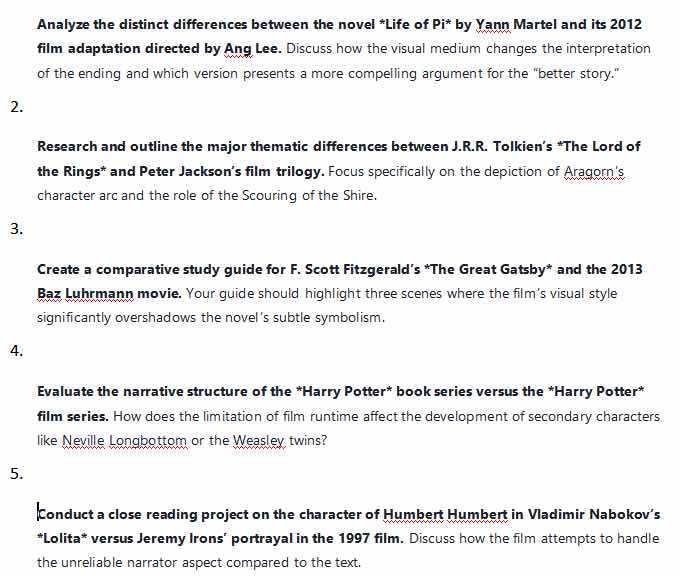
- analyze the distinct differences between the novel \life of pi\ by yann martel and its 2012 film adaptation directed by ang lee. discuss how the visual medium changes the interpretation of the ending and which version presents a more compelling argument for the \better story.\
- research and outline the major thematic differences between j.r.r. tolkien’s \the lord of the rings\ and peter jackson’s film trilogy. focus specifically on the depiction of aragorn’s character arc and the role of the scouring of the shire.
- create a comparative study guide for f. scott fitzgerald’s \the great gatsby\ and the 2013 baz luhrmann movie. your guide should highlight three scenes where the film’s visual style significantly overshadows the novel’s subtle symbolism.
- evaluate the narrative structure of the \harry potter\ book series versus the \harry potter\ film series. how does the limitation of film runtime affect the development of secondary characters like neville longbottom or the weasley twins?
- conduct a close reading project on the character of humbert humbert in vladimir nabokov’s \lolita\ versus jeremy irons’ portrayal in the 1997 film. discuss how the film attempts to handle the unreliable narrator aspect compared to the text.
Response
Since the user hasn't asked a specific question but provided a list of tasks, I'll assume they might want help with one of these tasks. Let's pick task 1 (analyzing "Life of Pi" novel vs film) and use the Answer - Explanation Format (as it's in Arts, specifically Literature and Film Studies which falls under Arts' subfields like Literature, Writing etc.).
Brief Explanations
- Novel vs Film Differences: The novel uses Pi's first - person narration to explore his internal struggle, faith, and the two stories (with animals and with humans). The film uses visuals (like the tiger, the ocean) to externalize Pi's journey.
- Ending Interpretation: In the novel, the reader infers the "better story" (animal or human) through Pi's words. The film's visual depiction of the tiger leaving and the human - only island makes the "better story" more visually - driven. The film's use of color, CGI (like the tiger, the whale) adds a surreal layer.
- Compelling Argument: The novel's ambiguity (relying on text to make readers choose) vs the film's visual - emotional appeal. The film's visual storytelling (e.g., the storm scene, the island) can make the "better story" argument more immediate, while the novel's introspective style is more thought - provoking.

Snap & solve any problem in the app
Get step-by-step solutions on Sovi AI
Photo-based solutions with guided steps
Explore more problems and detailed explanations
To analyze "Life of Pi" novel vs 2012 film:
- Differences: Novel: Internal, text - based exploration of faith/stories. Film: Visual, CGI - driven externalization.
- Ending Interpretation: Novel: Reader infers; Film: Visual cues (tiger leaving, island) guide.
- Compelling Argument: Novel (thought - provoking ambiguity) or Film (immediate visual - emotional appeal) – depends on whether one values introspection (novel) or visual storytelling (film).