QUESTION IMAGE
Question
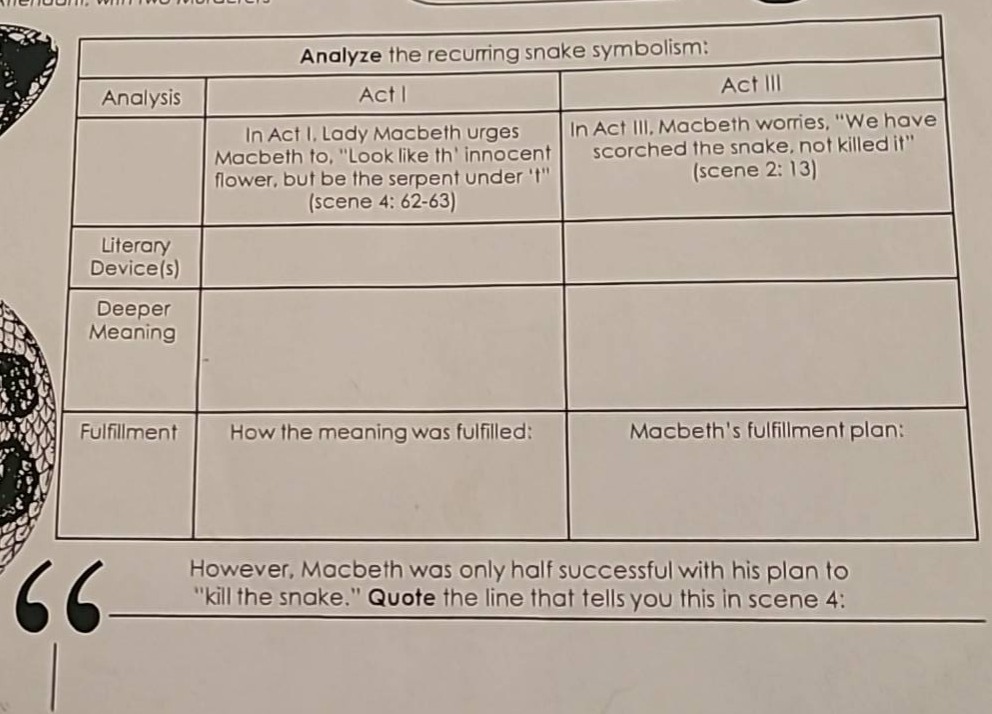
analyze the recurring snake symbolism:
| analysis | act i | act iii |
|---|---|---|
| literary device(s) | ||
| deeper meaning | ||
| fulfillment | how the meaning was fulfilled: | macbeths fulfillment plan: |
however, macbeth was only half successful with his plan to \kill the snake.\ quote the line that tells you this in scene 4:
Brief Explanations
Act I Analysis
- Literary Device(s): The snake is a metaphor comparing deceptive outward innocence to a hidden, dangerous serpent.
- Deeper Meaning: Lady Macbeth instructs Macbeth to mask his murderous ambition with a harmless, trustworthy appearance while harboring cruel, power-hungry intentions beneath.
- Fulfillment: Macbeth pretends to be a loyal, grateful thane to King Duncan, then murders him in his sleep, fulfilling the "serpent under the flower" deception.
Act III Analysis
- Literary Device(s): The snake is a metaphor for Banquo (and his heirs, the threat to Macbeth's throne) that is only injured, not eliminated.
- Deeper Meaning: Macbeth recognizes that his murder of Banquo only weakened his rival, not removed the threat entirely—Banquo's son Fleance escaped, leaving the line of heirs intact to challenge Macbeth's crown.
- Fulfillment Plan: Macbeth hires murderers to kill Banquo and Fleance to fully eliminate the threat to his throne.
Final Quote
In Act III, Scene 4, the line confirming Macbeth's half-success is: "Thou canst not say I did it. Never shake / Thy gory locks at me." (This refers to Banquo's ghost appearing, proving Fleance survived and the "snake" was not fully killed.)

Snap & solve any problem in the app
Get step-by-step solutions on Sovi AI
Photo-based solutions with guided steps
Explore more problems and detailed explanations
Act I
| Category | Details |
|---|---|
| Deeper Meaning | Mask ambition with innocence |
| Fulfillment | Pretends loyalty to Duncan, then murders him |
Act III
| Category | Details |
|---|---|
| Deeper Meaning | Unfinished threat to Macbeth's throne |
| Fulfillment Plan | Hire murderers to kill Banquo + Fleance |
Confirming Quote
"Thou canst not say I did it. Never shake / Thy gory locks at me." (Act III, Scene 4)