QUESTION IMAGE
Question
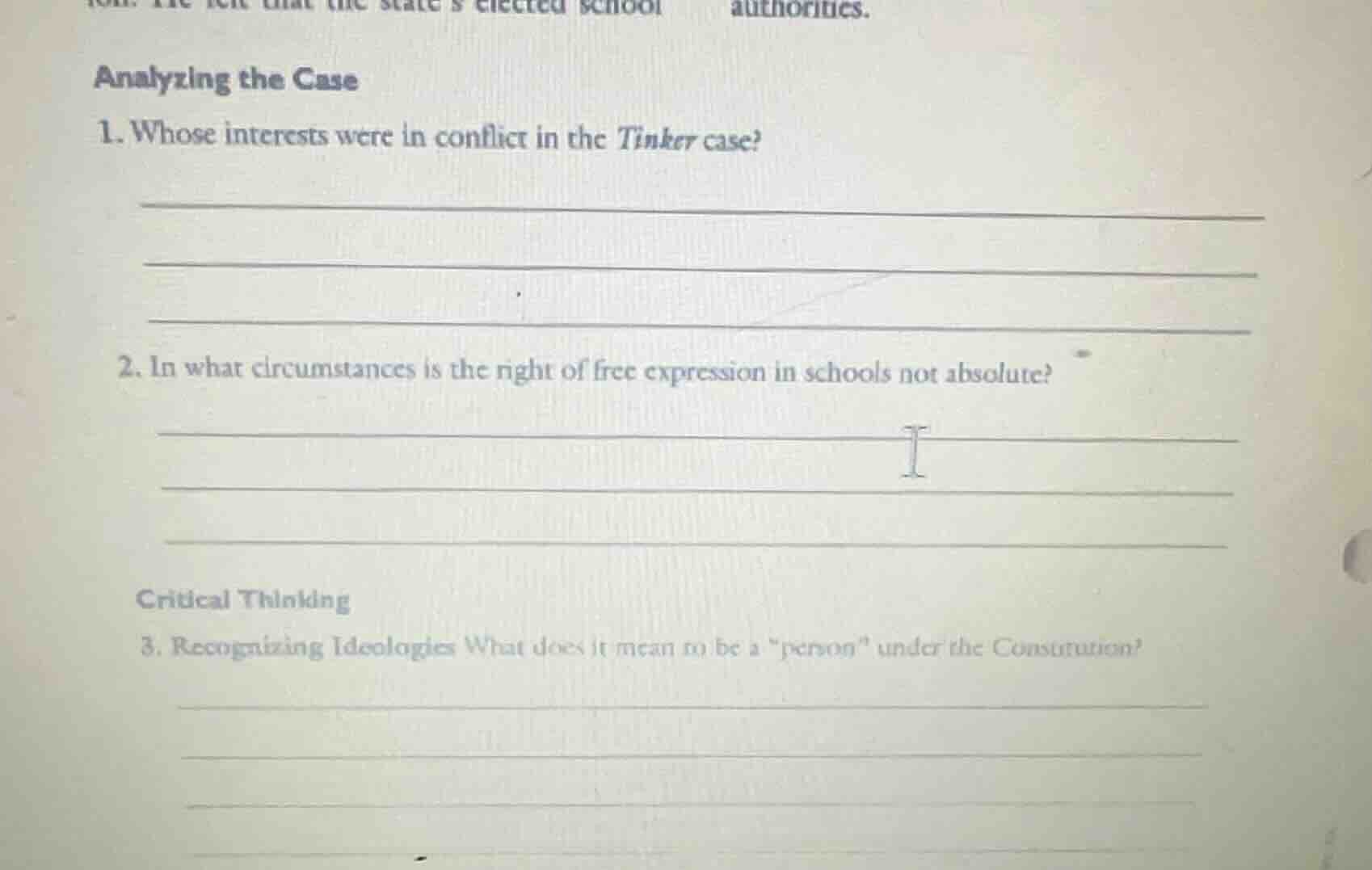
analyzing the case
- whose interests were in conflict in the tinker case?
- in what circumstances is the right of free expression in schools not absolute?
critical thinking
- recognizing ideologies what does it mean to be a \person\ under the constitution?
Brief Explanations
- For the Tinker case: The conflict was between the First Amendment free speech rights of student protesters (who wore black armbands to oppose the Vietnam War) and the school district's interest in maintaining order, avoiding disruption, and preventing potential controversy among students/staff.
- For school free expression: The right is not absolute when the expression causes or is reasonably predicted to cause a substantial disruption to school operations, interferes with the rights of other students, promotes illegal activity, or creates a hostile or unsafe learning environment (per the Tinker, Bethel, and Morse v. Frederick precedents).
- For constitutional "person": Under the U.S. Constitution, a "person" refers to entities entitled to constitutional protections. This includes all living human beings (citizens and non-citizens) within U.S. jurisdiction, and in some contexts, corporations or other legal entities, though protections vary by right (e.g., corporations have First Amendment rights but not Fifth Amendment self-incrimination rights).

Snap & solve any problem in the app
Get step-by-step solutions on Sovi AI
Photo-based solutions with guided steps
Explore more problems and detailed explanations
- The interests of the student protesters (seeking to exercise First Amendment free speech rights) and the school district (seeking to maintain school order and avoid disruption) were in conflict.
- The right of free expression in schools is not absolute when the expression would cause a substantial disruption to school activities, interfere with the rights of other students, encourage illegal acts, or create an unsafe/hostile learning environment.
- To be a "person" under the Constitution means being an entity granted constitutional legal protections. This primarily includes all living human beings in U.S. jurisdiction, and in certain contexts, legal entities like corporations, with protections varying by specific constitutional right.