QUESTION IMAGE
Question
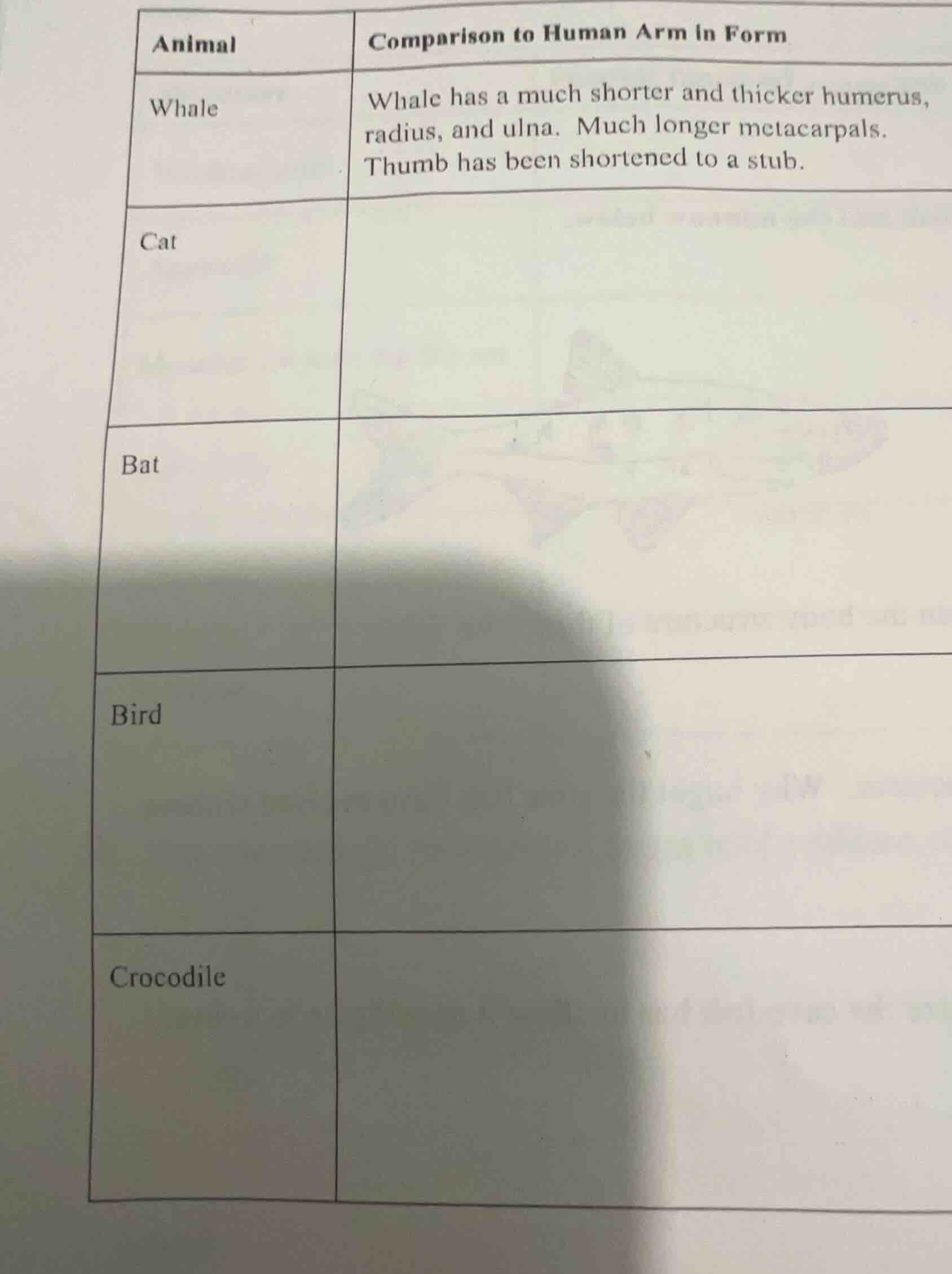
| animal | comparison to human arm in form |
|---|---|
| cat | |
| bat | |
| bird | |
| crocodile |
Brief Explanations
Each entry describes the skeletal structure of the animal's forelimb compared to a human arm, based on evolutionary and functional adaptations for their respective behaviors (locomotion, flight, swimming, etc.).

Snap & solve any problem in the app
Get step-by-step solutions on Sovi AI
Photo-based solutions with guided steps
Explore more problems and detailed explanations
| Animal | Comparison to Human Arm in Form |
|---|---|
| Cat | Humerus, radius, and ulna are relatively shorter and more robust; metacarpals and phalanges are elongated for walking/climbing, with retractable claws attached to distal phalanges; the thumb is reduced and non-opposable. |
| Bat | Extremely elongated metacarpals and phalanges that form the frame of the wing; humerus, radius, and ulna are light and slender; thumb is short, free, and has a claw for gripping. |
| Bird | Humerus, radius, and ulna are fused or rigid for flight stability; metacarpals and phalanges are highly fused into a single structure that supports the wing feathers; thumb is a small, reduced digit with no independent function. |
| Crocodile | Short, thick humerus, radius, and ulna for powerful weight-bearing; metacarpals are short and robust; all digits (including thumb) are thick, clawed, and positioned for swimming and gripping prey, with limited flexibility. |