QUESTION IMAGE
Question
answer attempt 2 out of 2
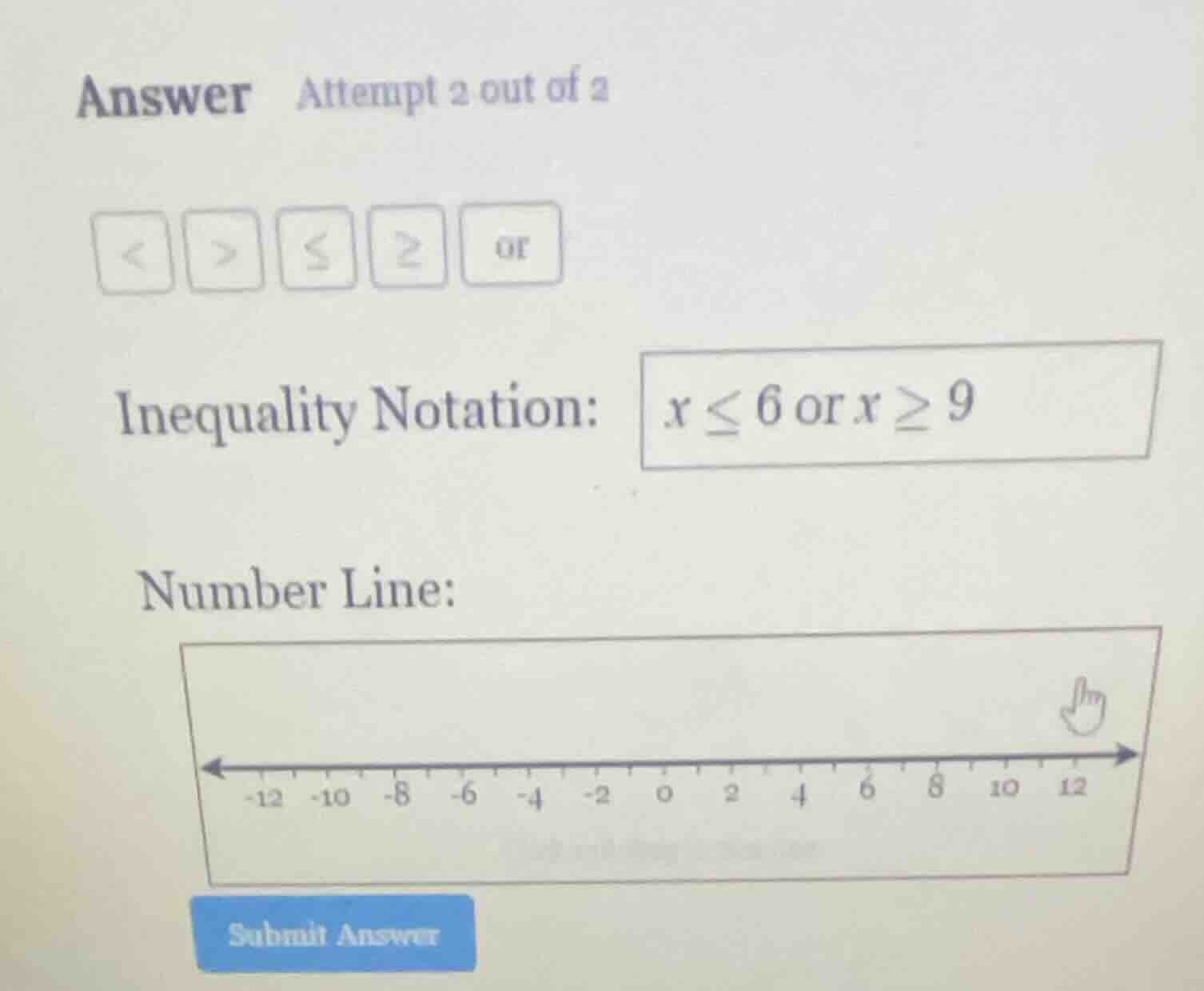
inequality notation: x ≤ 6 or x ≥ 9
number line:
-12 -10 -8 -6 -4 -2 0 2 4 6 8 10 12
To graph the inequality \( x \leq 6 \) or \( x \geq 9 \) on the number line:
Step 1: Graph \( x \leq 6 \)
- Locate 6 on the number line.
- Since \( x \leq 6 \) includes 6, we use a closed (filled) circle at 6.
- Draw an arrow to the left from 6 to represent all numbers less than or equal to 6.
Step 2: Graph \( x \geq 9 \)
- Locate 9 on the number line.
- Since \( x \geq 9 \) includes 9, we use a closed (filled) circle at 9.
- Draw an arrow to the right from 9 to represent all numbers greater than or equal to 9.
Final Graph Description
- At 6: Closed circle, arrow left.
- At 9: Closed circle, arrow right.
- The regions are separated (no overlap between \( x \leq 6 \) and \( x \geq 9 \) except if 6 and 9 were equal, which they aren’t, so the "or" means the solution is the union of these two intervals).
(Visually, on the given number line with marks at -12, -10, -8, -6, -4, -2, 0, 2, 4, 6, 8, 10, 12: place a closed dot at 6 and draw left, closed dot at 9 and draw right.)
If you needed the inequality notation (already given as \( x \leq 6 \) or \( x \geq 9 \)) and the number line graph as described, that’s the solution.

Snap & solve any problem in the app
Get step-by-step solutions on Sovi AI
Photo-based solutions with guided steps
Explore more problems and detailed explanations
To graph the inequality \( x \leq 6 \) or \( x \geq 9 \) on the number line:
Step 1: Graph \( x \leq 6 \)
- Locate 6 on the number line.
- Since \( x \leq 6 \) includes 6, we use a closed (filled) circle at 6.
- Draw an arrow to the left from 6 to represent all numbers less than or equal to 6.
Step 2: Graph \( x \geq 9 \)
- Locate 9 on the number line.
- Since \( x \geq 9 \) includes 9, we use a closed (filled) circle at 9.
- Draw an arrow to the right from 9 to represent all numbers greater than or equal to 9.
Final Graph Description
- At 6: Closed circle, arrow left.
- At 9: Closed circle, arrow right.
- The regions are separated (no overlap between \( x \leq 6 \) and \( x \geq 9 \) except if 6 and 9 were equal, which they aren’t, so the "or" means the solution is the union of these two intervals).
(Visually, on the given number line with marks at -12, -10, -8, -6, -4, -2, 0, 2, 4, 6, 8, 10, 12: place a closed dot at 6 and draw left, closed dot at 9 and draw right.)
If you needed the inequality notation (already given as \( x \leq 6 \) or \( x \geq 9 \)) and the number line graph as described, that’s the solution.