QUESTION IMAGE
Question
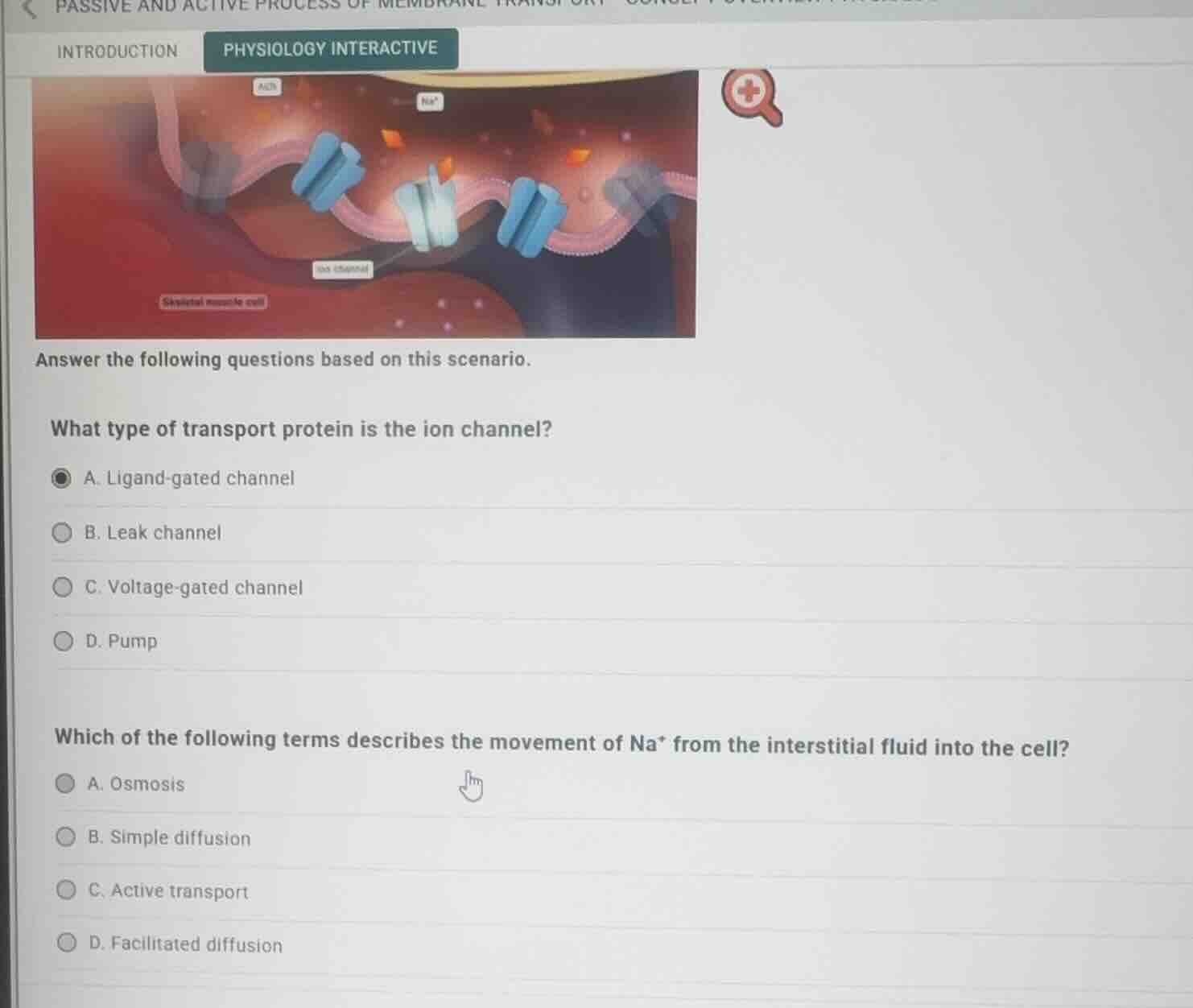
answer the following questions based on this scenario. what type of transport protein is the ion channel? a. ligand - gated channel b. leak channel c. voltage - gated channel d. pump which of the following terms describes the movement of na⁺ from the interstitial fluid into the cell? a. osmosis b. simple diffusion c. active transport d. facilitated diffusion
First Question (What type of transport protein is the ion channel?):
- Ligand - gated channels open in response to a ligand (like a neurotransmitter) binding. Leak channels are always open, allowing ions to leak across the membrane. Voltage - gated channels open in response to a change in membrane voltage. Pumps are for active transport (using energy to move ions against concentration gradients), while ion channels (like leak channels) are passive and some are always open to allow ion movement down concentration gradients. If we assume the ion channel here is a leak channel (as they are a type of ion channel that is always open, allowing ions to move passively), but wait, maybe the scenario (from the image which is about a skeletal muscle cell and ion channels) – actually, in the first question, if we re - evaluate: Wait, maybe the correct answer is B? Wait, no, let's think again. Wait, the options: A is ligand - gated (needs a ligand), B is leak channel (always open, passive), C is voltage - gated (responds to voltage), D is pump (active transport, not a channel). Ion channels can be leak (always open), ligand - gated, or voltage - gated. But if the image shows a channel that is maybe a leak channel? Wait, maybe the intended answer is B. Wait, no, maybe I made a mistake. Wait, let's check the second question first.
Second Question (Which of the following terms describes the movement of Na⁺ from the interstitial fluid into the cell?):
- Osmosis is the movement of water across a semi - permeable membrane. Simple diffusion is the movement of molecules (like non - polar molecules) directly through the lipid bilayer. Active transport requires energy (ATP) to move molecules against their concentration gradient. Facilitated diffusion is the movement of molecules (like ions or polar molecules) down their concentration gradient through a transport protein (like an ion channel). Na⁺ is a charged ion, so it can't move through simple diffusion. If Na⁺ is moving from interstitial fluid (higher concentration outside the cell, typically) into the cell, it's moving down its concentration gradient through a channel (like the ion channel in the image), so it's facilitated diffusion. So the answer for the second question is D.
Now back to the first question:
If the ion channel in the image (skeletal muscle cell) – leak channels are always open, allowing ions to move. But maybe the correct answer for the first question is B. Leak channel. Wait, but let's confirm: Ion channels can be classified as leak (non - gated, always open), ligand - gated, or voltage - gated. Pumps are not channels (they are transporters that use energy). So among the options, B (Leak channel) is a type of ion channel.

Snap & solve any problem in the app
Get step-by-step solutions on Sovi AI
Photo-based solutions with guided steps
Explore more problems and detailed explanations
s:
- For "What type of transport protein is the ion channel?": B. Leak channel
- For "Which of the following terms describes the movement of Na⁺ from the interstitial fluid into the cell?": D. Facilitated diffusion