QUESTION IMAGE
Question
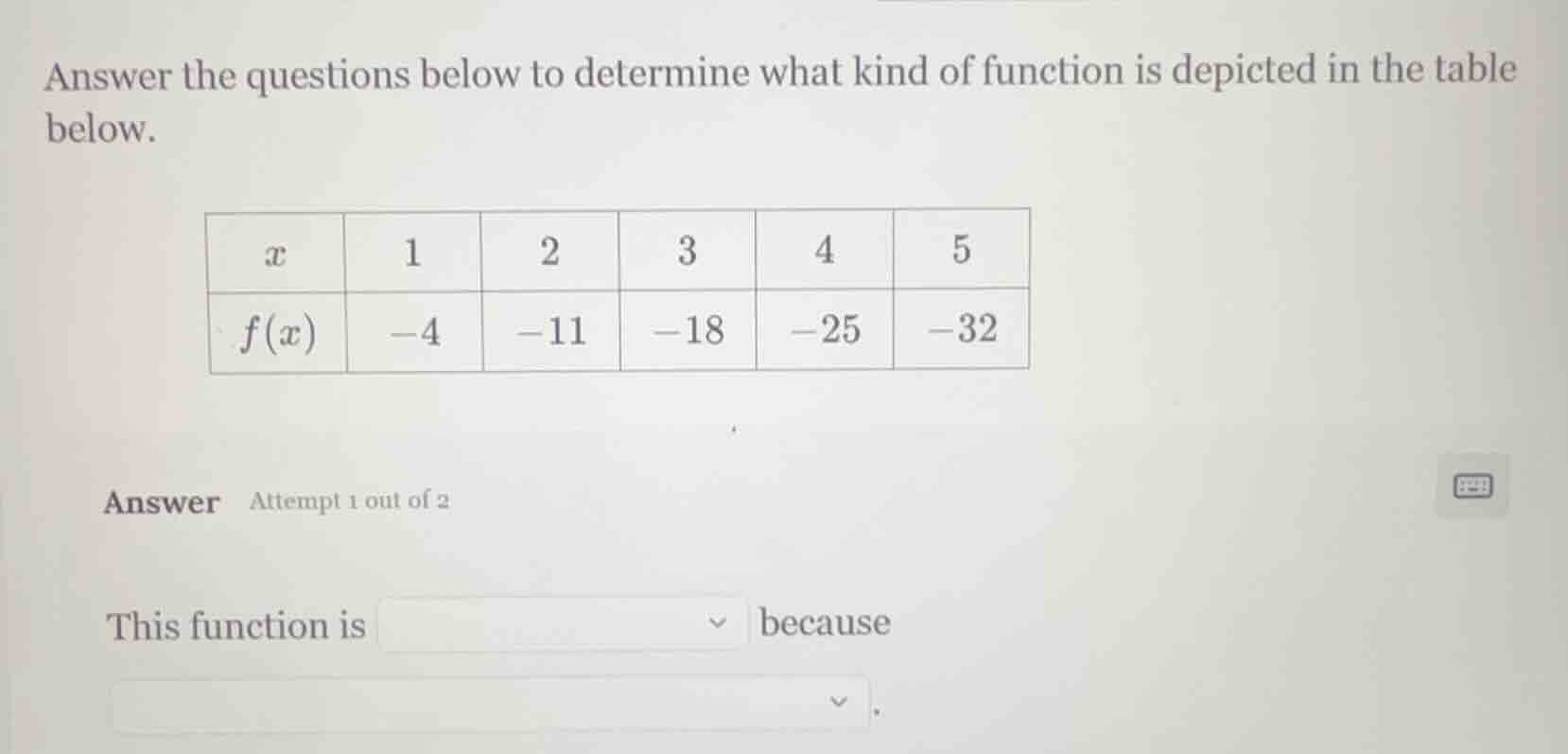
answer the questions below to determine what kind of function is depicted in the table below.
| $x$ | 1 | 2 | 3 | 4 | 5 |
| $f(x)$ | $-4$ | $-11$ | $-18$ | $-25$ | $-32$ |
answer attempt 1 out of 2
this function is because .
Step1: Calculate the differences between consecutive \( f(x) \) values.
For \( x = 1 \) to \( x = 2 \): \( -11 - (-4) = -7 \)
For \( x = 2 \) to \( x = 3 \): \( -18 - (-11) = -7 \)
For \( x = 3 \) to \( x = 4 \): \( -25 - (-18) = -7 \)
For \( x = 4 \) to \( x = 5 \): \( -32 - (-25) = -7 \)
Step2: Analyze the pattern of the differences.
The differences between consecutive \( f(x) \) values are all equal (\( -7 \)). In a function, if the first - differences (differences between consecutive outputs) are constant, the function is linear.

Snap & solve any problem in the app
Get step-by-step solutions on Sovi AI
Photo-based solutions with guided steps
Explore more problems and detailed explanations
This function is linear because the difference between consecutive \( f(x) \) values is constant (each difference is \( -7 \)).