QUESTION IMAGE
Question
answers must be written within the answer boxes provided. full marks are not necessarily awarded for a correct answer with no working. answers must be supported by working and/or explanations. solutions found from a graphic display calculator should be supported by suitable working. for example, if graphs are used to find a solution, you should sketch these as part of your answer. where an answer is incorrect, some marks may be given for a correct method, provided this is shown by written working. you are therefore advised to show all working.
- maximum mark: 6
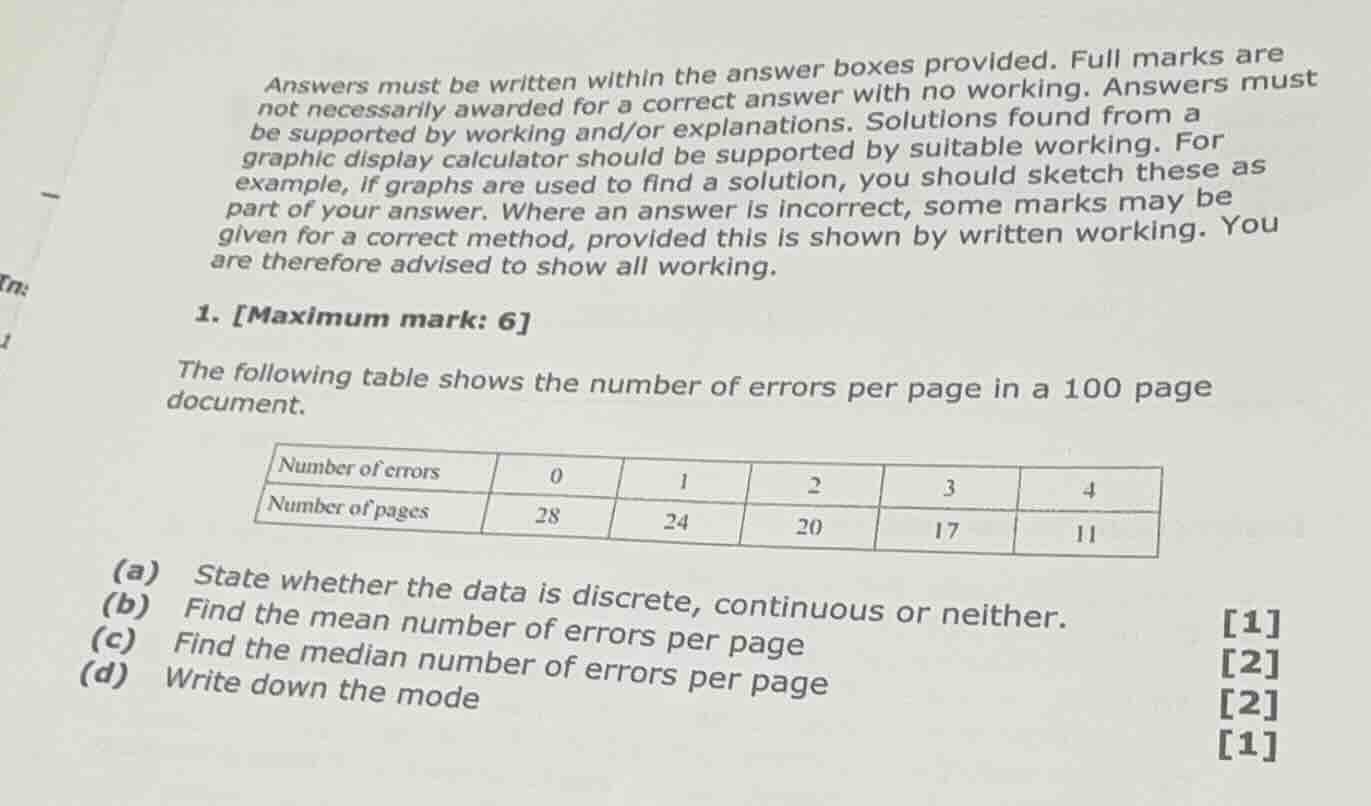
the following table shows the number of errors per page in a 100 page document.
| number of errors | 0 | 1 | 2 | 3 | 4 |
|---|
(a) state whether the data is discrete, continuous or neither. 1
(b) find the mean number of errors per page 2
(c) find the median number of errors per page 2
(d) write down the mode 1
Part (a)
Discrete data consists of distinct, separate values (like counts of errors, number of pages). The number of errors per page is a countable value (0, 1, 2, 3, 4), so it is discrete.
Step1: Recall the formula for the mean of a frequency - distribution.
The formula for the mean \(\bar{x}=\frac{\sum_{i = 1}^{n}f_{i}x_{i}}{\sum_{i = 1}^{n}f_{i}}\), where \(x_{i}\) is the value of the variable and \(f_{i}\) is the frequency.
Here, \(x_0 = 0,f_0=28\); \(x_1 = 1,f_1 = 24\); \(x_2=2,f_2 = 20\); \(x_3 = 3,f_3=17\); \(x_4=4,f_4 = 11\)
First, calculate \(\sum_{i = 0}^{4}f_{i}x_{i}\):
\(f_0x_0=0\times28 = 0\)
\(f_1x_1=1\times24=24\)
\(f_2x_2=2\times20 = 40\)
\(f_3x_3=3\times17=51\)
\(f_4x_4=4\times11 = 44\)
\(\sum_{i = 0}^{4}f_{i}x_{i}=0 + 24+40 + 51+44=159\)
Step2: Calculate the sum of frequencies.
\(\sum_{i = 0}^{4}f_{i}=28 + 24+20 + 17+11 = 100\)
Step3: Calculate the mean.
\(\bar{x}=\frac{159}{100}=1.59\)
Step1: Find the cumulative frequencies.
For \(x = 0\), cumulative frequency \(CF_0=28\)
For \(x = 1\), \(CF_1=28 + 24=52\)
For \(x = 2\), \(CF_2=52+20 = 72\)
For \(x = 3\), \(CF_3=72 + 17=89\)
For \(x = 4\), \(CF_4=89+11 = 100\)
The total number of pages \(n = 100\). The median is the value of \(x\) such that \(\frac{n}{2}=50\) lies in the cumulative - frequency interval.
We look for the smallest \(CF_i\) such that \(CF_i\geq50\)
\(CF_0 = 28<50\), \(CF_1=52\geq50\)
So the median class is \(x = 1\) (when the cumulative frequency first exceeds or equals \(\frac{n}{2}\))
But we can also calculate it using the formula for grouped data (although this is a discrete case, we can use the position). The median is the \((\frac{n + 1}{2})\)th value when \(n\) is odd and the average of the \(\frac{n}{2}\)th and \((\frac{n}{2}+1)\)th values when \(n\) is even. Here \(n = 100\) (even), so we need the average of the 50th and 51st values.
The first 28 values are \(x = 0\), the next 24 values (from 29th to 52nd) are \(x = 1\). So the 50th and 51st values are both \(x = 1\). So the median is \(1\)

Snap & solve any problem in the app
Get step-by-step solutions on Sovi AI
Photo-based solutions with guided steps
Explore more problems and detailed explanations
discrete