QUESTION IMAGE
Question
- a. do any of the organisms have the same number of differences from human cytochrome c?
b. in situations like this, how would you decide which is more closely related to humans?
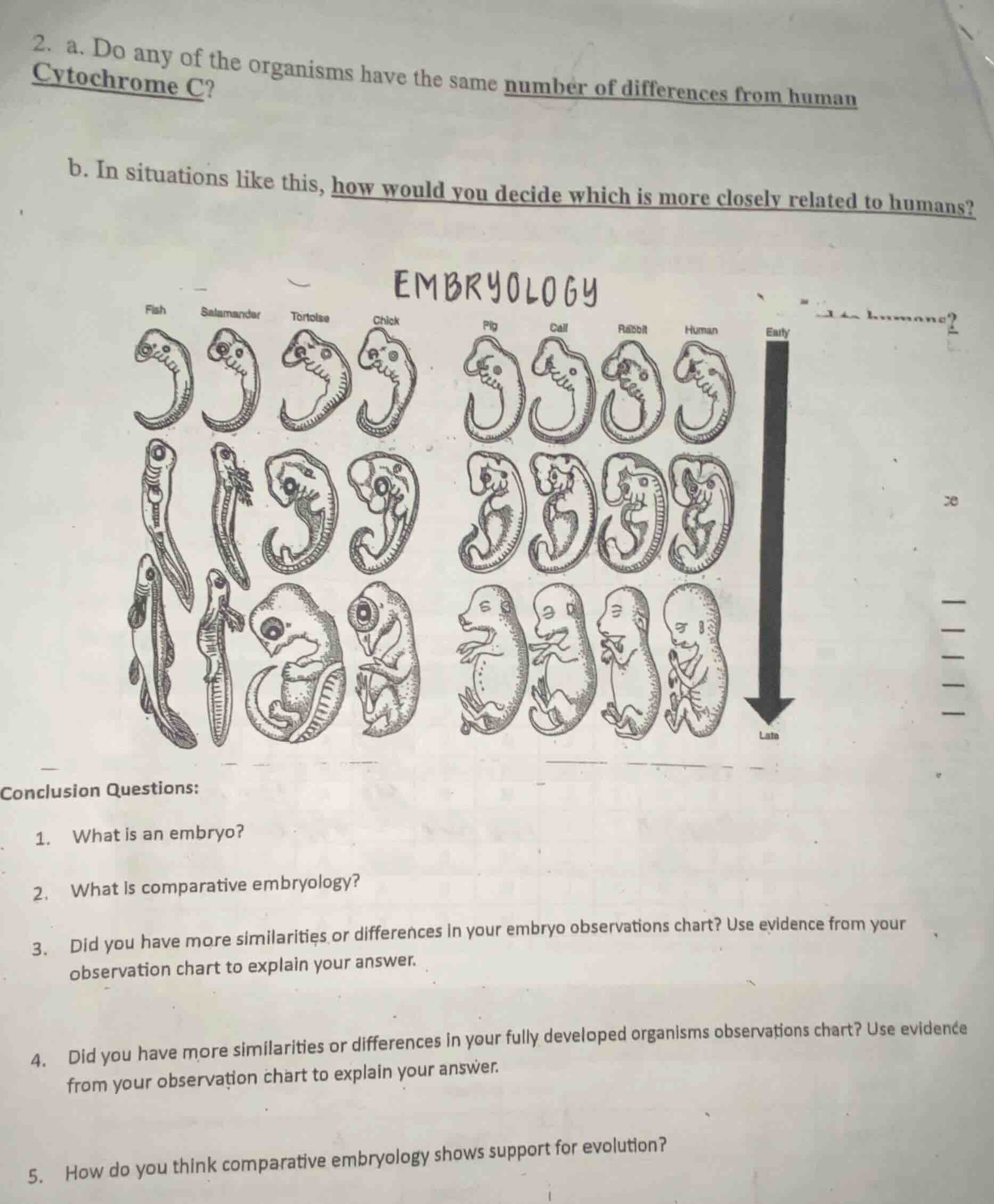
embryology
conclusion questions:
- what is an embryo?
- what is comparative embryology?
- did you have more similarities or differences in your embryo observations chart? use evidence from your observation chart to explain your answer.
- did you have more similarities or differences in your fully developed organisms observations chart? use evidence from your observation chart to explain your answer.
- how do you think comparative embryology shows support for evolution?
2a
To answer if any organisms have the same number of differences from human Cytochrome C, we would typically refer to a data table (not shown here) comparing amino acid differences in Cytochrome C between humans and other organisms. In common datasets, organisms like chimpanzees and humans have 0 differences, but if we consider other pairs, for example, sometimes gorillas and chimps might have the same number of differences from humans, or other mammals. Without the specific data, but in general, it's possible—for example, in some studies, pig and cow might have the same number of differences from human Cytochrome C.
To decide which organism is more closely related to humans when the number of Cytochrome C differences is the same, we use additional evidence. This includes: 1) Comparing other proteins (e.g., hemoglobin, insulin) for differences—fewer differences in another protein would indicate closer relatedness. 2) Fossil evidence—looking at shared anatomical features in fossils. 3) Comparative embryology (as shown in the image)—organisms with more similar embryonic development (like the pig, calf, rabbit, and human embryos shown) are likely more closely related. 4) Molecular clock analysis—estimating divergence time from DNA/protein mutations. 5) Anatomical homology—shared structural features (e.g., skeletal structure).
An embryo is an early stage of development of a multicellular organism, following fertilization (or parthenogenesis) and before birth/hatching. It is the stage where cells differentiate and the basic body plan of the organism is established, as seen in the provided embryology diagram with different species’ embryos.

Snap & solve any problem in the app
Get step-by-step solutions on Sovi AI
Photo-based solutions with guided steps
Explore more problems and detailed explanations
(Assuming typical data) Yes, for example, Pig and Cow may have the same number of differences from human Cytochrome C (specific answer depends on the dataset used, but in many standard comparisons, some organisms do share the same number of differences).