QUESTION IMAGE
Question
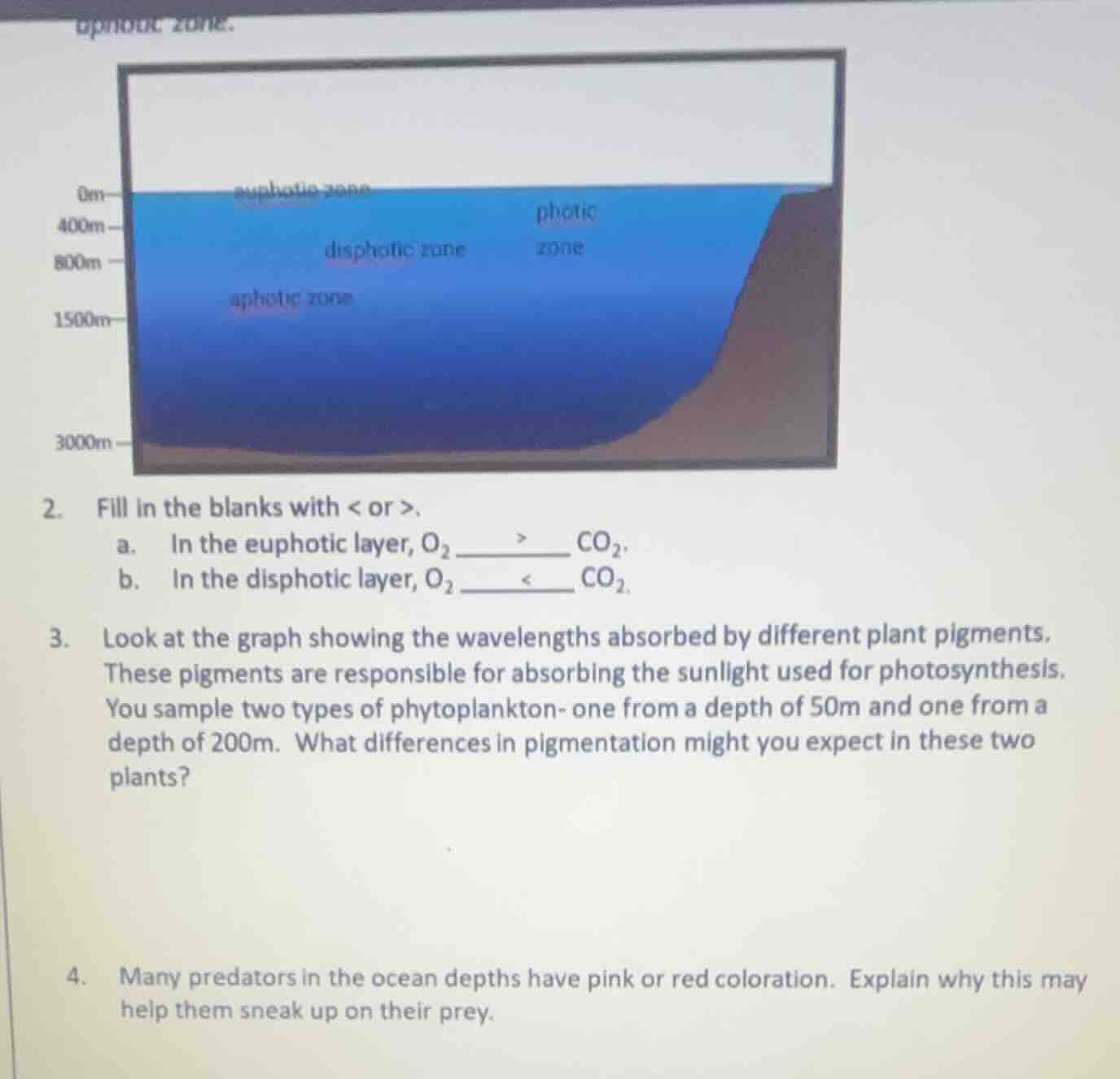
aphotic zone.2. fill in the blanks with < or >.a. in the euphotic layer, $o_2$ ____ $co_2$.b. in the disphotic layer, $o_2$ ____ $co_2$.3. look at the graph showing the wavelengths absorbed by different plant pigments. these pigments are responsible for absorbing the sunlight used for photosynthesis. you sample two types of phytoplankton- one from a depth of 50m and one from a depth of 200m. what differences in pigmentation might you expect in these two plants?4. many predators in the ocean depths have pink or red coloration. explain why this may help them sneak up on their prey.
For Question 2:
a. The euphotic zone has enough light for intense photosynthesis, which produces far more oxygen ($O_2$) than the carbon dioxide ($CO_2$) consumed, so $O_2$ levels are higher.
b. The disphotic zone has limited light: photosynthesis is minimal, while respiration by organisms uses oxygen and produces carbon dioxide, so $CO_2$ levels are higher.
For Question 3:
Sunlight loses longer (red/orange) wavelengths as depth increases; only shorter (blue/green) wavelengths reach 200m. The 50m phytoplankton uses common pigments like chlorophyll a/b that absorb red/blue light. The 200m phytoplankton will have accessory pigments (like phycobilins or fucoxanthin) that absorb blue/green light efficiently, and may have less chlorophyll that relies on red wavelengths.
For Question 4:
Red light is absorbed quickly in water and does not reach deep ocean zones. Red/pink predators appear dark or invisible in this lightless/blue-dominated environment, so prey cannot easily detect them, allowing the predators to ambush effectively.

Snap & solve any problem in the app
Get step-by-step solutions on Sovi AI
Photo-based solutions with guided steps
Explore more problems and detailed explanations
- a. $O_2 > CO_2$
b. $O_2 < CO_2$
- The phytoplankton from 50m will have more chlorophyll a/b (absorbs red/blue light, abundant near the surface). The phytoplankton from 200m will have more accessory pigments (e.g., phycobilins, fucoxanthin) that absorb the remaining blue/green wavelengths available at that deeper depth, and less chlorophyll that depends on red light.
- Red light cannot penetrate deep ocean waters, so red/pink-colored predators appear dark or nearly invisible in the dim, blue-dominated deep ocean environment. This camouflage lets them avoid being seen by their prey, making it easier to sneak up and ambush.