QUESTION IMAGE
Question
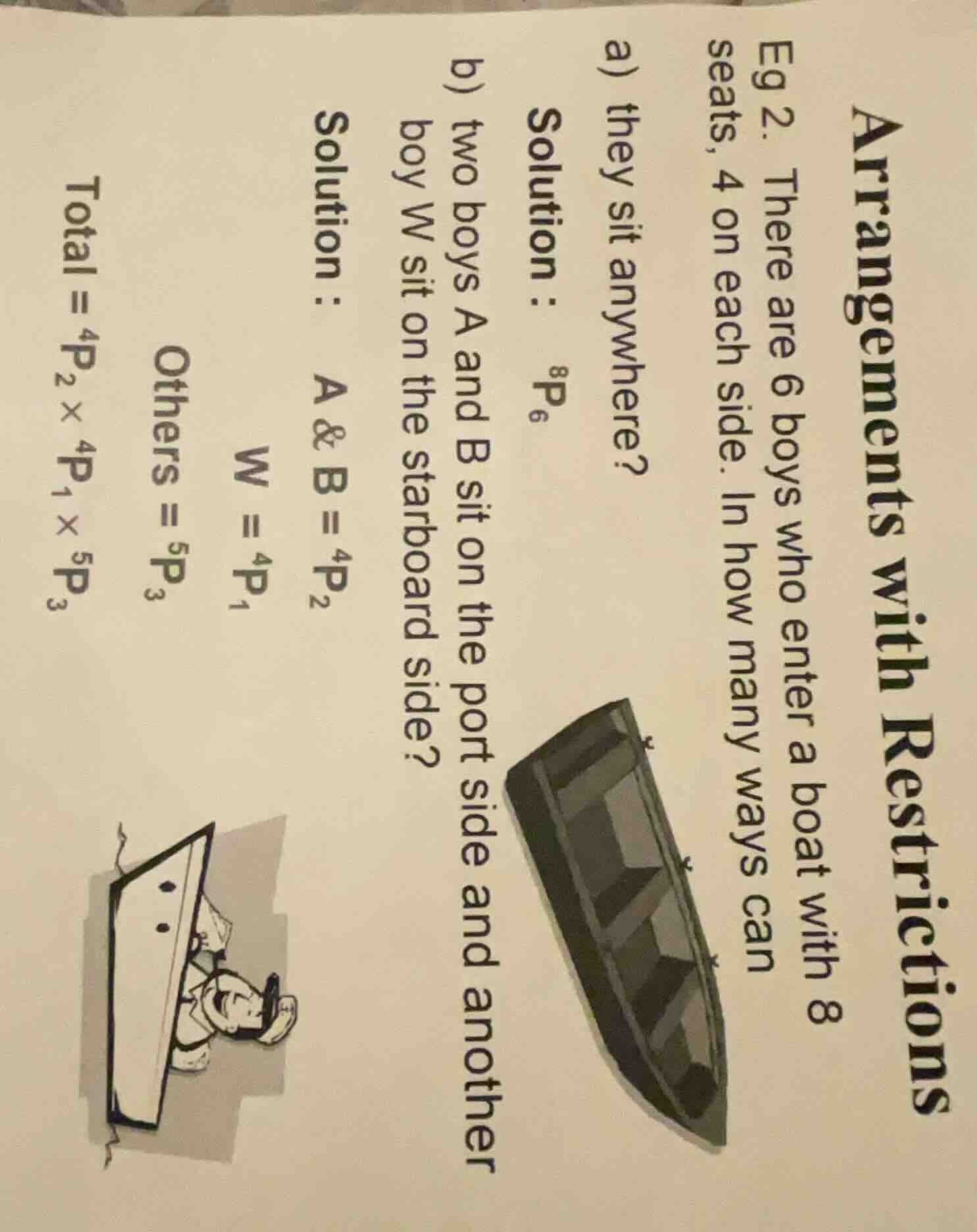
arrangements with restrictions eg 2. there are 6 boys who enter a boat with 8 seats, 4 on each side. in how many ways can a) they sit anywhere? solution: $^8p_6$ b) two boys a and b sit on the port side and another boy w sit on the starboard side? solution: a & b = $^4p_2$ w = $^4p_1$ others = $^5p_3$ total = $^4p_2 \times ^4p_1 \times ^5p_3$
Part (a)
Step1: Understand Permutation Formula
The permutation formula is \( _nP_r=\frac{n!}{(n - r)!} \), where \( n \) is the total number of items, and \( r \) is the number of items to arrange. Here, we have 8 seats and 6 boys, so we want to arrange 6 boys in 8 seats.
Step2: Apply Permutation Formula
Using \( _nP_r \) with \( n = 8 \) and \( r=6 \), we calculate \( _8P_6=\frac{8!}{(8 - 6)!}=\frac{8!}{2!} \).
We know that \( n!=n\times(n - 1)\times\cdots\times1 \), so \( 8! = 8\times7\times6\times5\times4\times3\times2\times1 \) and \( 2! = 2\times1 \).
Then \( \frac{8!}{2!}=\frac{8\times7\times6\times5\times4\times3\times2!}{2!}=8\times7\times6\times5\times4\times3 \).
Calculating this: \( 8\times7 = 56 \), \( 56\times6 = 336 \), \( 336\times5 = 1680 \), \( 1680\times4 = 6720 \), \( 6720\times3 = 20160 \).
Step1: Arrange Boys A and B
First, arrange boys A and B on the port side (4 seats). Using permutation, \( _4P_2=\frac{4!}{(4 - 2)!}=\frac{4!}{2!} \).
\( 4! = 4\times3\times2\times1 \), \( 2! = 2\times1 \), so \( \frac{4!}{2!}=\frac{4\times3\times2!}{2!}=4\times3 = 12 \).
Step2: Arrange Boy W
Next, arrange boy W on the starboard side (4 seats). Using permutation, \( _4P_1=\frac{4!}{(4 - 1)!}=\frac{4!}{3!} \).
\( 4! = 4\times3! \), so \( \frac{4\times3!}{3!}=4 \).
Step3: Arrange Remaining Boys
After arranging A, B, and W, we have \( 6-3 = 3 \) boys left and \( 8 - 2 - 1=5 \) seats left. Using permutation, \( _5P_3=\frac{5!}{(5 - 3)!}=\frac{5!}{2!} \).
\( 5! = 5\times4\times3\times2\times1 \), \( 2! = 2\times1 \), so \( \frac{5!}{2!}=\frac{5\times4\times3\times2!}{2!}=5\times4\times3 = 60 \).
Step4: Multiply the Results
To find the total number of arrangements, we multiply the number of arrangements from each step: \( _4P_2\times_4P_1\times_5P_3=12\times4\times60 \).
First, \( 12\times4 = 48 \), then \( 48\times60 = 2880 \).

Snap & solve any problem in the app
Get step-by-step solutions on Sovi AI
Photo-based solutions with guided steps
Explore more problems and detailed explanations
20160