QUESTION IMAGE
Question
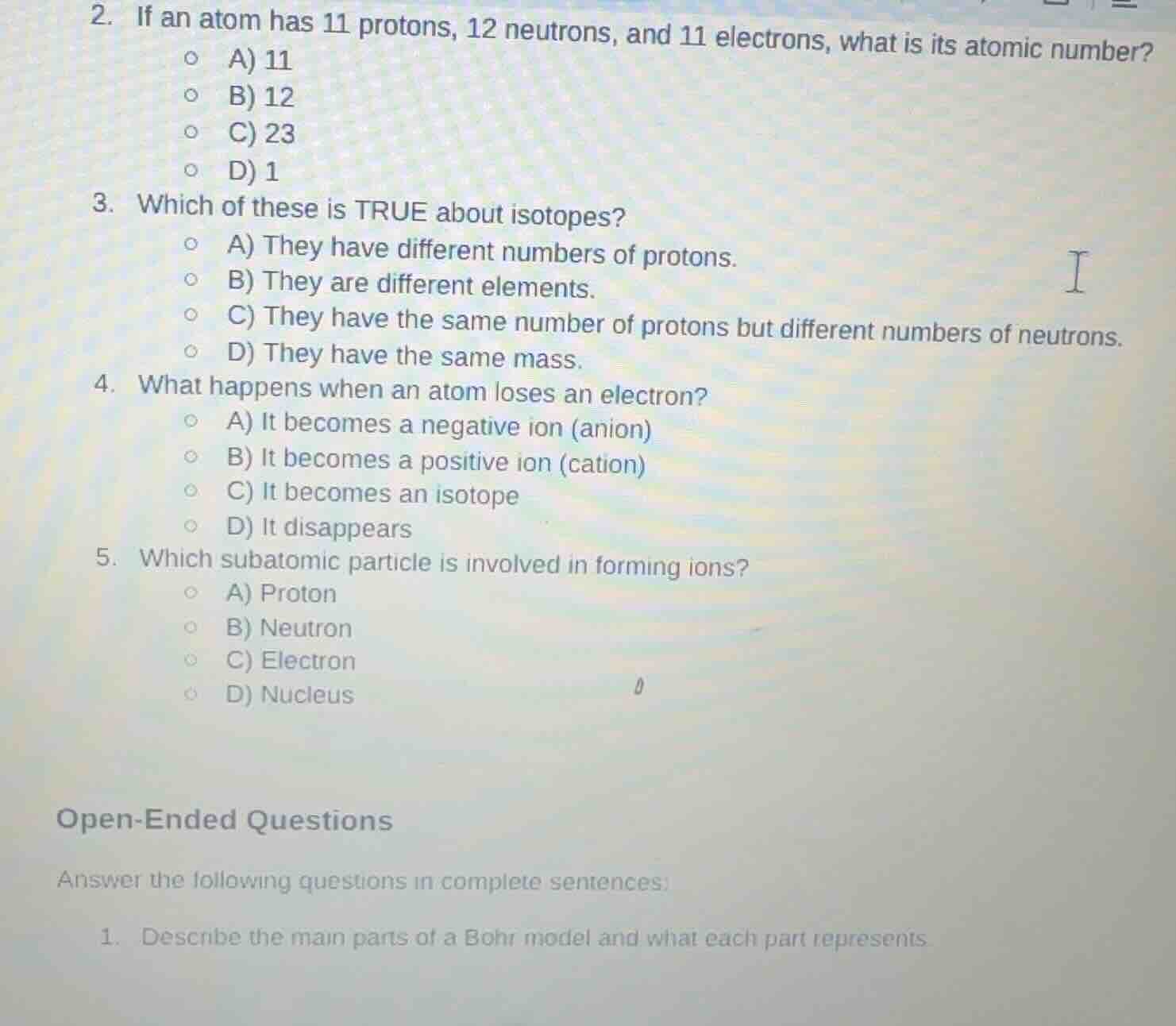
- if an atom has 11 protons, 12 neutrons, and 11 electrons, what is its atomic number? a) 11 b) 12 c) 23 d) 1 3. which of these is true about isotopes? a) they have different numbers of protons. b) they are different elements. c) they have the same number of protons but different numbers of neutrons. d) they have the same mass. 4. what happens when an atom loses an electron? a) it becomes a negative ion (anion) b) it becomes a positive ion (cation) c) it becomes an isotope d) it disappears 5. which subatomic particle is involved in forming ions? a) proton b) neutron c) electron d) nucleus open - ended questions answer the following questions in complete sentences: 1. describe the main parts of a bohr model and what each part represents
For Question 2:
The atomic number of an atom is defined as the number of protons in its nucleus, which matches the given proton count.
For Question 3:
Isotopes are variants of the same element, meaning they share the same proton count (defining the element) but differ in neutron count, which changes their mass.
For Question 4:
Atoms are neutral when proton and electron counts are equal. Losing an electron leaves more positive protons, creating a positively charged ion (cation).
For Question 5:
Ions form when atoms gain or lose electrons, altering their overall charge; protons and neutrons remain unchanged in this process.
For Open-Ended Question 1:
The Bohr model is a simplified representation of an atom with two core components, each with a specific role in representing atomic structure.

Snap & solve any problem in the app
Get step-by-step solutions on Sovi AI
Photo-based solutions with guided steps
Explore more problems and detailed explanations
Multiple Choice Questions:
- A) 11
- C) They have the same number of protons but different numbers of neutrons.
- B) It becomes a positive ion (cation)
- C) Electron
Open-Ended Question 1:
The main parts of a Bohr model are a central nucleus and circular electron shells surrounding it. The nucleus represents the dense, positively charged core of the atom, containing protons and neutrons. The electron shells represent fixed energy levels where negatively charged electrons orbit the nucleus, with each shell holding a specific maximum number of electrons.