QUESTION IMAGE
Question
authors style
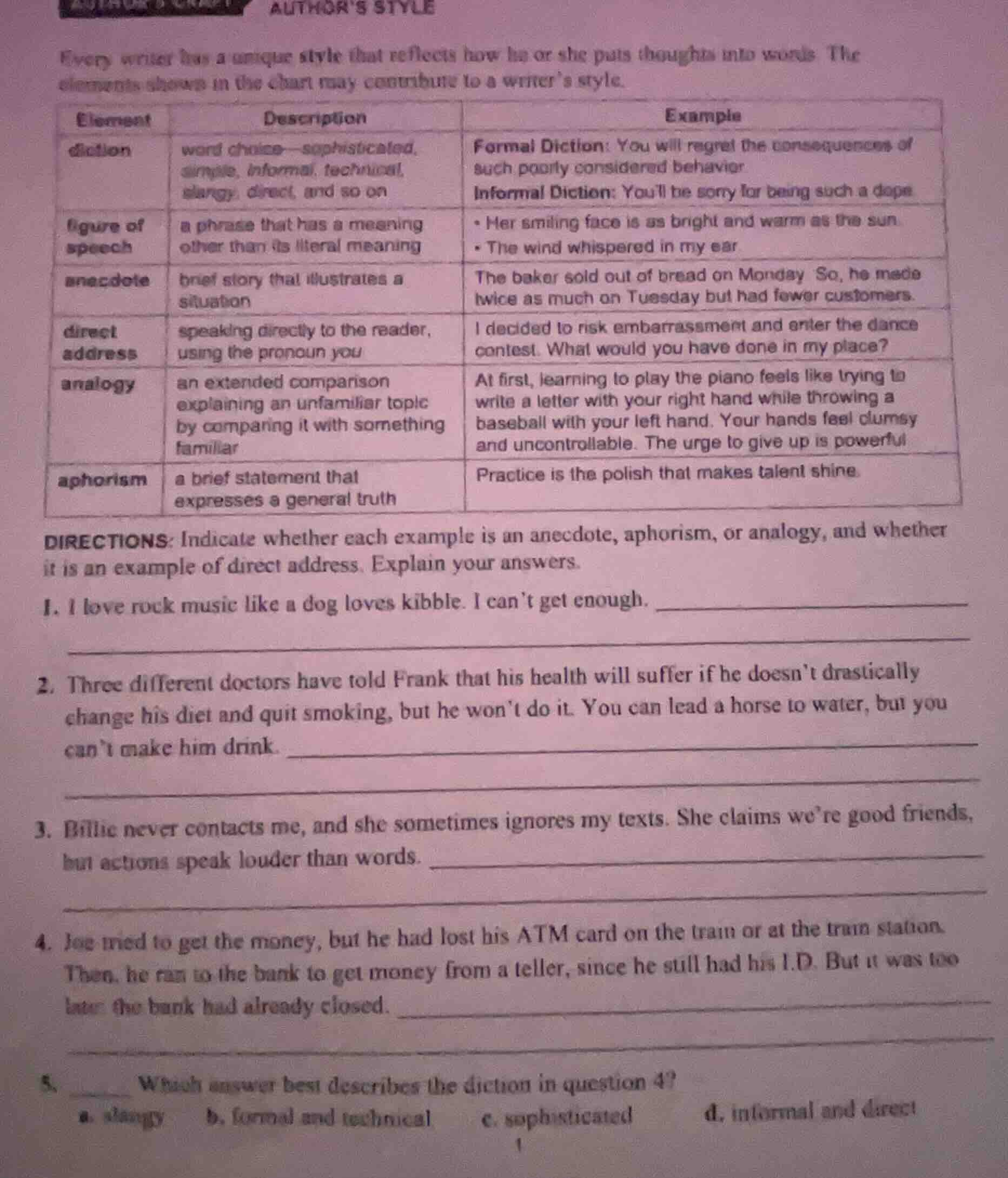
every writer has a unique style that reflects how he or she puts thoughts into words. the
elements shown in the chart may contribute to a writer’s style.
| element | description | example |
|---|---|---|
| figure of speech | a phrase with a meaning other than literal | • her smiling face is as bright and warm as the sun.<br>• the wind whispered in my ear. |
| anecdote | brief story illustrating a situation | the baker sold out of bread on monday. so, he made twice as much on tuesday but had fewer customers. |
| direct address | speaking directly to the reader, using “you” | i decided to risk embarrassment and enter the dance contest. what would you have done in my place? |
| analogy | extended comparison to explain an unfamiliar topic using something familiar | at first, learning to play the piano feels like trying to write a letter with your right hand while throwing a baseball with your left hand. your hands feel clumsy and uncontrollable. the urge to give up is powerful. |
| aphorism | brief statement expressing a general truth | practice is the polish that makes talent shine. |
directions: indicate whether each example is an anecdote, aphorism, or analogy, and whether it is an example of direct address. explain your answers.
- i love rock music like a dog loves kibble. i can’t get enough.
- three different doctors have told frank that his health will suffer if he doesn’t drastically change his diet and quit smoking, but he won’t do it. you can lead a horse to water, but you can’t make him drink.
- billie never contacts me, and she sometimes ignores my texts. she claims we’re good friends, but actions speak louder than words.
- joe tried to get the money, but he had lost his atm card on the train or at the train station. then, he ran to the bank to get money from a teller, since he still had his i.d. but it was too late: the bank had already closed.
- ______ which answer best describes the diction in question 4?
a. slangy
b. formal and technical
c. sophisticated
d. informal and direct
Brief Explanations
- Item 1: It draws an extended comparison between loving rock music and a dog loving kibble, fitting the definition of analogy. It does not use direct address (no "you" to speak to the reader).
- Item 2: The phrase "You can lead a horse to water, but you can't make him drink" is a short statement expressing a general truth about inability to force others to change, so it is an aphorism. It does not use direct address.
- Item 3: "Actions speak louder than words" is a brief statement conveying a general truth about actions over claims, so it is an aphorism. It does not use direct address.
- Item 4: It is a short, specific story about Joe's failed attempt to get money, which fits the definition of anecdote. It does not use direct address.
- Item 5: The language in question 4 uses simple, everyday words and straightforward storytelling, which matches informal and direct diction. Slangy, formal/technical, and sophisticated do not apply.

Snap & solve any problem in the app
Get step-by-step solutions on Sovi AI
Photo-based solutions with guided steps
Explore more problems and detailed explanations
- Analogy; Not direct address. It compares loving rock music to a dog loving kibble, an extended comparison of a familiar and relatable scenario to describe the speaker's feeling, and does not address the reader directly.
- Aphorism; Not direct address. "You can lead a horse to water, but you can't make him drink" is a short statement expressing a general truth about being unable to force others to act, and does not address the reader directly.
- Aphorism; Not direct address. "Actions speak louder than words" is a brief statement conveying a general truth about actions carrying more weight than claims, and does not address the reader directly.
- Anecdote; Not direct address. It is a brief, specific story about Joe's trouble getting money, and does not address the reader directly.
- d. informal and direct