QUESTION IMAGE
Question
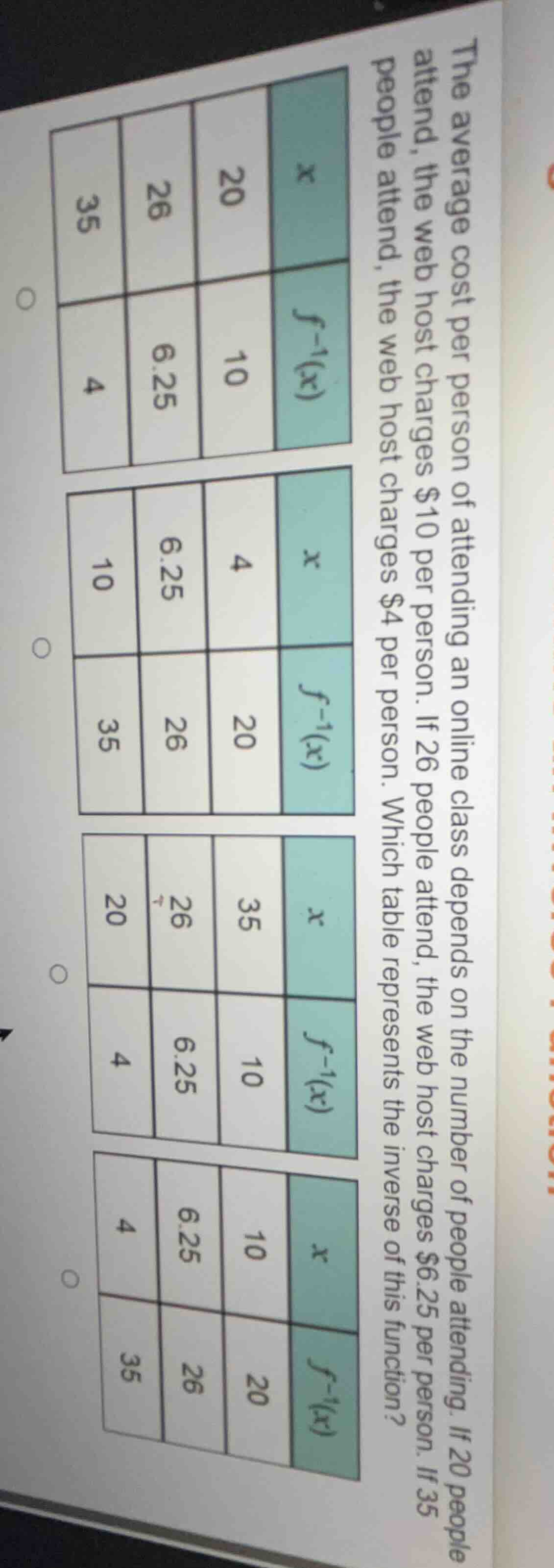
the average cost per person of attending an online class depends on the number of people attending. if 20 people attend, the web host charges $10 per person. if 26 people attend, the web host charges $6.25 per person. if 35 people attend, the web host charges $4 per person. which table represents the inverse of this function?
To determine the inverse function's table, we first analyze the original function. The original function \( f(x) \) maps the number of people \( x \) to the cost per person \( f(x) \). From the problem:
- When \( x = 20 \), \( f(20)=10 \)
- When \( x = 26 \), \( f(26)=6.25 \)
- When \( x = 35 \), \( f(35)=4 \)
The inverse function \( f^{-1}(y) \) maps the cost per person \( y \) back to the number of people \( x \). So we need to swap the \( x \) (input) and \( f(x) \) (output) values.
Step 1: Identify original function pairs
Original pairs: \( (20, 10) \), \( (26, 6.25) \), \( (35, 4) \)
Step 2: Swap to get inverse function pairs
After swapping, the inverse function pairs are: \( (10, 20) \), \( (6.25, 26) \), \( (4, 35) \)
Looking at the tables, the table where \( x \) (input of inverse) is 10, 6.25, 4 and \( f^{-1}(x) \) (output of inverse) is 20, 26, 35 matches these pairs.

Snap & solve any problem in the app
Get step-by-step solutions on Sovi AI
Photo-based solutions with guided steps
Explore more problems and detailed explanations
The table with \( x \) values 10, 6.25, 4 and \( f^{-1}(x) \) values 20, 26, 35 (the fourth table option as per the image layout, with \( x \) column: 10, 6.25, 4 and \( f^{-1}(x) \) column: 20, 26, 35).