QUESTION IMAGE
Question
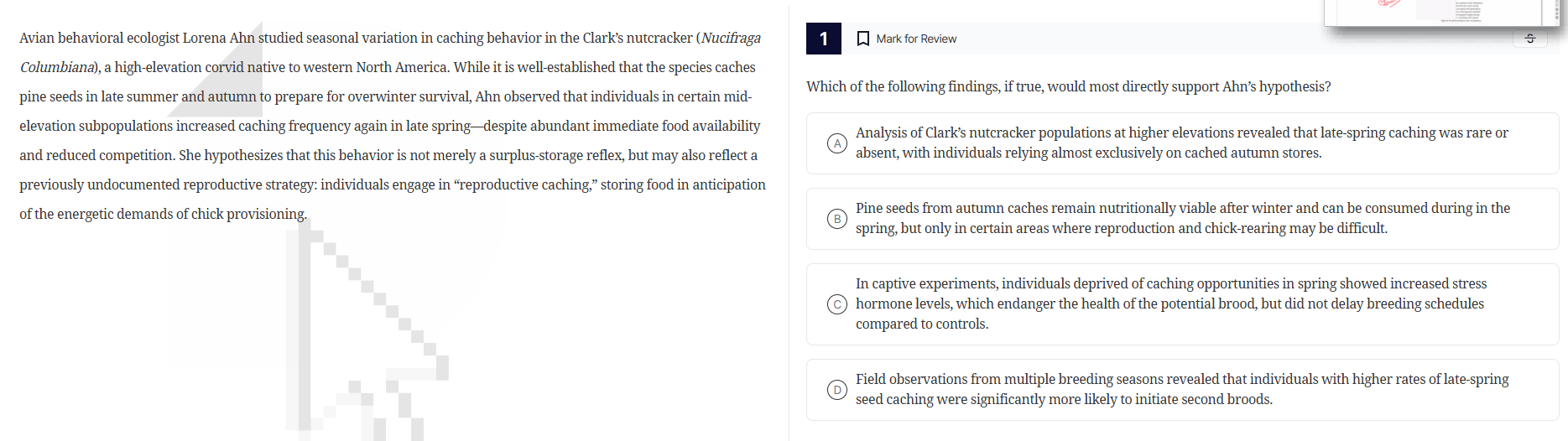
avian behavioral ecologist lorena ahn studied seasonal variation in caching behavior in the clarks nutcracker (nucifraga columbiana), a high - elevation corvid native to western north america. while it is well - established that the species caches pine seeds in late summer and autumn to prepare for overwinter survival, ahn observed that individuals in certain mid - elevation subpopulations increased caching frequency again in late spring—despite abundant immediate food availability and reduced competition. she hypothesizes that this behavior is not merely a surplus - storage reflex, but may also reflect a previously undocumented reproductive strategy: individuals engage in “reproductive caching,” storing food in anticipation of the energetic demands of chick provisioning.
1 □ mark for review
which of the following findings, if true, would most directly support ahns hypothesis?
① analysis of clarks nutcracker populations at higher elevations revealed that late - spring caching was rare or absent, with individuals relying almost exclusively on cached autumn stores.
② pine seeds from autumn caches remain nutritionally viable after winter and can be consumed during in the spring, but only in certain areas where reproduction and chick - rearing may be difficult.
③ in captive experiments, individuals deprived of caching opportunities in spring showed increased stress hormone levels, which endanger the health of the potential brood, but did not delay breeding schedules compared to controls.
④ field observations from multiple breeding seasons revealed that individuals with higher rates of late - spring seed caching were significantly more likely to initiate second broods.
Ahn's hypothesis is that late - spring caching (reproductive caching) is for the energetic demands of chick provisioning (a reproductive strategy).
- Option A: Comparing higher - elevation populations doesn't directly support the link between late - spring caching and reproductive needs of mid - elevation subpopulations.
- Option B: Talking about autumn - cached seeds' viability in spring doesn't relate to the purpose of late - spring caching for reproduction.
- Option C: Increased stress hormones without delayed breeding doesn't show that caching is for reproductive chick provisioning.
- Option D: Shows that higher late - spring caching rates are associated with a higher likelihood of initiating second broods, which is a reproductive event. This directly supports the idea that late - spring caching is a reproductive strategy for chick provisioning (as second broods would require food for chicks).

Snap & solve any problem in the app
Get step-by-step solutions on Sovi AI
Photo-based solutions with guided steps
Explore more problems and detailed explanations
D. Field observations from multiple breeding seasons revealed that individuals with higher rates of late - spring seed caching were significantly more likely to initiate second broods.