QUESTION IMAGE
Question
background essay questions
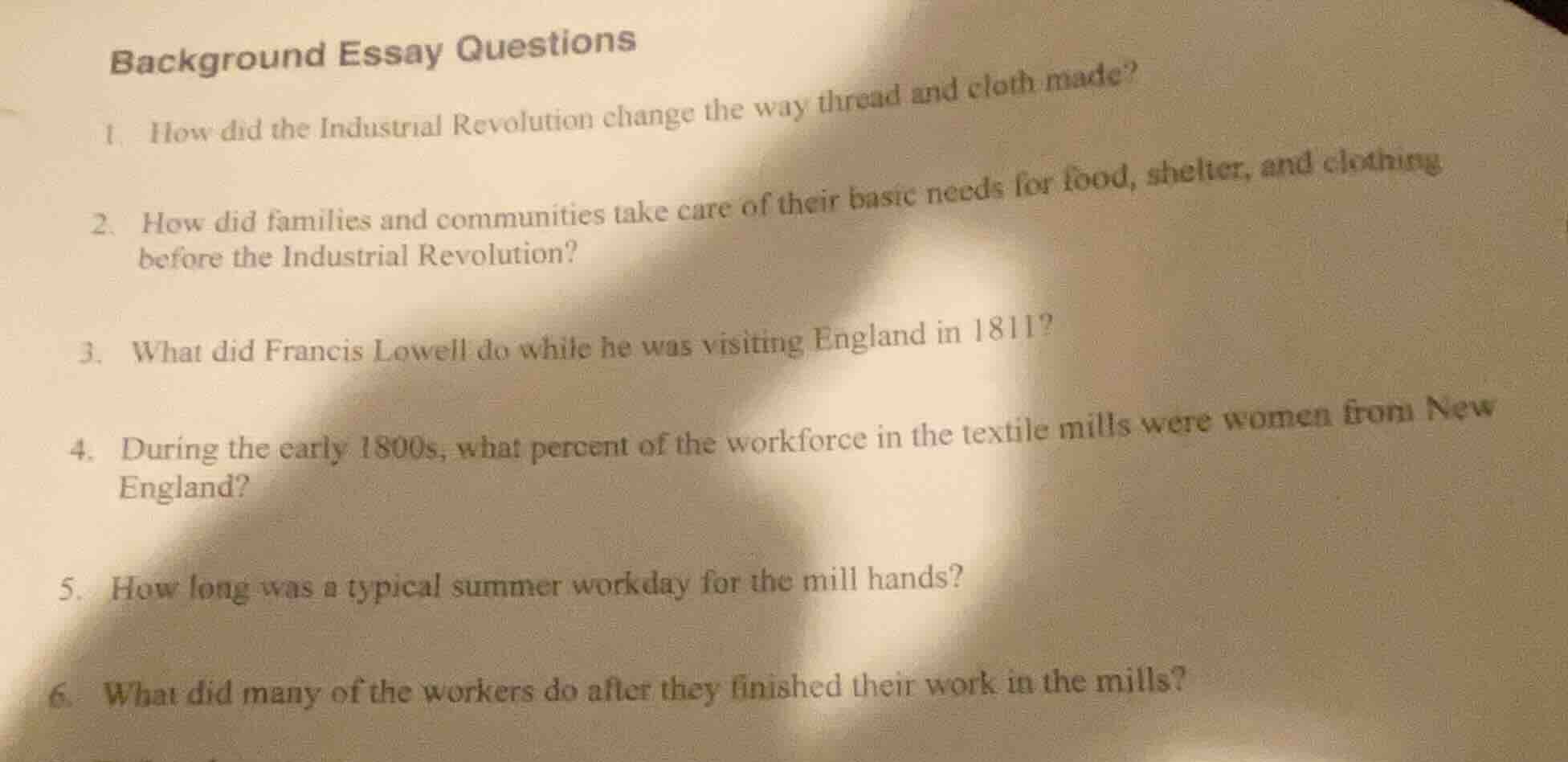
- how did the industrial revolution change the way thread and cloth made?
- how did families and communities take care of their basic needs for food, shelter, and clothing before the industrial revolution?
- what did francis lowell do while he was visiting england in 1811?
- during the early 1800s, what percent of the workforce in the textile mills were women from new england?
- how long was a typical summer workday for the mill hands?
- what did many of the workers do after they finished their work in the mills?
Brief Explanations
- Covers shift from hand to machine textile production.
- Explores pre-industrial subsistence and community self-reliance.
- Details Lowell's industrial espionage of British mills.
- Cites historical labor demographic data for New England mills.
- Notes standard 19th-century mill workday length.
- Describes post-work activities of mill laborers.

Snap & solve any problem in the app
Get step-by-step solutions on Sovi AI
Photo-based solutions with guided steps
Explore more problems and detailed explanations
- Before the Industrial Revolution, thread and cloth were made by hand in homes (putting-out system) with simple tools like spinning wheels and hand looms. The Industrial Revolution introduced mechanized production in factories; inventions like the spinning jenny, water frame, and power loom allowed for mass production of thread and cloth at a much faster rate, centralized in mill facilities rather than decentralized home settings.
- Families were largely self-sufficient: they grew their own food (farming, raising livestock), built their own shelters using local materials, and made their own clothing by spinning thread and weaving cloth at home. Communities also relied on mutual aid, sharing resources and labor for tasks like harvesting or building, and traded surplus goods locally for items they could not produce themselves.
- Francis Lowell toured British textile mills, secretly studying their mechanized production systems (including power looms) and memorized the designs of the machinery, since exporting such industrial technology was illegal in Britain at the time. He planned to replicate these mills in the United States.
- Approximately 75-80% of the workforce in New England textile mills in the early 1800s were women.
- A typical summer workday for mill hands was 12-14 hours long, from sunrise to sunset, with short breaks for meals.
- Many mill workers, especially the young women who made up a large portion of the workforce, participated in educational classes, joined religious or reform groups (like temperance or abolitionist movements), wrote for mill newspapers, or spent their free time socializing with other workers in boarding houses (where many lived). Some also used their wages to support their families or save for their own futures.