QUESTION IMAGE
Question
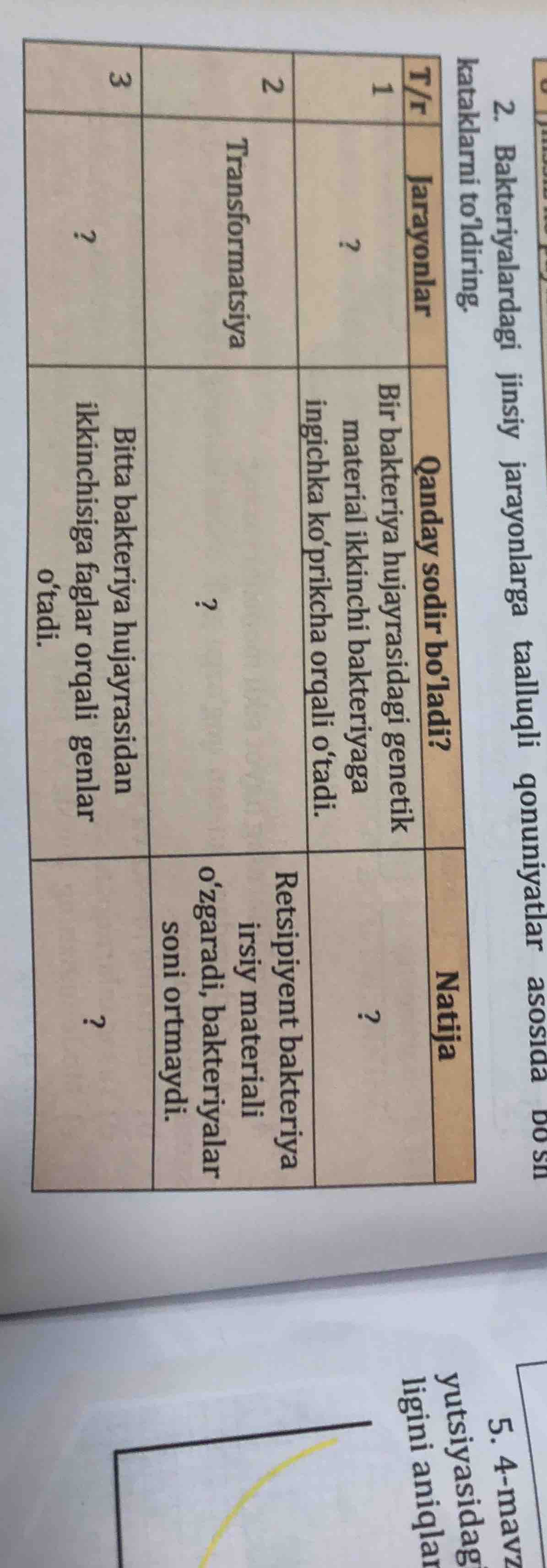
- bakteriyalardagi jinsiy jarayonlarga taalluqli donumiyatlar asosida bosh kataklarni toldiring.
t/r | 1 | 2 | 3
--- | --- | --- | ---
jarayonlar | ? | transformatsiya | ?
qanday sodir boladi? | bir bakteriya hujayrasidagi genetik material ikkinchi bakteriyaga ingichka koprikcha orqali otadi. | ? | bitta bakteriya hujayrasidan ikkinchisiga faglar orqali genlar otadi.
natija | ? | retsipiyent bakteriya irsiy materiali ozgaradi, bakteriyalar soni ortmaydi. | ?
To solve this problem about bacterial genetic processes, we analyze each row:
Row 1 (Jarayonlar - Processes)
The description is about a bacterium transferring genetic material to another via a bridge (conjugation). So the process is Konjugatsiya (Conjugation).
Row 1 (Natija - Result)
In conjugation, the recipient bacterium gains new genetic material, so the result is the bacterium acquires new genetic traits (e.g., antibiotic resistance). So the result is the bacterium’s genetic makeup changes (it gains the transferred genetic material).
Row 2 (Qanday sodir bo'ladi? - How does it happen?)
For Transformatsiya (Transformation), bacteria take up free DNA from the environment. So the description here is: “Bakteriyalar atrof-muhitdagi bo'sh DNA molekulalarini qabul qiladi” (Bacteria take up free DNA molecules from the environment).
Row 3 (Jarayonlar - Processes)
The description is about a bacterium transferring genes to another via a virus (bacteriophage). This process is Transdüksiya (Transduction).
Row 3 (Qanday sodir bo'ladi? - How does it happen?)
In transduction, a bacteriophage (virus) carries bacterial DNA from one bacterium to another. So: “Bakteriofag bir bakteriya hujayrasidan ikkinchisiga genlarni olib boradi” (A bacteriophage carries genes from one bacterial cell to another).
Row 3 (Natija - Result)
The recipient bacterium gains the genetic material from the donor (via the phage), so the result is the bacterium’s genetic makeup changes (it acquires the new genes).
Filling the Table:
| T/r | Jarayonlar | Qanday sodir bo'ladi? | Natija |
|---|---|---|---|
| 2 | Transformatsiya | Bakteriyalar atrof-muhitdagi bo'sh DNA molekulalarini qabul qiladi | Ret sipiyent bakteriya irsiy materiali o'zgaradi, bakteriyalar soni ortmaydi. |
| 3 | Transdüksiya | Bakteriofag bir bakteriya hujayrasidan ikkinchisiga genlarni olib boradi | Bakteriyaning genetik tarkibi o'zgaradi (yangi genlar oladi). |
Key Takeaways:
- Conjugation: Direct transfer via a pilus (bridge) between bacteria.
- Transformation: Uptake of free DNA from the environment.
- Transduction: Transfer via a bacteriophage (virus that infects bacteria).
Each process changes the recipient bacterium’s genetics, with transformation not increasing bacterial count (unlike conjugation/transduction, which involve cell-to-cell transfer but don’t necessarily multiply the bacteria).

Snap & solve any problem in the app
Get step-by-step solutions on Sovi AI
Photo-based solutions with guided steps
Explore more problems and detailed explanations
To solve this problem about bacterial genetic processes, we analyze each row:
Row 1 (Jarayonlar - Processes)
The description is about a bacterium transferring genetic material to another via a bridge (conjugation). So the process is Konjugatsiya (Conjugation).
Row 1 (Natija - Result)
In conjugation, the recipient bacterium gains new genetic material, so the result is the bacterium acquires new genetic traits (e.g., antibiotic resistance). So the result is the bacterium’s genetic makeup changes (it gains the transferred genetic material).
Row 2 (Qanday sodir bo'ladi? - How does it happen?)
For Transformatsiya (Transformation), bacteria take up free DNA from the environment. So the description here is: “Bakteriyalar atrof-muhitdagi bo'sh DNA molekulalarini qabul qiladi” (Bacteria take up free DNA molecules from the environment).
Row 3 (Jarayonlar - Processes)
The description is about a bacterium transferring genes to another via a virus (bacteriophage). This process is Transdüksiya (Transduction).
Row 3 (Qanday sodir bo'ladi? - How does it happen?)
In transduction, a bacteriophage (virus) carries bacterial DNA from one bacterium to another. So: “Bakteriofag bir bakteriya hujayrasidan ikkinchisiga genlarni olib boradi” (A bacteriophage carries genes from one bacterial cell to another).
Row 3 (Natija - Result)
The recipient bacterium gains the genetic material from the donor (via the phage), so the result is the bacterium’s genetic makeup changes (it acquires the new genes).
Filling the Table:
| T/r | Jarayonlar | Qanday sodir bo'ladi? | Natija |
|---|---|---|---|
| 2 | Transformatsiya | Bakteriyalar atrof-muhitdagi bo'sh DNA molekulalarini qabul qiladi | Ret sipiyent bakteriya irsiy materiali o'zgaradi, bakteriyalar soni ortmaydi. |
| 3 | Transdüksiya | Bakteriofag bir bakteriya hujayrasidan ikkinchisiga genlarni olib boradi | Bakteriyaning genetik tarkibi o'zgaradi (yangi genlar oladi). |
Key Takeaways:
- Conjugation: Direct transfer via a pilus (bridge) between bacteria.
- Transformation: Uptake of free DNA from the environment.
- Transduction: Transfer via a bacteriophage (virus that infects bacteria).
Each process changes the recipient bacterium’s genetics, with transformation not increasing bacterial count (unlike conjugation/transduction, which involve cell-to-cell transfer but don’t necessarily multiply the bacteria).